
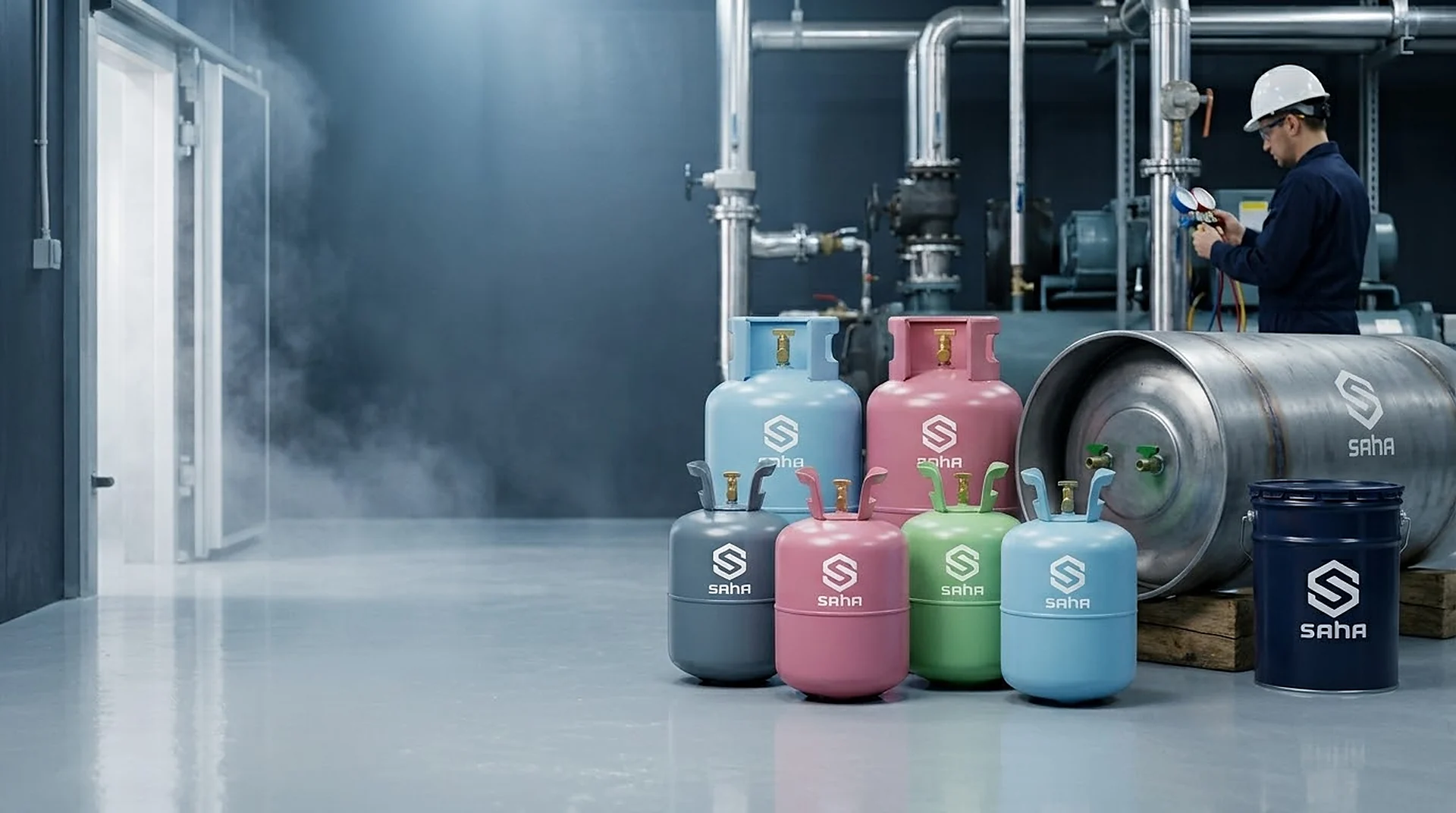

Plan a food/cold-chain plant as a 'whole-factory system where food safety governs every choice,' not part-by-part: start from the temperature band and cold chain — choose the refrigeration system/refrigerant by target temperature (chilled/frozen/blast/ultra-low), then confirm refrigerant safety per ASHRAE 15/EN 378/ISO 5149 (charge limits + machinery room + leak detection) · wet, hot-washdown zones need PU-cement, not ordinary epoxy · process water and food-contact compressed air must be class-controlled (boiler/RO/CIP + ISO 8573). Hard rules: choose the refrigerant by temperature + safety before buying the system + pick floors/coatings by food-contact zone + standardize materials to lock project pricing.
Food & beverage plant owners, engineering managers, and maintenance teams running cold storage all face the same problem when building or upgrading a line: "I have to bring in many systems at once — cold rooms, refrigerants, hygienic floors, water and compressed air — each from a different supplier, on a different spec, with prices that move, and every point has a GMP/HACCP/BRC auditor watching. Get one choice wrong and it can mean contaminated product, a stopped line, or a failed audit. How do I fit it all out, control cost, and pass food-safety standards?" Choosing the wrong refrigerant for the temperature band, or laying ordinary epoxy in a hot-washdown zone even once, can mean rework that costs several times the material price, a scrapped batch, and food-law risk.
This article is a field guide for fitting out and maintaining a food/cold-chain plant — viewing the whole factory as a "system × by food-contact zone," with food safety governing every choice, not bought part-by-part. It includes a complete selection table from refrigeration → refrigerants → ultra-low/freeze-dry → hygienic floors/coatings → water-air, the points food plants most often get wrong, and how to standardize materials to forecast quantities and lock project pricing.
This is a "plant-level decision map" — to go deep on any topic, follow the per-topic technical article links (cold storage/refrigerant/floor/water/air) embedded in each section below.
Three principles before fitting out a food/cold-chain plant
- Food safety governs every choice, not just durability — every material above or contacting food (floor, wall coating, compressed air, water) must be chosen to food-contact standards (ISO 8573, ISO 22196) and fit the plant's HACCP/GMP/ISO 22000 system. Materials that are "tough but not food-contact grade" are the most common audit failure.
- Start from temperature and the cold chain as the core — choose the refrigeration system and refrigerant by target temperature band (chilled/frozen/blast/ultra-low) and confirm refrigerant safety per ASHRAE 15/EN 378/ISO 5149 (charge limit + machinery room + leak detection) before brand or price. Choosing the wrong refrigerant or ignoring phase-out means replacing the whole system.
- Cleanable and protected beats repair — floors that can be cleaned and don't harbour bacteria, surfaces corrosion-protected to the right grade, and class-controlled utilities cost far less than a stopped line, scrapped product, and a failed audit.
Master table: the "whole food/cold-chain plant" system map
| Food-plant / cold-chain system | Function | Key decision | Go deeper |
|---|---|---|---|
| Refrigeration / cold rooms | Chill-freeze-hold the cold chain | Temperature band + system type + cooling load | Cold-room chiller/freezer/blast · Glycol chiller vs DX food processing · VRF/VRV vs chiller |
| Refrigerants | Working fluid in the cooling system | Temperature band + phase-out + safety (A2L/ammonia/CO2) | Refrigerant selection by system · Natural refrigerants R290/R600a/R744 · Leak detection ASHRAE 15/EN 378 |
| Ultra-low / freeze-dry | Freeze-dry, blast, -40 to -86°C rooms | Cascade system + ultra-low refrigerant + retrofit of legacy | Freeze-dryer/lyophilizer refrigerant · CO2 R-744 vs R-23 ultra-low · Retrofit R-13B1/R-503/R-508B |
| Processing floors (food-contact) | Hot-water washdown, food acids, hygiene | PU-cement vs epoxy by wet zone/temperature + coving | Floor coating epoxy/PU/PU-cement · Food/pharma surface coating ISO 22196 |
| Wall/tank corrosion coatings | Surface life in humidity/food chemicals | Coating system by condition + tank/CIP | Food/pharma coating FDA/ISO 22196 · Chemical-resistant tank lining API 652 · Rust converter vs sandblast |
| Process water | Boiler-cooling-RO-CIP | Split by use + scale/corrosion/microbe control | Water treatment boiler/cooling/RO · cooling tower legionella control · process pump NPSH selection |
| Food-contact compressed air | Air in packaging/blow/conveying | Control particle-water-oil class | Compressed air quality per ISO 8573 |
| Refrigerant safety | Ammonia/refrigerant/machinery room | Leak detection + eyewash/safety shower | Leak detection ASHRAE 15/EN 378/ISO 5149 · eyewash/safety shower per ANSI Z358 |
Table values are real-world starting points — the temperature band, refrigerant type, floor system, and final design must always be confirmed against the job spec/design engineer, refrigerant safety standards, and the plant's GMP/HACCP requirements.
Step 1: Refrigeration & cold chain — start from "temperature + refrigerant safety"
Cooling is the heart of a food plant and the most expensive thing to get wrong. The right order is:
- Set the temperature band by product — chilled (0 to +4°C), frozen (-18 to -25°C), blast/IQF (fast pulldown), ultra-low/freeze-dry (-40 to -86°C). Each band uses a different system and refrigerant (cold-room chiller/freezer/blast).
- Choose the refrigerant by band + phase-out + safety — newer low-GWP synthetics (A2L/HFO blends) for general duty, ammonia (R-717) for large cold stores needing top efficiency (toxic, control tightly), CO2 (R-744) as a high-pressure natural refrigerant for cascade/booster — avoid charging a refrigerant being phased out under Kigali (refrigerant selection by system · natural refrigerants).
- Confirm refrigerant safety per ASHRAE 15/EN 378/ISO 5149 — charge limit per area by safety group (A1/A2L/A3/B2L), machinery room and ventilation, leak detection and pressure-relief valves (leak detection ASHRAE 15/EN 378/ISO 5149).
- Ultra-low/freeze-dry must be cascade — -40 to -86°C systems use a two-stage (cascade) design + ultra-low-temperature refrigerant. Legacy machines still on R-13B1 (discontinued) need a retrofit plan to a replacement matching the properties (freeze-dryer/lyophilizer · CO2 R-744 vs R-23 · retrofit R-13B1/R-503/R-508B).
Step 2: Floors + food-contact coatings — what auditors check first
Floors and surfaces in processing zones take water, steam, and food acids every day — "choose the right system, cleanable, audit passes; choose wrong, it delaminates into a bacteria harbourage":
- Wet / hot-washdown zones: use PU-cement (polyurethane cement) that resists hot-water/steam washdown, food acids, and hot-cold thermal shock — not ordinary epoxy that peels fast under hot washdown. Add coving between floor and wall and falls to drains so water doesn't pool. Adequate prep (concrete moisture control + mechanical profiling) is 80% of floor life (floor coating epoxy/PU/PU-cement).
- Walls / food-contact surfaces: choose a food/pharma-grade coating system with a smooth, easy-clean finish and antibacterial properties along ISO 22196 where needed (food/pharma surface coating FDA/ISO 22196).
- Tanks / CIP systems: tanks and pipework contacting raw material or cleaning chemicals need a lining matched to the chemical and temperature (chemical-resistant tank lining API 652).
- Steel corrosion protection: frames in high humidity/cold rooms need a corrosion system, always prep the surface first (converter vs sandblast + epoxy).
Step 3: Water + compressed air — utilities that hit food directly
- Process water: split by use — boiler feed water (scale/corrosion control), cooling water/cooling towers (legionella control), RO water for ingredients or CIP. Select process pumps to the right NPSH to avoid cavitation.
- Food-contact compressed air: air contacting food/packaging must be controlled to ISO 8573-1 (particles, moisture, oil) — choose oil-free or coalescing + activated-carbon filtration to the required class.
3 things food/cold-chain plants get wrong that cost the job
- Choosing a refrigerant/system without phase-out + safety (A2L/charge/ammonia) — charging a phasing-out refrigerant, or exceeding charge-per-area limits per ASHRAE 15/EN 378, forces rework and risks audits.
- Ordinary epoxy in hot-washdown zones — delaminates in 1-2 years into a bacteria harbourage; must be PU-cement with coving and drainage falls.
- Uncontrolled compressed-air/water class — oil/moisture/microbes in food-contact air or water contaminate product unnoticed.
Programming a food/cold-chain plant — the decision overview
flowchart TD
    A["Set product + temperature band (chilled/frozen/blast/ultra-low)"] --> B["Choose refrigeration system + cooling load"]
    B --> C["Choose refrigerant by band + phase-out + safety group"]
    C --> D["Confirm refrigerant safety ASHRAE 15/EN 378/ISO 5149 (charge + machinery room + detection)"]
    A --> E{"Hot-washdown/wet zone?"}
    E -->|Yes| F["PU-cement floor + coving + drainage falls"]
    E -->|No| G["Epoxy/PU floor to the load"]
    F --> H["Coat walls/tanks food/pharma + corrosion protection"]
    G --> H
    D --> J["Utilities: water boiler/cooling/RO + compressed air ISO 8573"]
    H --> L["Standardize materials → project quote + lock pricing"]
    J --> L
For food-plant procurement: how to source so material is ready, cost is stable, audits pass
What loses margin and creates risk on a food-plant project isn't only "choosing the wrong system" but "many systems from many suppliers, prices that move, stock-outs when you must start the line on schedule, and missing food-grade/SDS documents when the GMP/HACCP/BRC auditor asks" — solved by standardizing + ordering from a supplier who can supply multiple systems:
| Food-plant / cold-chain pain point | Procurement fix |
|---|---|
| Many systems (refrigerant/floor/water/air) from many shops | Order from a supplier who covers several systems, stock ready, no chasing many vendors |
| Volatile prices × whole-plant quantities = swinging budget | Forecast whole-project quantity → lock pricing in advance |
| Must start the line/run cold rooms on schedule; stock-out = lost plan + waste | A supplier with stock ready + on-time delivery |
| Auditors ask for SDS + food-grade docs (NSF/FDA) + technical data | Order from a supplier who sends manufacturer documents with every order |
| Buying under a company; need tax invoice | Full tax invoice, compliant for government/private work |
Sahawatthanakit (1988) Co., Ltd. supplies materials and equipment for food & beverage plants and cold storage across several systems:
- ✓ Refrigerants for cold/frozen/ultra-low storage (specify temperature band/system)
- ✓ Antimicrobial concrete sealer — concrete floors and walls in food and pharma plants and hygiene areas
- ✓ Anti-rust coatings — steel frames, tanks, pipes · wet and underwater application (see Industrial coatings)
- ✓ Full documents — SDS + manufacturer technical data + tax invoice on every order
- ✓ Project pricing + price lock + nationwide delivery
Order and request a quote (project pricing)
Tell us the cold-room temperature bands/refrigeration system + wet, hot-washdown zone areas + water-air quality you need + delivery location, we promptly quote — the team helps standardize the systems and materials before quoting:
- Call: 02-096-2118 / 081-866-8368 (Khun Nawin)
- LINE: @sahawatt1988
- Email: info@sahawatthanakit1988.com
- Request a quote for food-plant/cold-chain materials and systems (project pricing) →
- Mon–Fri 08:00–17:00 | Nationwide delivery
Food/cold-chain tip: send each room's temperature band + a wet/dry zone layout + audit requirements (GMP/HACCP/BRC), and we'll align refrigerants-floors-utilities across the whole plant, then lock pricing and delivery — cutting both cost and audit risk (start at refrigerant selection by system and cold-room chiller/freezer/blast).
Get this guide as a reference brief (PDF)
Summary + full section list + standards cited, Saha-branded for your memo/RFQ — emailed to you too.
Questions after reading? Talk to our engineers
Tell us what you need — our engineers help you spec it right, with a real quote. No charge.
Need help with this in your facility?
Our team handles full procurement and installation for the topics covered in this article. Free quote promptly during business hours.
Another line of ours — spreadsheet tools for SMEs
Landed Cost Per Unit — Import Costing (Thai + English editions)
Know what one unit really costs once it reaches your warehouse — duty, VAT, clearance and trucking included, with the lowest price that still meets your target margin.
Frequently Asked Questions
1Which refrigerant/refrigeration system should a food factory choose?
+
2Why does epoxy peel fast in hot-washdown food zones — what should I use?
+
3What must be controlled for compressed air and process water in food production?
+
4Can I plan and source food-factory/cold-chain materials and lock project pricing?
+
Comparison tables related to this article
Related content
Industrial Cold Room / Cold Storage: Chiller vs Freezer vs Blast Freezer + Refrigerant Selection + Cooling Load Calculation + EN 378/GDP Standards for Thai Food, Pharma & Logistics Plants
Buyer's guide to industrial cold storage: separate chiller (+2 to +8°C) / freezer (−18 to −25°C) / blast freezer → calculate real cooling load before sizing → compare refrigerants R-449A/R-448A/R-290/R-744/NH3 → choose PIR panel thickness → contractor checklist + EN 378/ISO 5149/GDP/HACCP standards for plants in Thailand.
VRF/VRV vs Chilled-Water Chiller: Choosing Factory/Office/Cleanroom HVAC — Load, Efficiency, and EN 378 Refrigerant-Charge Limits for Thailand
Industrial HVAC buyer's guide: compare VRF/VRV (refrigerant-to-room) vs chilled-water chiller (AHU/FCU) → calculate cooling load → IEER/IPLV efficiency → R-32 A2L charge limits per EN 378 / ISO 5149 → contractor checklist + cleanroom considerations + Thai ambient +38°C de-rating for factories and offices.
Very-Low / Ultra-Low Temperature Refrigerant Retrofit — Replacing R-13B1 / R-503 / R-13 in Freeze Dryers & Cascade Systems with R-508B, Done Right
A guide to very-low / ultra-low temperature (VLT/ULT) refrigerant retrofits for freeze dryers (lyophilizers), environmental chambers, blast freezers and cascade systems in Thailand: why R-13B1 (halon), R-503 and R-13 (CFC) are obsolete/unobtainable, the modern replacement R-508B across −40 to −80°C, the most-missed core of the job — changing compressor oil (mineral/AB → POE) and low-temperature oil return, how glide/azeotrope affects charging and the TXV, retrofitting both stages of a cascade, the correct procedure (recover → flush → change drier/seals → deep vacuum < 500 micron → charge by weight → pulldown), and why moisture is the deadly enemy at ULT — plus the high GWP of R-508B/R-23, lower-GWP options, and refrigerant import licensing via Thailand's DIW under Montreal/Kigali obligations.
Magnetic Bearing Compressor (Turbocor) vs Screw Compressor — 15-Year TCO for Thai Chillers
Comparing two chiller compressor types: oil-free magnetic bearing centrifugal (Danfoss Turbocor) versus positive-displacement screw — covering part-load IPLV efficiency, first cost, maintenance, oil-free vs oil-flooded, surge limits, and a 15-year TCO model at Thai electricity ~THB 4.5/kWh, with guidance for data centers, hospitals, malls and factories.