
Comparing two approaches to managing structural steel rust in Thailand — 5-year total cost of ownership, job speed, SSPC-SP / ISO 12944 standards, and the conditions that determine the right choice
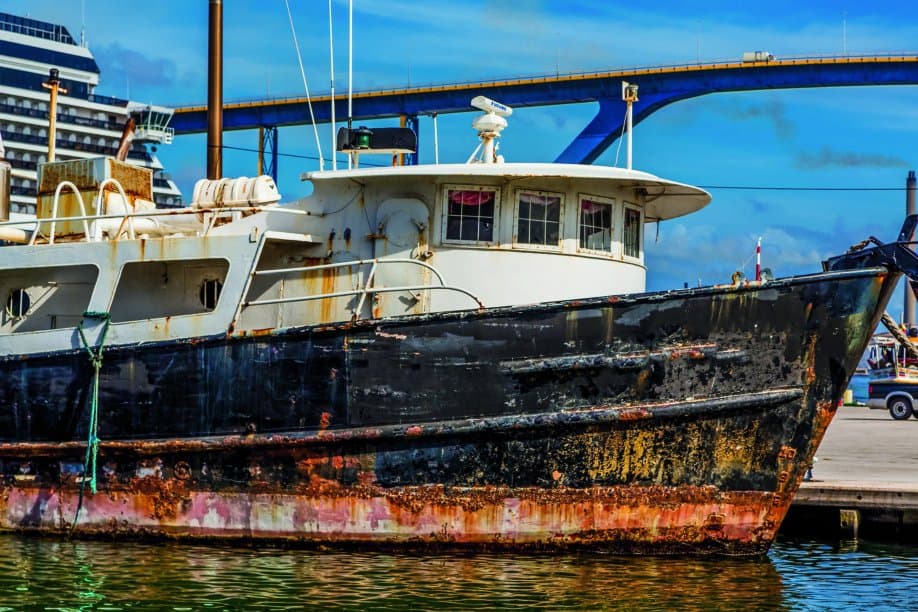
Most structural steel in Thailand operates in ISO 12944 environments ranging from C3 (industrial moderate) to C5-I (industrial severe), which means the question arises before every surface repair: apply rust converter directly, or spend the budget on sandblasting followed by epoxy primer? This article compares the two systems using real figures from SSPC, ISO 12944, and field data from Thailand.
Chemistry and Limitations — Why Rust Converter Is Not Always a Substitute for Sandblasting
Most rust converters use tannic acid + phosphoric acid to react with Fe₂O₃·xH₂O (red rust) and convert it into a layer of ferric tannate — a stable black compound that functions as a built-in primer.
Limitations specified by ASTM D610 and ISO 12944-5:
- Suitable for rust graded ASTM D610 grade 5–9 (Re 1–3 per ISO 4628-3) — rust thickness not exceeding 0.5 mm
- Loose mill scale must be removed first using hand tool (SSPC-SP 2) or power tool (SSPC-SP 3)
- Must not be applied to wet surfaces or surfaces contaminated with oil, grease, or chlorides > 50 mg/m²
- Topcoat must not be applied until converter has cured for 6–24 hours (depending on temperature and humidity)
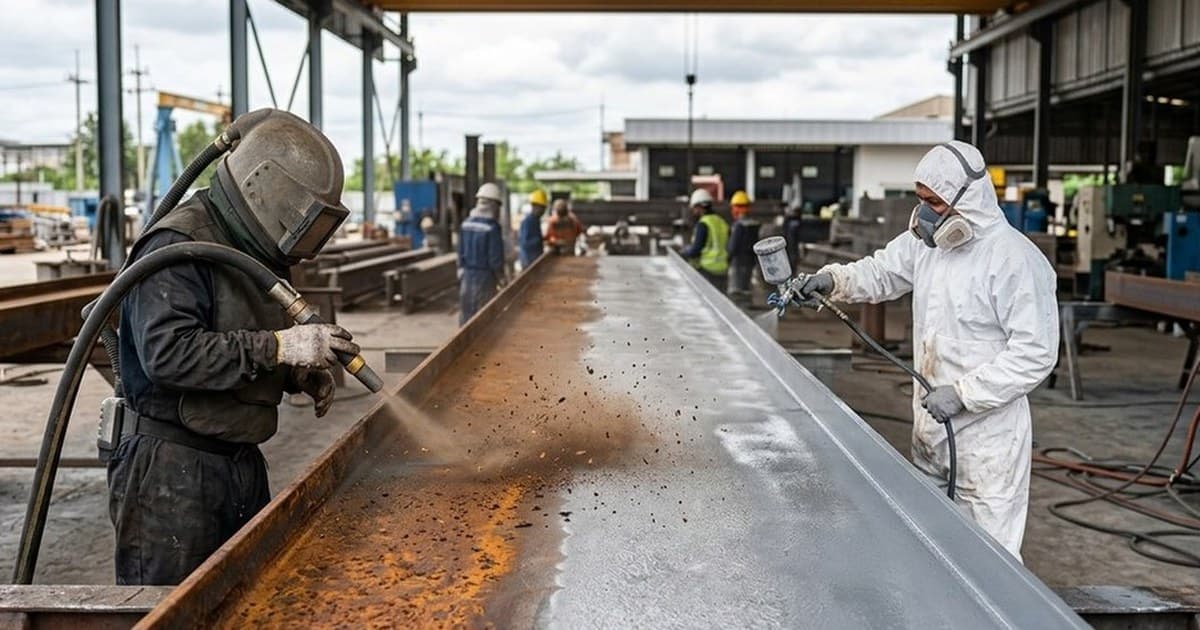
By contrast, SSPC-SP 10 (Sa 2½ Near-White Metal) removes everything down to bare steel — rust, mill scale, paint, and all contaminants. This gives Epoxy Primer (zinc-rich or surface-tolerant type) a pull-off adhesion exceeding 5 MPa per ISO 4624.
5-Year TCO Comparison Table (1,000 m² Area)
| Item | Rust Converter + 2-coat topcoat | Sandblast SP 10 + Epoxy 3-coat (240 μm DFT) |
|---|---|---|
| Work duration | 1–2 days | 3–5 days |
| Material cost (THB/m²) | 80–150 | 250–450 |
| Labour + equipment (THB/m²) | 120–180 | 350–550 |
| Total initial cost | 200–330 THB/m² | 600–1,000 THB/m² |
| Life before touch-up (C3) | 3–5 years | 7–15 years |
| Repair cost at year 3 | 30–50% of initial cost | 0 |
| 5-Year TCO | 260–430 THB/m² | 600–1,000 THB/m² |
| Dust / noise | Low | High (containment required) |
| Environment rating | ISO 12944 C2–C3 | ISO 12944 C3–C5 |
For small areas under 500 m² or early-stage rust, rust converter wins on TCO. For large areas over 2,000 m² or heavy rust, Sandblast + Epoxy wins on long-term TCO.
System Selection Criteria — Decision Flowchart
flowchart TD
  A[Assess steel surface] --> B{Rust grade
ASTM D610?}
  B -->|Grade 9-10
Early stage| C{Job area?}
  B -->|Grade 5-8
Moderate| C
  B -->|Grade 1-4
Heavy| D[Sandblast SP 10
+ Epoxy 3-coat]
  C -->|< 500 m²| E[Rust converter
+ topcoat]
  C -->|500–2000 m²| F{Environment
ISO 12944?}
  C -->|> 2000 m²| D
  F -->|C2-C3| E
  F -->|C4-C5| D
  E --> G[5-Year TCO
260–430 THB/m²]
  D --> H[5-Year TCO
600–1,000 THB/m²
Service life 7–15 years]
Urgent Work and Dust-Restricted Production Areas
Continuously operating plants (food, rubber, electronics factories) face specific constraints:
- No iron dust permitted — abrasive blasting generates dust above 50 mg/m³, contaminating production lines
- Low-solvent requirements — VOC must be under 250 g/L per Department of Industrial Works regulations
- Limited shutdown windows — typically less than 12 hours per cycle
Options:
- Water-based rust converter + low-VOC topcoat — fast, no dust, minimal odour
- Ultra-high pressure water jetting (UHP WJ-3 per SSPC-SP WJ-3) at 30,000+ PSI — removes rust with water, no dust, but wastewater must be managed
- Power tool cleaning (SP 11) + surface-tolerant epoxy — for touch-up or small areas
Abrasive blasting in production areas should not be used — even with dust collector enclosures, 100% containment cannot be guaranteed.
6 Procurement Guidelines
- Inspect the surface condition before submitting a quotation. Use the ASTM D610 visual comparator or ISO 4628-3. Photograph at least 6 points across the structure.
- State the standard in the contract. TOR documents must specify "SSPC-SP 10" or "SP 11" clearly — do not simply write "surface cleaning."
- Specify Dry Film Thickness (DFT) per ISO 12944-5. C3 = 160–200 μm; C5 = 240–320 μm. Measure with a magnetic gauge (ISO 2808).
- Request MSDS + COA for both the rust converter and the epoxy. Check active ingredients: tannic acid ≥ 3%, phosphoric acid 10–25%.
- Define QC hold points. Surface prep inspection → Primer DFT → Intermediate cure check → Final DFT/holiday test.
- Specify warranty periods. 2–5 years for Sandblast + Epoxy; 1–2 years for rust converter — written clearly in the quotation.
Summary
Rust converter is the right choice for urgent jobs, small areas, ISO 12944 C2–C3 environments, and operating factories — low initial cost with good 5-year TCO. Sandblast + Epoxy 3-coat suits large jobs, C4–C5 environments (coastal, power plants, petrochemical facilities) — higher initial cost but the lowest TCO over 10–15 years.
Sahawatthanakit provides free surface condition assessments in Bangkok and surrounding provinces, along with system proposals matched to site conditions and client budget, in accordance with SSPC and ISO 12944 standards.
Frequently Asked Questions
Can rust converter replace sandblasting? No — not 100%. Rust converter converts red rust into stable ferric tannate, suitable for early-to-moderate rust (ASTM D610 grade 5–9). If rust exceeds 0.5 mm thickness or there is loose mill scale, sandblasting to Sa 2½ (SSPC-SP 10) is the only method that will achieve the adhesion required by ISO 12944.
How much do the TCOs differ? For a 1,000 m² project in C3 conditions, the rust converter system has approximately 30–40% lower initial cost, but requires touch-up every 1–2 years. Sandblast + Epoxy has a higher initial cost but 15–25% lower 5-year TCO because the service life is 7–15 years without repairs.
How is Sa 2½ measured on site? Using the ISO 8501-1 visual comparator (reference photographs) comparing colour and cleanliness. Sa 2½ means the steel surface is clean to bare metal on at least 95% of the area. If rust or mill scale exceeds 5%, the surface must be re-blasted.
How long does rust converter last? Under C3 (industrial moderate) — 3–5 years before the first touch-up. Under C5-M (marine severe) — only 1–2 years. Not recommended as a standalone treatment in coastal or chemical plant environments.
For an urgent one-day job, what should I choose? Rust converter — no blasting required (saving 4–8 hours per 100 m²), no containment needed, topcoat can be applied 4–6 hours after cure. Sandblast + Epoxy requires 2–3 days including overcoat windows.
Plant is in production — no dust permitted. What do I choose? Water-based rust converter + low-VOC topcoat (no iron dust), or Ultra-High Pressure Water Jetting SP WJ-3 at 30,000+ PSI (removes rust with water — meets food-grade / cleanroom standards). Abrasive blasting in production areas should not be attempted even with a dust collector enclosure.
Order & Inquiries
Sahawatthanakit (1988) Co., Ltd. — Rust treatment product supplier across Thailand, VAT invoices available.
- Tel: +66-2-096-2118
- Email: info@sahawatthanakit1988.com
- LINE: @sahawatt1988
- Web: sahawatthanakit1988.com
- Mon–Fri 08:00–17:00 ICT
- Nationwide delivery | Express in Bangkok / Nonthaburi
Get this guide as a reference brief (PDF)
Summary + full section list + standards cited, Saha-branded for your memo/RFQ — emailed to you too.
Questions after reading? Talk to our engineers
Tell us what you need — our engineers help you spec it right, with a real quote. No charge.
Need help with this in your facility?
Our team handles full procurement and installation for the topics covered in this article. Free quote promptly during business hours.
Another line of ours — spreadsheet tools for SMEs
Quote Register + Win Rate (Thai + English editions)
For quotes that go silent — one row per quote, telling you which to chase today and what your real win rate is.
Frequently Asked Questions
1Can rust converter replace sandblasting entirely?
+
2How far apart are the 5-year TCOs for the two systems?
+
3How is Sa 2½ measured on site according to SSPC-SP 10?
+
4How long does rust converter last if applied correctly?
+
5If a job must be completed in one day, which approach should I use?
+
6The plant is in continuous production and dust is not permitted. What can be done to structural columns?
+
Comparison tables related to this article
Related content
Zinc-Rich Primer vs Hot-Dip Galvanizing — Choosing a Steel Corrosion System per ISO 12944 and ISO 1461
Comparing two corrosion-protection routes for structural steel: zinc-rich primer in a paint system to ISO 12944 vs hot-dip galvanizing to ISO 1461 — corrosivity categories C1-CX, thickness vs life, duplex systems, and how to choose by environment in Thailand.
Budget Rust Protection in Thailand — Standard Line vs NOVA Eco (2026 Guide + Real Prices)
A tight budget is no reason to skip corrosion protection. Comparing the standard line (TIS 3029-2563 / ISO 12696) with the NOVA GalvaTect and NOVA Paints budget line — real prices and a 4-question decision framework.
Corrosion-Resistant Rebar — Epoxy (A775) vs Galvanized (A767) vs Stainless (A955): Choosing for Budget and Service Life
Comparing three corrosion-resistant rebar systems: epoxy-coated (ASTM A775/A934), hot-dip galvanized (A767), and stainless (A955) — protection mechanism, chloride threshold, cost relative to black bar, installation cautions, and a decision tree to choose by exposure + design life for Thai coastal projects.
Carbonation vs Chloride — The Two Root Causes of Rebar Corrosion, and How to Match the Right Protection
Rebar in concrete corrodes by two fundamentally different mechanisms: carbonation (pH drop, uniform corrosion) and chloride attack (localized pitting). How to tell them apart with phenolphthalein + chloride profiling, EN 206 exposure classes, the Tuutti model, and how to match protection (cover, CP anodes, coatings) to the actual cause.