
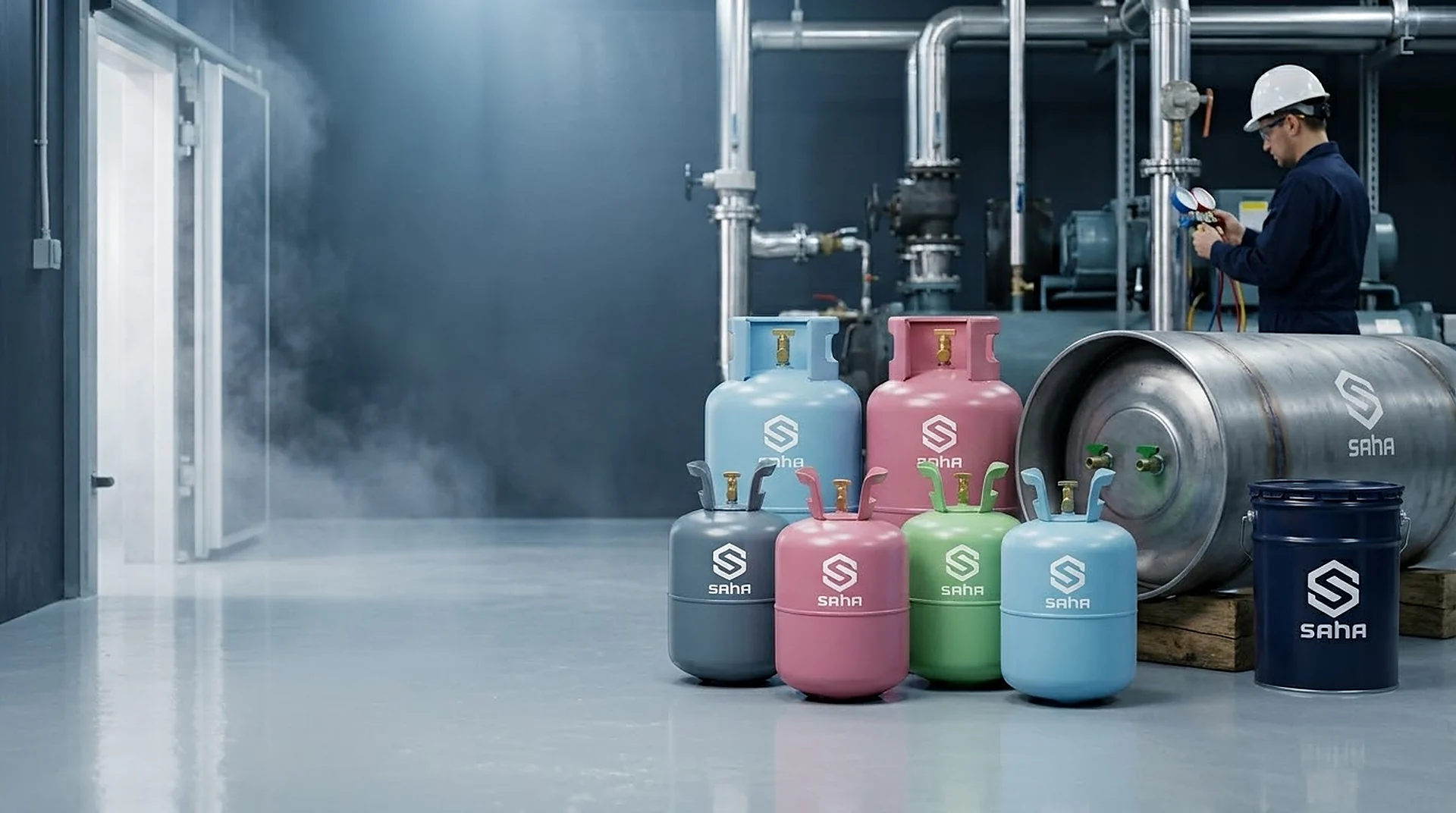
Natural refrigerant selection for commercial + industrial Thailand — R-290 propane, R-600a isobutane, R-744 CO2. Kigali Amendment compliance + A3 safety class + capex/OPEX comparison + Thai regulatory + supplier landscape
Why Natural Refrigerants Now
The Kigali Amendment (Thailand ratified 2019) mandates HFC consumption reduction:
- -10% by 2029 (vs 2020-2022 baseline)
- -30% by 2035
- -50% by 2045
- -80% by 2047
HFCs widely used in Thailand — R-32 (GWP 675), R-410A (2,088), R-134a (1,300), R-404A (3,943) — will face import quotas, rising prices, supply restrictions. Natural refrigerants offer a phase-out-proof path for the equipment lifetime.
graph LR
    A[HFC R-32/R-410A/R-134a] -->|Kigali phase-down| B{Path}
    B -->|Short-term| C[HFO R-1234yf/R-454B
GWP 1-466]
    B -->|Long-term| D[Natural Refrigerants
GWP 1-3]
    D --> E[R-290 Propane
Commercial AC/Chiller]
    D --> F[R-600a Isobutane
Household Fridge]
    D --> G[R-744 CO2
Supermarket/Deep-freeze]
    style D fill:#10b981,color:#fff
    style E fill:#3b82f6,color:#fff
    style F fill:#14b8a6,color:#fff
    style G fill:#0ea5e9,color:#fff
Compare the Three
| Property | R-290 Propane | R-600a Isobutane | R-744 CO₂ |
|---|---|---|---|
| Chemical | C₃H₈ | C₄H₁₀ | CO₂ |
| GWP (IPCC AR4) | 3 | 3 | 1 |
| ODP | 0 | 0 | 0 |
| Safety class (ASHRAE 34) | A3 highly flammable | A3 highly flammable | A1 non-toxic, non-flammable |
| LFL (% in air) | 1.7-1.8 | 1.7-1.8 | N/A |
| Critical temp (°C) | 96.7 | 134.7 | 31.0 (transcritical) |
| Operating pressure (bar) | 8-15 | 1-6 | 60-120 |
| Max charge per IEC 60335-2-40 | ≤ 150g (small room) | ≤ 57g | unlimited (A1) |
| Capex vs HFC baseline | +20-35% | +15-25% | +30-50% |
| COP improvement | +3-5% vs R-32 | similar to R-32 | +10-20% transcritical chillers |
Choose by Application
R-290 Propane — Commercial AC, Chiller, Heat Pump
Sweet spot:
- Commercial AC 5-50 kW (hotels, offices, restaurants)
- Industrial chiller 50-500 kW (beverage plants, processing)
- Heat pump for heating + hot water
Pros:
- High COP — 3-5% energy savings vs R-32
- Future-proof Kigali — near-zero GWP
- Low refrigerant cost — propane ~฿80-150/kg vs R-32 ~฿650-900/kg
Cons:
- A3 flammable — charge limit 150g per room per IEC 60335-2-40
- Systems must be hermetic sealed, no field-brazed joints
- Service technicians need BS EN 13313 spark-proof training — scarce in Thailand
- Ventilation calculation + leak detection required
R-600a Isobutane — Household + Light Commercial Fridge
Sweet spot:
- Household refrigerators (95% of global household fridges use R-600a)
- Small commercial refrigeration: mini bar, display chiller, ice maker
- Bottle coolers in convenience stores
Pros:
- Lowest capex in natural refrigerant family — +15-25% vs R-134a
- Low pressure — robust compressor + piping + long lifetime
- Small charge ≤ 57g — high safety margin
Cons:
- A3 flammable — no field-braze
- Cooling capacity limited to ~3 kW per system — unsuitable for commercial AC
R-744 CO₂ — Supermarket + Deep-Freeze + Heat Pump
Sweet spot:
- Supermarket refrigeration (chiller + freezer chain) — Big C, Lotus's, Makro 2024-2025 pilots
- Deep-freeze -40°C (seafood export, ice cream)
- Cold-climate heat pump (northern Thailand, cold storage)
Pros:
- A1 non-flammable + non-toxic — safe in any location
- High COP in transcritical + ejector — 10-20% efficiency gain
- Cheapest refrigerant — CO₂ ~฿20-50/kg
Cons:
- Highest capex +30-50% vs HFC (compressor + piping rated for 90-120 bar)
- Transcritical mode efficiency drops in hot climate (>32°C) — special gas cooler design needed
- Thai technicians experienced with R-744 transcritical are scarce
Decision Matrix
graph TD
    Start[New system being designed] --> Q1{Cooling capacity?}
    Q1 -->|≤3 kW| R600a[R-600a Isobutane
Hermetic small refrig]
    Q1 -->|3-50 kW| Q2{Charge size + room volume?}
    Q1 -->|≥50 kW + deep-freeze| R744[R-744 CO₂
Transcritical]
    Q2 -->|Charge ≤150g per room| R290[R-290 Propane
Commercial AC/Chiller]
    Q2 -->|Charge >150g| Q3{Insurance + safety
requirement?}
    Q3 -->|Strict A1 required| R744_alt[R-744 CO₂
or HFO/HFC short-term]
    Q3 -->|A3 OK + technicians available| R290_split[Split into multiple
R-290 systems]
    style R290 fill:#3b82f6,color:#fff
    style R600a fill:#14b8a6,color:#fff
    style R744 fill:#0ea5e9,color:#fff
    style R744_alt fill:#0ea5e9,color:#fff
    style R290_split fill:#3b82f6,color:#fff
Thai Regulatory Landscape
1. Hazardous Substance Act B.E. 2535
- R-290 propane: UN 1978 — DIW permit required
- R-600a isobutane: UN 1969 — DIW permit required
- R-744 CO₂: UN 1013 — pressure vessel + transport permit
2. Department of Skill Development (DSD) — Refrigeration Technician License
Currently no certification specific to natural refrigerants — most R-290 technicians use general training + supplementary BS EN 13313 (UK standard).
3. RACT + EIT/IIET
No full natural-refrigerant code yet — Thai standards reference ISO 5149 + EN 378 + ASHRAE 15 in the interim.
4. Department of Industrial Works (DIW)
R-290 + R-600a are listed in Annex II hazardous chemical list. Import + storage + commercial use require permits.
Saha Service Offering
Saha distributes + supervises natural refrigerants for commercial applications:
- R-290 / R-600a: household + light commercial refrigeration (mini bar, display chiller, beer bottle cooler)
- R-744 CO₂: supermarket + deep-freeze cylinder + heat pump installation
- Compliance: UN classification + DIW permit + hazardous-goods transport
- Engineering: charge size calculation + ventilation design + leak detection wiring
Send equipment spec + application + required charge size → team promptly responds with refrigerant + supplier + price + compliance checklist.
Conclusion + Action
Natural refrigerants are no longer a future trend — they are a present requirement as Kigali pushes HFC prices up 30-100% over the next 5-10 years. R-290 + R-744 are likely to dominate Thai commercial refrigeration by 2035.
Recommendation:
- New systems — choose natural refrigerants if supplier + technician available
- Legacy HFC systems — plan phase-out within 7-10 years
- Service techs — invest in BS EN 13313 training now — R-290 specialists will command premium rates in 3-5 years
For a detailed comparison see /en/compare/r290-vs-r600a-vs-r744-natural-refrigerant — full specs + capex + lifetime + safety class. Or see the HFC vs HFO transition path at /en/compare/hfc-vs-hfo-refrigerant-transition.
Get this guide as a reference brief (PDF)
Summary + full section list + standards cited, Saha-branded for your memo/RFQ — emailed to you too.
Questions after reading? Talk to our engineers
Tell us what you need — our engineers help you spec it right, with a real quote. No charge.
Need help with this in your facility?
Our team handles full procurement and installation for the topics covered in this article. Free quote promptly during business hours.
Another line of ours — spreadsheet tools for SMEs
Landed Cost Per Unit — Import Costing (Thai + English editions)
Know what one unit really costs once it reaches your warehouse — duty, VAT, clearance and trucking included, with the lowest price that still meets your target margin.
Comparison tables related to this article
Related content
Industrial Cold Room / Cold Storage: Chiller vs Freezer vs Blast Freezer + Refrigerant Selection + Cooling Load Calculation + EN 378/GDP Standards for Thai Food, Pharma & Logistics Plants
Buyer's guide to industrial cold storage: separate chiller (+2 to +8°C) / freezer (−18 to −25°C) / blast freezer → calculate real cooling load before sizing → compare refrigerants R-449A/R-448A/R-290/R-744/NH3 → choose PIR panel thickness → contractor checklist + EN 378/ISO 5149/GDP/HACCP standards for plants in Thailand.
R-22 → R-32 / R-454B Chiller Conversion Playbook — Get Ready Before Thailand's 2030 Phase-out
Practical guide to converting R-22 (HCFC) industrial chillers to R-32 / R-454B (HFO) ahead of the Kigali Amendment + DIW Thailand 2030 phase-out — costs, which machines can be converted, TXV/EXV comparison table, and A2L safety requirements.
Thailand's Air Conditioner Export Boom 2026 — How to Choose the Right Refrigerant Grade Under the Law
Thailand is a top global air-conditioner exporter and 2026 shipments are surging on the European heatwave. This article covers the export figures, why refrigerant demand is climbing, and how to choose R-32 / R-410A / R-454B correctly under the Kigali Amendment and EU F-gas rules — for technicians and factories.
R417a, R454C, R123 — Made-to-Order Refrigerants for R-22 Retrofit, Low-GWP Chillers, and Centrifugal Chillers
A guide to three hard-to-source refrigerant grades in Thailand — R417a (drop-in R-22 replacement, no compressor change), R454C (very low-GWP A2L for new equipment), R123 (low-pressure centrifugal chiller, R-11 replacement) — with when to use each.