
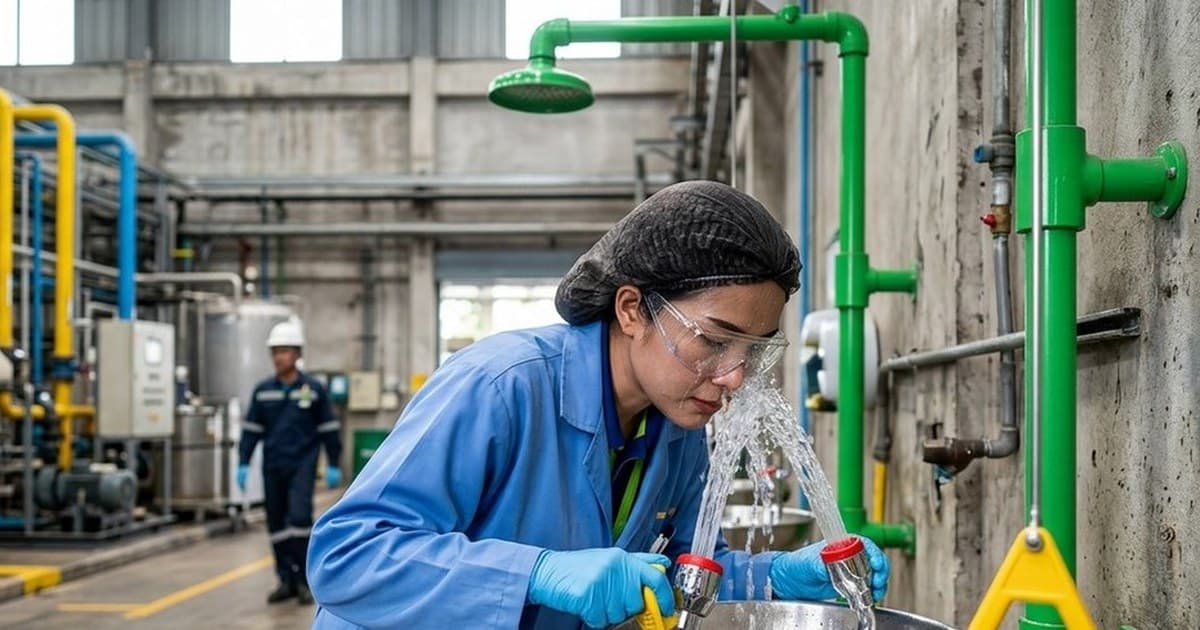
Guide to selecting and installing Emergency Eyewash + Safety Shower per ANSI Z358.1-2014 — 10-second reach from the hazard, minimum flow rate, water temperature, weekly + annual testing
In chemical plants, laboratories, food factories, and EPC welding/painting sites — Emergency Eyewash + Safety Shower is first-line equipment that prevents permanent eye damage and chemical burns. The ANSI Z358.1-2014 standard is the international benchmark that every country (including Thailand, via ISO 45001 + EPC contracts) uses to decide whether a facility passes a safety audit. Choosing the wrong spec or installing in the wrong location = failing the audit + risking life-changing injury.
10-second / 55-feet Rule — the iron law of Z358.1
The ANSI Z358.1 standard states clearly:
- The eyewash + shower must be within reach of an injured person within 10 seconds
- ~55 feet (17 meters) at a normal walking pace on flat ground
- No door, stair, obstacle, or hazardous area may be in the path
- No activation device may be required to pass through — e.g. key pad, badge reader
In high-hazard work (strong acid/base, > 30% concentration) — ANSI recommends "immediately adjacent," meaning < 3 seconds / 10 feet (3 meters).
Placement flowchart
flowchart TD
  A[Identify Hazardous Area] --> B{SDS Section 4
says 'flush'?}
  B -->|Yes| C{Hazard level?}
  B -->|No| D[Z358.1 not required
but recommended in chem room]
  C -->|High > 30%
Strong acid/base| E[Immediately adjacent
3 sec / 10 ft]
  C -->|Moderate| F[10-second rule
55 ft / 17 m]
  E --> G{Plumbed water
available?}
  F --> G
  G -->|Yes| H[Plumbed Eyewash + Shower
First choice]
  G -->|No - remote/mobile| I[Self-contained 15-26 gal
+ refill schedule]
  H --> J[Weekly test 3 minutes]
  I --> J
  J --> K[Annual test 15 minutes
+ flow + temp + spray pattern]
Flow Rate + Pressure Requirements
| Equipment | Min Flow | Duration | Pressure |
|---|---|---|---|
| Eyewash (eyes only) | 1.5 GPM = 5.7 LPM | 15 min continuous | 30 PSI = 2 bar |
| Eye/Face Wash | 3.0 GPM = 11.4 LPM | 15 min continuous | 30 PSI = 2 bar |
| Safety Shower | 20 GPM = 75.7 LPM | 15 min continuous | 30 PSI = 2 bar |
| Combination Unit (both) | 21.5 GPM = 81 LPM | 15 min continuous | 30 PSI = 2 bar |
| Drench Hose (supplementary) | 3.0 GPM | 15 min | 30 PSI |
Supply calculation:
- Pipe size: minimum 1" (25 mm) for shower / 0.5" for eyewash
- Tank reserve: 21.5 GPM × 15 min = 322.5 gallons (1,221 L) minimum for a combo unit
- If the city water service is insufficient → install a gravity tank or booster pump
Tepid Water — why it matters
ASSE 1071 defines "tepid" in Z358.1 as 16-38°C (60-100°F):
- < 16°C: hypothermia + vasoconstriction — the injured person will stop flushing before the necessary 15 minutes
- > 38°C: makes a chemical burn to the eye worse — heat + chemical increases cell damage
In Thailand:
- Most underground-pipe water is 22-28°C → OK
- A rooftop tank in the sun → may reach 45°C → needs a thermostatic mixing valve
- Outdoor pipe in the sun → insulate + paint white
Solution: install an ASSE 1071 thermostatic mixing valve near the point of use — takes hot + cold input, outputs tepid water. Price 8,000-25,000 THB.
Spray Pattern + Anti-scald
Eyewash nozzle per Z358.1:
- 2 nozzles with a spray pattern covering both eyes
- Spray height 33-53 inches (84-135 cm) from the floor
- Anti-scald: opens instantly, constant flow, no shock
Safety Shower:
- Shower head 82-96 inches (208-244 cm) from the floor
- Spray pattern covering 20 inches (51 cm) at a height of 60 inches
- Hands-free operation — pull rod, push handle, foot treadle, all stay-open
Testing + Maintenance Schedule
Weekly Test (ANSI Z358.1 4.6.5 / 5.5.5)
- Run the water at full flow for ~3 minutes
- Flush stagnant water (prevent Legionella + nozzle scaling)
- Check flow + nozzle clogging + spray pattern
- Record in the log
Annual Test (ANSI Z358.1 5.5.6)
- Flow rate — measured with a calibrated gauge
- Duration — 15 minutes continuous
- Tepid temperature — 16-38°C
- Spray pattern — Eyewash covers both eyes simultaneously
- Activation — pull rod / push handle / foot treadle stays open
- Alarm signal — if present (signals the safety officer)
- Strobe light + audible alarm — light + sound alert when in use
Retain records ≥ 2 years + attach a tag to the equipment
Self-Contained vs Plumbed — how to choose
| Factor | Plumbed | Self-Contained (portable) |
|---|---|---|
| Water source | Plumbing | Internal tank 15-26 gal (56-100 L) |
| Refill schedule | Not required | Every 3-6 months (manufacturer spec) |
| Initial cost | 25,000-80,000 ฿ | 35,000-80,000 ฿ |
| Recurring cost | 0 | 3,000-6,000 ฿/year (refill solution + maintenance) |
| Mobility | No | Yes |
| Reliability | High | Moderate (depends on refill discipline) |
| Used in | Factory, permanent lab | Mobile lab, outdoor remote, temporary site |
First choice = Plumbed. Self-contained only where there is no plumbing — and it requires a strict refill schedule.
Equipment Categories Recognized by Z358.1
| Type | Min Flow | Use Case |
|---|---|---|
| Personal Squeeze Bottle | < 0.5 GPM | First-aid only, 5-min supplement, not a replacement |
| Plumbed Eyewash | 1.5 GPM | Standard eye irrigation |
| Plumbed Eye/Face Wash | 3.0 GPM | Strong chemical splash |
| Plumbed Safety Shower | 20 GPM | Full body chemical contamination |
| Combination Unit | 21.5 GPM | Both eye + shower in 1 unit |
| Drench Hose | 3.0 GPM | Supplement — not counted as a primary eyewash |
A squeeze bottle (like a simple plastic bottle) is a supplement only — it does not count as a compliance unit.
Installation Locations in Thai Factories — Checklist
Install Eyewash + Shower (combo unit) within the 10-sec rule of these areas:
- Battery charging room (sulfuric acid)
- Laboratory using acid/base/solvent
- Refrigerant handling R22, R32, R410A, R134a, R1234yf — A2L mild flammable / Halogenated
- Electroplating tank — chromic acid, cyanide solution
- Paint mixing / spray booth — solvent + pigment
- Cleaning chemical storage — bleach, hypochlorite, drain cleaner
- Pesticide / Herbicide storage
- Welding flux + electrode coating area
- Cement / concrete batching — high alkaline cement dust
- Fuel handling — diesel, gasoline, jet fuel
6 Procurement Guidelines
- Specify ANSI Z358.1-2014 + ASSE 1071 in the TOR — mandate the standard
- Hands-free stay-open valve — Pull rod / push handle / foot treadle
- Thermostatic mixing valve if the water supply is not within the tepid range
- Anti-scale + anti-bacterial nozzle — prevent Legionella + Pseudomonas
- Alarm signal + strobe light integration with the safety office
- Compliance label + serial number — for the inspection audit trail
Summary
ANSI Z358.1-2014 is the recognized worldwide standard for Emergency Eyewash + Safety Shower. 10-second rule = 55 feet / 17 m from the hazard. High hazard = 3 seconds / 10 feet. Flow rate: Eyewash 1.5 GPM, Shower 20 GPM, Combo 21.5 GPM @ 30 PSI for 15 minutes continuous. Tepid water 16-38°C minimum — use an ASSE 1071 mixing valve if needed. Plumbed first — self-contained only where there is no plumbing. Weekly + annual test, records retained 2 years.
Sahawatthanakit supplies ANSI Z358.1 Eyewash + Safety Shower combo units with thermostatic valve, alarm integration, and on-site installation + commissioning — contact our team to request a site survey.
Frequently Asked Questions
Is the 10-second rule mandatory in Thailand? No law by that exact name, but OSHA 1910.151(c) + the Act 2554 + ISO 45001 + EPC contracts all reference Z358.1 = de facto binding.
Minimum flow rate? Eyewash 1.5 GPM (5.7 LPM), Shower 20 GPM (75.7 LPM), Combo 21.5 GPM (81 LPM) at 30 PSI for 15 minutes continuous. Pipe ≥ 1" for shower.
What water temperature? ANSI tepid = ASSE 1071 16-38°C. < 16 hypothermia, > 38 chemical burn. Rooftop tank > 40°C → thermostatic mixing valve.
How is the test done? Weekly 3 minutes (flush stagnant + check flow). Annual 15 minutes (flow + duration + tepid + spray pattern + activation + alarm). Retain records ≥ 2 years.
Plumbed vs Self-contained? Plumbed first choice (no refill). Self-contained 15-26 gal used only for remote/mobile + refill every 3-6 months.
Near which chemicals to install? SDS Section 4 says 'flush' = Z358.1 mandatory. Includes battery acid, lab acid/base, electroplating, refrigerant, pesticide, paint, cleaning chemical, fuel.
Get this guide as a reference brief (PDF)
Summary + full section list + standards cited, Saha-branded for your memo/RFQ — emailed to you too.
Questions after reading? Talk to our engineers
Tell us what you need — our engineers help you spec it right, with a real quote. No charge.
Need help with this in your facility?
Our team handles full procurement and installation for the topics covered in this article. Free quote within 2 hours.
Another line of ours — spreadsheet tools for SMEs
Quote Register + Win Rate (Thai + English editions)
For quotes that go silent — one row per quote, telling you which to chase today and what your real win rate is.
Frequently Asked Questions
1What is the 10-second rule and is it really enforced in Thailand?
+
2What is the minimum flow rate for an eyewash + shower?
+
3What temperature range can the water be?
+
4What must a weekly test and annual test cover?
+
5Self-contained (portable) vs Plumbed — which to choose?
+
6Near which chemicals should they be installed?
+
Comparison tables related to this article
Related content
HVAC Commissioning — When to Demand It From Your Contractor, and How to Specify It
Start-up, TAB and commissioning are three different things. How ANSI/ASHRAE/IES 202-2018, Guideline 0-2019 and Guideline 1.4-2019 divide the work, and when a Thai industrial owner should make it contractual.
BMS Protocol Selection: BACnet vs Modbus vs KNX — and How to Spec It Without Vendor Lock-In
A standards-based comparison of BACnet (ANSI/ASHRAE 135 / ISO 16484-5), Modbus and KNX, with selection criteria by system layer, cybersecurity requirements, and specification language that keeps a building maintainable.
Thailand's Building Energy Code (BEC): OTTV, RTTV and LPD Limits — and Whether Factories Are Covered
The 2020 Ministerial Regulation made energy compliance a building-permit condition in Thailand from 13 March 2023 for all nine building types over 2,000 m². Full OTTV/RTTV/LPD table, HVAC criteria, and the whole-building compliance path.
Selecting an Industrial Process Pump + Preventing Cavitation (NPSH): Centrifugal vs Positive Displacement, BEP, and VFD Energy Savings per ANSI/HI–ISO for Thai Plants
Buyer's guide to industrial process pumps: differentiate Centrifugal vs Positive Displacement → calculate NPSHa to prevent cavitation → operate within BEP (70–120%) → cut electricity with VFD (Affinity Laws) → supplier checklist + ANSI/HI–ISO 13709/API 610/API 682 standards for plants in Thailand.