
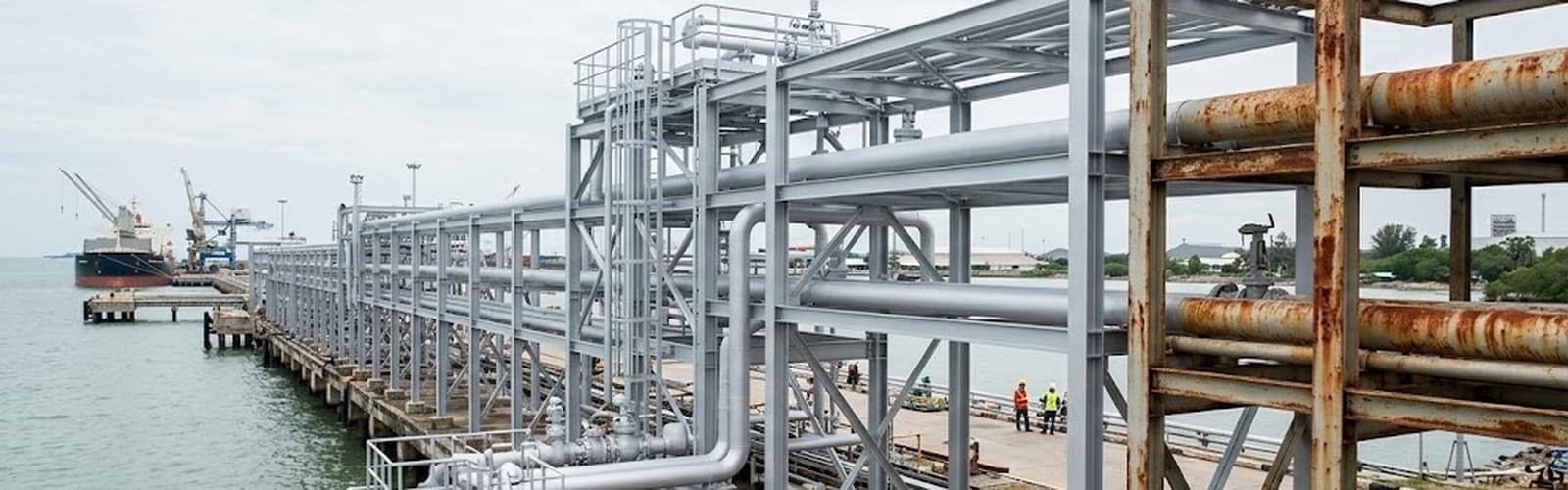
Stainless 304/316L surfaces need coating to (1) seal pit corrosion that pickling does not cover (2) provide antimicrobial action that reduces biofilm — use 2-part solvent-free food-grade epoxy FDA + acrylic-silicate antimicrobial concrete sealer ISO 22196 — DFT 200-400 μm depending on exposure
See the whole-system guide: the Food & Cold-Chain plant fit-out guide — this article is one step — see the end-to-end fit-out guide.
Food and pharmaceutical (food + pharma) plants in Thailand must pass HACCP, GMP, ISO 22000, FDA Thailand, and the regulatory requirements of export countries — and among these, surface coating is a point of rigorous inspection, because:
- Food contact surface comes into direct contact with raw materials — there must be no migration of chemicals from the paint
- CIP (Clean-In-Place) chemistry — caustic NaOH 2-4% + acid 1-2% + sanitizer (PAA, ClO₂) → destroys ordinary paint
- Biofilm prevention — stainless structures with pits or scratches become accumulation points for Listeria, E. coli, and biofilm
- Audit traceability — FDA + EU regulators require a Certificate of Compliance (CoC) for every lot of paint
Not every paint can be used — ordinary industrial paints (construction epoxy paint, alkyd, latex) do not pass FDA and will migrate into raw materials in the first CIP cycle
This article summarizes:
- Why stainless 304/316L still needs coating — the pit + biofilm problem
- Standards that must be met — FDA 21 CFR 175.300, ISO 22196, TIS (มอก.) 1521
- SAHA SKUs that meet the standards — 2-part solvent-free food-grade epoxy, acrylic-silicate antimicrobial concrete sealer
- DFT (Dry Film Thickness) + application + QC
Why Stainless Still Needs Coating
Pit Corrosion That Pickling Does Not Cover
Stainless 304L (Cr 18% Ni 8%) and 316L (adding Mo 2% for chloride resistance) undergo a pickling + passivation process at the factory to form a surface oxide layer (Cr₂O₃) — but at points such as:
- Welding HAZ — heat affected zone after welding where chromium is drawn out
- Cold-formed corners — curved corners with high surface strain
- Mechanical scratch — from installation or tool drop
- Crevice in flange / gasket — standing water
pit corrosion at the μm-mm scale will occur — taking up chloride from CIP cleaning + saltwater residue → becoming a permanent corrosion point
Coating role: seal the pit + crevice surface before biofilm formation, creating a chemical barrier between the stainless and the environment
Biofilm Prevention
The smooth surface (Ra <0.8 μm) of stainless looks clean — but at the 0.5-1 μm scale there is surface roughness where bacteria attachment forms within 24-72 hours → multilayer biofilm → accumulation point for Listeria / Salmonella / Pseudomonas → audit fail
Antimicrobial coating (ISO 22196 certified) contains silver ion (Ag⁺) or zinc-pyrithione (ZnPT) that releases continuously → kills bacteria at the surface → reduces biofilm rate 99%+
Standards That Must Be Met
| Standard | Inspection point | Test method |
|---|---|---|
| FDA 21 CFR 175.300 | Resin + monomer in the paint must not migrate beyond limit | Extractive test: 8% ethanol + 50% ethanol + n-heptane + water 120°F × 24 hr |
| EU 10/2011 | Overall migration limit OML ≤ 10 mg/dm² | EN 1186 test |
| ISO 22196 | Antibacterial activity R ≥ 2.0 (log reduction) | E. coli + S. aureus inoculation 35°C × 24 hr |
| NSF/ANSI 51 | Food equipment material — finished surface | NSF protocol |
| TIS มอก. 1521-2541 | Thai paint — heavy metal limit + food contact | TIS extractive test |
| HACCP / GMP | Process control + supplier traceability | Manufacturer must submit CoC + COA for every lot |
Tip: Choose a paint with a CoC from a manufacturer that specifies FDA 21 CFR 175.300 + EU 10/2011 + ISO 22196 — covering all the main audits of a food/pharma plant.
SAHA SKUs for This Application
2-Part Solvent-free Food-Grade Epoxy
- Application: food contact area, water-immersed surface, CIP-resistant
- FDA 21 CFR 175.300: ✓ certified
- VOC: Zero VOC (FDA compliance)
- DFT recommended: 400 μm in two coats (200 μm × 2 layers)
- Cure: at 25°C — 8 hr recoat, 7 days full cure
- Substrate: stainless 304/316L, mild steel pre-treated, concrete (food production floor)
- Pack: 4L kit (3L A + 1L B), 20L kit
Acrylic-Silicate Antimicrobial Concrete Sealer
- Application: floor + wall (food production area), antimicrobial surface
- ISO 22196 Activity: R ≥ 3.0 (99.9% bacteria reduction E. coli + S. aureus)
- Service life: 3-5 years antimicrobial activity
- DFT: 150-200 μm
- Substrate: concrete (food plant floor), painted surface (over the food-grade epoxy)
- Pack: 4L, 20L
Combo Recommendation — Production Hall Floor
Layer 1 (Primer): 1-part moisture-curing PU primer @ 150 μm
Layer 2 (Topcoat 1): 2-part food-grade epoxy @ 200 μm
Layer 3 (Topcoat 2): 2-part food-grade epoxy @ 200 μm
Layer 4 (Sealer): acrylic-silicate antimicrobial sealer @ 150 μm
Total DFT: ~700 μm
Service life: 8-12 years (heavy traffic), 12-20 years (light traffic)
DFT — Choose by Exposure
| Application | DFT | Coating spec | Re-paint cycle |
|---|---|---|---|
| Storage tank — dry food contact | 200 μm | food-grade epoxy × 1 | 10-15 years |
| Mixing vessel — wet + chemical | 400 μm | food-grade epoxy × 2 | 5-8 years |
| Production floor — light traffic | 500-700 μm | PU primer + food-grade epoxy × 2 + antimicrobial sealer | 8-12 years |
| Production floor — heavy traffic + forklift | 800-1000 μm | PU primer + food-grade epoxy × 3 + antimicrobial sealer | 5-8 years |
| Cold storage wall (4°C / -18°C) | 300 μm | food-grade epoxy + antimicrobial topcoat | 8-12 years |
| Pharma clean room (GMP-D) | 400 μm | food-grade epoxy × 2 | 5-7 years (per audit cycle) |
Application Procedure (for contractor / TOR)
Surface Preparation
- Degrease: FDA-compliant alkaline cleaner → rinse until pH neutral
- Mechanical prep: SSPC-SP10 near-white blast (for steel) or SSPC-SP1 + abrasive scrub (for stainless)
- Surface profile: 25-50 μm (Ra) with hardness Rockwell C 60 + grit
- Final clean: wipe down with 70% IPA before applying primer
Application
- Mixing ratio: per manufacturer (parts A + B mixed at the specified ratio) — pot life 30-45 minutes
- Application method: airless spray (best) — pressure 2,500-3,500 psi, tip 17-21 thou
- Recoat window: 4-8 hr (before curing to "hard dry")
- Cure environment: clean room 18-30°C, RH < 80%, no contamination during cure
QC + Documentation
- DFT measurement: every 10 m² with an ASTM D7091 magnetic gauge — record min/max/avg
- Pinhole test: ASTM D5162 holiday detector — 5V/μm DFT
- Adhesion test: ASTM D4541 pull-off — minimum 5 MPa
- Documentation: CoC + COA + DFT report + holiday test report submitted to QA / quality manager
TOR Template for Food / Pharma Plants
1. Scope of work: paint application — surface preparation + 3-coat system for
   [Production hall floor / Mixing tank interior / Pharma clean room wall]
   total area [N] m²

2. Standards that must be met:
   - FDA 21 CFR 175.300 (resin + monomer migration)
   - ISO 22196:2011 (antimicrobial R ≥ 2.0)
   - TIS มอก. 1521-2541
   - or an equivalent standard from EU, NSF, JFRL

3. Coating system:
   - Primer: 1-part moisture-curing PU (ASTM B117 salt spray ≥ 2,000 hr)
   - Topcoat: 2-part solvent-free epoxy food-grade FDA
   - Optional sealer: acrylic-silicate antimicrobial ISO 22196
   - Total DFT: [200-1000 μm per application]

4. Documentation per delivery batch:
   - CoC + COA per pail
   - MSDS / SDS Thai + English
   - FDA + ISO 22196 certificate (3rd-party lab)
   - DFT measurement report (ASTM D7091)
   - Holiday detection report (ASTM D5162)
   - Adhesion pull-off ≥ 5 MPa (ASTM D4541)

5. Warranty: 5 years (light traffic) / 3 years (heavy traffic) — coating system
   with service-call if a crack or delamination occurs within the warranty

6. Disposal: used thinner oil + containers → through a DIW-licensed waste contractor
   invoice + manifest returned to the client
Choosing a Painting Contractor
The minimum a contractor must have:
- Training certificate from the paint manufacturer
- Food/pharma plant experience — show references for 3+ projects
- DFT gauge + holiday detector + adhesion tester
- Team > 4 people — able to run continuous shifts during shutdown
- Worker comp + product liability insurance
SAHA Engineering Service: takes on design + spec + contractor supervision + final QC — for plants without an in-house coating team
This article is reference information for procurement + engineering — for GMP-A/B clean room work requiring specific migration testing, or NSF Foodzone-certified coating, contact the Sahawatthanakit (1988) engineering team for an on-site survey + spec recommendation
Get this guide as a reference brief (PDF)
Summary + full section list + standards cited, Saha-branded for your memo/RFQ — emailed to you too.
Questions after reading? Talk to our engineers
Tell us what you need — our engineers help you spec it right, with a real quote. No charge.
Need help with this in your facility?
Our team handles full procurement and installation for the topics covered in this article. Free quote promptly during business hours.
Another line of ours — spreadsheet tools for SMEs
Quote Register + Win Rate (Thai + English editions)
For quotes that go silent — one row per quote, telling you which to chase today and what your real win rate is.
Related content
Holiday / Pinhole Detection in Coatings — Wet Sponge vs High-Voltage Spark per NACE/AMPP SP0188 & ASTM D5162
A guide to detecting holidays/pinholes (invisible discontinuities) in protective coating films: choosing low-voltage wet sponge (thin film < 500 µm) vs high-voltage spark/DC (thick film > 500 µm) per NACE/AMPP SP0188, SP0490 and ASTM D5162 — setting voltage by DFT (too low misses holidays, too high burns the film), which work requires it (tanks/pipes/immersion/marine), mark-repair-retest, and what a TOR must specify.
Coating Inspectors: NACE/AMPP CIP vs FROSIO — Who Needs Certification, Levels 1/2/3, and TOR Requirements
A comparison of the two main coating-inspector certification schemes: NACE/AMPP CIP (Coating Inspector Program — Levels 1/2/3, after NACE merged into AMPP in 2021) vs FROSIO (the Norwegian scheme — competence levels I/II/III) — what each level can do, which projects need which level, recognition in Thailand and abroad, and what a TOR must specify (level, independence, hold points, reporting) so coating work can actually be accepted.
Coating Application Conditions — The 'Surface ≥ Dew Point + 3°C' Rule, RH < 85% per ISO 8502-4 & ISO 12944-7
A guide to environmental conditions during protective-coating application: steel surface must be at least 3°C above the dew point, relative humidity RH < 85% (per the TDS), surface temperature within the product's range — how to measure the 4 readings (air temp, RH, dew point, surface temp) per ISO 8502-4 and ISO 12944-7, why painting in humid/near-dew-point conditions causes peeling/blistering/flash rust, and what a TOR must specify for Thailand's humid climate.
ISO 12944 Protective Paint Systems for Steel — Selecting Corrosivity C2–CX, Durability, and Primer/Intermediate/Topcoat for Thailand
How to select a protective coating system for steel structures per ISO 12944: corrosivity categories C1–C5/CX (2017/2018 revision), durability ranges L/M/H/VH, matching zinc-rich primer + epoxy MIO + PU topcoat systems to dry film thickness (DFT) per category, mapping to Thai environments (urban plants vs coastal Map Ta Phut/Laem Chabang), and the spec mistakes TOR writers make most.