
A guide to chemical-resistant tank linings: epoxy, epoxy novolac (98% acid), vinyl ester (acids/alkalis/solvents, high temperature), immersion surface prep, holiday testing, and standards API 652 / NACE SP0178 / SP0188 — selecting by chemical and temperature for work in Thailand.
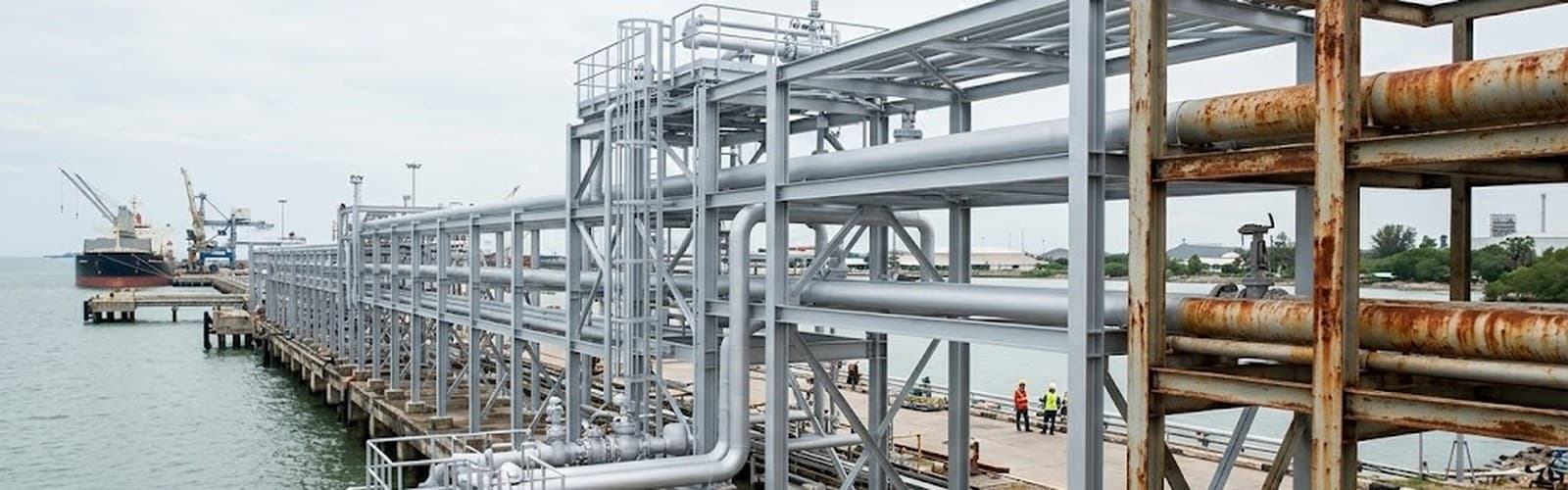
Storage tanks — acid, alkali, oil, fuel, water, chemicals — corrode "from the inside" continuously while holding liquid, far harsher than external corrosion. Ordinary external anti-rust paint cannot be used for immersion — it requires a dedicated tank lining (chemical-resistant internal coating).
This article explains lining types, selection by chemical, surface prep, holiday testing, and the API 652 / NACE standards.
1. Why Immersion Is Harsher Than the Exterior
flowchart TD
  A[Steel surface inside tank] --> B[Submerged in liquid continuously
immersion service]
  B --> C[Chemical permeation]
  B --> D[High concentration + temperature]
  B --> E[Abrasion from agitation/flow]
  C --> F[Needs special chemical-resistant resin
+ thicker + 100% holiday test]
  D --> F
  E --> F
- Permeation — chemicals diffuse through the film to the steel if the lining is thin/wrong type
- Concentration + temperature accelerate corrosion
- A single pinhole = liquid reaches steel = perforating corrosion
2. Lining Types — Choose by Chemical
| Lining | Resists | Temperature | Application |
|---|---|---|---|
| Epoxy | general chemicals | medium | general water/fuel tanks |
| Epoxy Novolac | concentrated acids (H₂SO₄ to 98%) | ~95-130°C | acid/oil/mild-solvent tanks |
| Vinyl Ester | broad acids+alkalis+solvents | high + abrasion | aggressive chemicals/high temp (6-40 mils) |
| Rubber / Glass-flake | specialized acid/abrasion | per system | special work |
Choose by the manufacturer's chemical resistance chart against the actual chemical + concentration + temperature.
3. The Heart — Surface Prep + Holiday Test
- Immersion surface prep is more rigorous — abrasive blast Sa 2.5+ and correction of surface imperfections (sharp edges, welds, porosity) per NACE SP0178
- 100% holiday test (NACE SP0188) — inspect the whole surface for pinholes with a high-voltage spark (thick linings) or wet sponge (thin linings) — one holiday fails it
- DFT per lining spec (immersion needs more thickness than atmospheric work)
Unlike external work which tolerates minor imperfections — immersion must be 100%.
4. Standards
- API 652 — lining of aboveground oil-storage tank bottoms
- NACE SP0178 — surface prep/weld detailing for immersion lining
- NACE SP0188 — holiday/discontinuity testing
- ISO 12944 (Im category) — immersion · NACE SP0181 — internal coating
5. Tank Lining Spec Checklist
- State chemical + concentration + temperature in the tank (sets the lining choice)
- Select the resin from the chemical resistance chart (novolac/vinyl ester)
- Specify surface prep (Sa 2.5+, correct surface imperfections per NACE SP0178)
- Specify DFT + 100% holiday test (NACE SP0188)
- Food/drinking water → certified lining for food/water contact
We supply and coordinate chemical-resistant tank linings — epoxy, epoxy novolac (concentrated acids), vinyl ester (aggressive chemicals/high temperature) to API 652 / NACE SP0178 / SP0188 — with guidance on selecting the resin by actual chemical + temperature, immersion surface prep, and 100% holiday testing for acid/fuel/water/food tanks.
Talk to our engineering team to select a lining system that fits your chemicals — call 02-096-2118 or LINE OA @sahawatt1988.
Summary
- Tank lining ≠ external paint — immersion is harsher (permeation + concentration + temperature + abrasion)
- Epoxy novolac (concentrated acids ~95-130°C) · Vinyl ester (broad acids/alkalis/solvents, high temp)
- Choose by the chemical resistance chart (chemical + concentration + actual temperature)
- Surface prep Sa 2.5+ (NACE SP0178) + 100% holiday test (SP0188) — a single pinhole fails
- Standards: API 652 / NACE SP0178 / SP0188 / ISO 12944 Im
The right lining type + complete holiday testing = no tank leaks/contamination, where repair + downtime cost many times more.
Get this guide as a reference brief (PDF)
Summary + full section list + standards cited, Saha-branded for your memo/RFQ — emailed to you too.
Questions after reading? Talk to our engineers
Tell us what you need — our engineers help you spec it right, with a real quote. No charge.
Need help with this in your facility?
Our team handles full procurement and installation for the topics covered in this article. Free quote promptly during business hours.
Another line of ours — spreadsheet tools for SMEs
Quote Register + Win Rate (Thai + English editions)
For quotes that go silent — one row per quote, telling you which to chase today and what your real win rate is.
Frequently Asked Questions
1How does tank lining (internal) differ from external anti-rust paint?
+
2Epoxy Novolac or Vinyl Ester — which to choose?
+
3Why is holiday testing so critical for tank lining?
+
4Which Thai applications need tank lining?
+
Related content
Coating Inspectors: NACE/AMPP CIP vs FROSIO — Who Needs Certification, Levels 1/2/3, and TOR Requirements
A comparison of the two main coating-inspector certification schemes: NACE/AMPP CIP (Coating Inspector Program — Levels 1/2/3, after NACE merged into AMPP in 2021) vs FROSIO (the Norwegian scheme — competence levels I/II/III) — what each level can do, which projects need which level, recognition in Thailand and abroad, and what a TOR must specify (level, independence, hold points, reporting) so coating work can actually be accepted.
Holiday / Pinhole Detection in Coatings — Wet Sponge vs High-Voltage Spark per NACE/AMPP SP0188 & ASTM D5162
A guide to detecting holidays/pinholes (invisible discontinuities) in protective coating films: choosing low-voltage wet sponge (thin film < 500 µm) vs high-voltage spark/DC (thick film > 500 µm) per NACE/AMPP SP0188, SP0490 and ASTM D5162 — setting voltage by DFT (too low misses holidays, too high burns the film), which work requires it (tanks/pipes/immersion/marine), mark-repair-retest, and what a TOR must specify.
Coating Application Conditions — The 'Surface ≥ Dew Point + 3°C' Rule, RH < 85% per ISO 8502-4 & ISO 12944-7
A guide to environmental conditions during protective-coating application: steel surface must be at least 3°C above the dew point, relative humidity RH < 85% (per the TDS), surface temperature within the product's range — how to measure the 4 readings (air temp, RH, dew point, surface temp) per ISO 8502-4 and ISO 12944-7, why painting in humid/near-dew-point conditions causes peeling/blistering/flash rust, and what a TOR must specify for Thailand's humid climate.
ISO 12944 Protective Paint Systems for Steel — Selecting Corrosivity C2–CX, Durability, and Primer/Intermediate/Topcoat for Thailand
How to select a protective coating system for steel structures per ISO 12944: corrosivity categories C1–C5/CX (2017/2018 revision), durability ranges L/M/H/VH, matching zinc-rich primer + epoxy MIO + PU topcoat systems to dry film thickness (DFT) per category, mapping to Thai environments (urban plants vs coastal Map Ta Phut/Laem Chabang), and the spec mistakes TOR writers make most.