
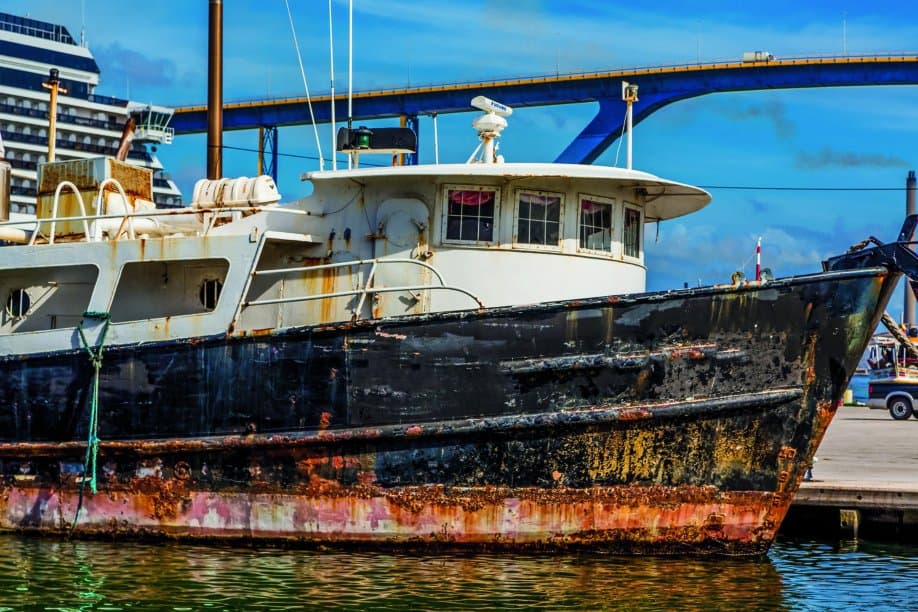

Protect marine steel as a zone-based system, not by overcoating: getting surface prep to Sa 2.5 + controlling dew point (ISO 8502-4) is 80% of coating life · pick the paint system by severity per ISO 12944 — coastal above water = C5-M, offshore = CX, immersed = Im2 · immersed/buried steel must add cathodic protection (zinc/aluminium anodes in seawater, magnesium in fresh water/soil) designed to DNV-RP-B401. Hard rules: surface prep before paint grade + match coating↔cathodic to the zone + standardize materials to lock project pricing.
Shipyard maintenance teams, jetty operators, and coastal steel-structure contractors face the same problem on every project: "Coastal steel rusts many times faster than elsewhere, paint peels within 1–2 years, and submerged parts corrode even faster — how do we keep the corrosion-protection system alive for its full design life, control cost, and pass the spec/inspector?" Choosing the wrong system for the zone, or under-preparing the surface even once, can mean redoing the whole structure — paying for scaffolding/re-blasting that costs many times the material — and losing credibility with the owner.
This is a field guide for shipyard and marine-structure work — viewing corrosion protection as a "whole system × by exposure zone," not as overcoating. It covers everything from surface prep → paint system by ISO 12944 class → cathodic protection of submerged parts → hot-work safety → marine machinery lubrication, plus where yards commonly fail, and how to standardize materials to forecast volume and lock pricing for the whole project.
This is a "project-level decision map" — for deep dives on each topic, links to individual technical articles (surface prep / paint systems / anodes / hot work) are embedded in each section below.
Three principles before planning marine corrosion protection
- Corrosion protection is a "system," not "paint" — and it must match the exposure zone. One structure has many zones (above water in salt air, tidal/splash, permanently submerged, buried). Each has different severity and protection methods. The paint system + surface prep + cathodic protection must match the zone per ISO 12944.
- Surface prep always comes before paint grade. Almost all marine paint failures come from a surface that isn't clean enough or has residual salt/moisture — not "bad paint." Sa 2.5 + dew-point control + salt washing is the heart of coating life.
- Submerged parts must add cathodic protection. Paint always develops holidays; those spots corrode fast without a cathodic system controlling the potential. Anodes/ICCP are the indispensable second line of defence below the waterline.
Master table: the whole-asset corrosion map by exposure zone
| Zone / part of structure | Severity (ISO 12944) | Surface prep | Primary protection | Deep dive |
|---|---|---|---|---|
| Above water, coastal (columns/railings/decks) | C5-M | Sa 2.5 + profile per paint | epoxy + zinc-rich primer multi-coat system | ISO 12944 C5/CX · zinc-rich primer vs galvanize |
| Offshore platform / very severe salt spray | CX | Sa 2.5–Sa 3 | thick offshore system (ISO 20340/NORSOK) | marine coating offshore IM2 |
| Tidal / splash zone | Im2 + abrasion risk | Sa 2.5 | thick seawater-resistant paint + impact wrap | abrasive blast Sa 2.5 |
| Permanently submerged (hull/legs/piles) | Im2 | Sa 2.5 | immersion paint + cathodic protection (anode/ICCP) | anode design DNV-RP-B401/ISO 12696 · ICCP vs sacrificial anode |
| Under jetty (submerged) | Im3 | as accessible | coating + zinc/aluminium anode | anodes: zinc/aluminium/magnesium · zinc anode price |
| Reinforced concrete on the coast (jetty/seawall) | high chloride | per surface | cathodic protection in concrete ISO 12696 | cathodic protection in concrete · carbonation vs chloride |
The values are practical starting points — final severity class, paint system, DFT, and cathodic design must always be confirmed against the project spec/designer and the standards referenced in the contract.
Step 1: Surface prep — 80% of corrosion-system life
No matter how good the paint, if the surface prep falls short the whole system fails. The correct order is:
- Wash off salt/oil/contaminants before blasting — invisible chloride salt is the number-one enemy of marine work; wash and verify residual chloride is within limits.
- Abrasive blast to Sa 2.5 (near-white metal) per ISO 8501-1 with the anchor profile the paint maker specifies — see the Sa 2.5 abrasive blast guide.
- Control the dew point per ISO 8502-4 — the surface must be at least 3°C above dew point before and during painting, or moisture condenses under the film (dew point/RH application conditions).
- Apply to full thickness (DFT) and inspect — measure DFT per ISO 19840/SSPC-PA2 and check for holidays per NACE/AMPP SP0188 before submersion (DFT inspection · holiday/pinhole testing).
Step 2: Match the paint system ↔ cathodic protection below the waterline
🧮 Coating condition changes the anode count more than any other input — the Anode Sizing Calculator lets you switch between bare, degraded and sound coating and see the difference immediately.
Below the waterline, paint and cathodic protection work together, not as substitutes:
- Paint reduces the bare steel area that must be protected → so anodes work less and last longer.
- Cathodic protection controls the spots where paint has failed (holidays) — choose the anode by condition:
| Environment | Suitable anode | Why |
|---|---|---|
| Seawater (high conductivity) | zinc (Zn) or aluminium (Al) | good potential/capacity in salt water; Al is light and high-capacity |
| Brackish / medium resistivity | aluminium | balanced potential and life |
| Fresh or very brackish water | magnesium (Mg) condenser anode | high enough driving potential in a high-resistivity medium |
| Large / long-life / wide area | consider ICCP (impressed current) | precise, adjustable potential control; cost-effective at scale |
Size the number/mass of anodes by submerged surface area and design life per DNV-RP-B401 (and ISO 12696 for steel in concrete/seawater) — compare the two systems and the calculation method in ICCP vs sacrificial anode and anode sizing.
5 mistakes shipyards/marine work make that ruin the job
- Surface prep below Sa 2.5 or no salt washing — paint peels in sheets within 1–2 years; residual chloride causes blistering and under-film rust no matter how thick the paint.
- Choosing a severity class lower than reality — using a C3/C4 system on coastal work (needs C5-M) or an above-water system on submerged parts (needs Im2), so the paint dies before its life (compare ISO 12944 classes).
- Painting submerged steel but omitting/misdesigning anodes — once the paint has a defect, that spot perforates fast with no cathodic control, or the wrong anode is used (e.g. magnesium in seawater = consumed too fast).
- Painting when humidity/dew point fails — painting in the cool morning when the surface is below dew point traps moisture under the film and the paint won't bond; always keep a dew-point margin ≥3°C.
Plan a marine corrosion program — decision overview
flowchart TD
    A["Survey the asset + split exposure zones"] --> B["Classify severity per ISO 12944 (C5-M / CX / Im2 / Im3)"]
    B --> C["Set surface prep standard Sa 2.5 + dew-point control"]
    C --> D["Select paint system by class + DFT"]
    D --> E{"Submerged/buried part?"}
    E -->|Yes| F["Design cathodic protection (anode/ICCP) per DNV-RP-B401"]
    E -->|No| G["Inspect DFT + holiday before handover"]
    F --> G
    D --> I["Standardize materials -> request project pricing + lock"]
    G --> I
For project procurement: how to order so materials are ready and cost is steady
What loses margin on marine work isn't only "choosing the wrong system," it's "many materials from many suppliers, swinging prices, stock-outs when the ship hits the dock on schedule, and missing documents when the inspector asks." Fix it by standardizing + ordering from a supplier with the full system in stock:
| Field problem on a marine project | Procurement fix |
|---|---|
| Many materials (paint/anode) from many shops | order from a supplier with the full system, in stock — no chasing several vendors |
| Price volatility × large work volume = budget swings | forecast whole-project volume → lock pricing ahead |
| Ship docks on schedule, stock-out = lost slot and berth cost | a supplier holding stock + on-time delivery cycles |
| Inspector/owner asks for SDS + technical data | order from a supplier that issues complete documents per order |
| Operating as a company, need a tax invoice | full tax invoicing, compliant for government/private work |
Sahawatthanakit (1988) Co., Ltd. supplies marine corrosion materials as a full system, for shipyards, jetties, and coastal steel structures:
- ✓ Cathodic-protection anodes — zinc / aluminium / magnesium by water condition
- ✓ Anti-corrosion paint systems — epoxy, zinc-rich primer, ISO 12944 C5-M/CX/Im2 systems
- ✓ Complete documents — SDS + technical data + tax invoice, every order
- ✓ Project pricing + price lock + nationwide delivery
Order and request a quote (project pricing)
Tell us the structure type + exposure zone (above water/tidal/submerged/buried) + approximate surface area + work volume + delivery location and we promptly send a quote — our engineers help standardize the system and materials before quoting:
- Call: 02-096-2118 / 081-866-8368 (Khun Navin)
- LINE: @sahawatt1988
- Email: info@sahawatthanakit1988.com
- Request a marine corrosion material quote (project pricing) →
- Mon–Fri 08:00–17:00 | Nationwide delivery
Marine tip: send the drawings/scope + zone split + surface area per zone so we can align paint–anode–fire-blanket for the whole project, then lock pricing and delivery — cutting both cost and rework risk (see the steel-corrosion overview in the cathodic protection of steel guide and price context at zinc anode price 2026).
Get this guide as a reference brief (PDF)
Summary + full section list + standards cited, Saha-branded for your memo/RFQ — emailed to you too.
Questions after reading? Talk to our engineers
Tell us what you need — our engineers help you spec it right, with a real quote. No charge.
Need help with this in your facility?
Our team handles full procurement and installation for the topics covered in this article. Free quote promptly during business hours.
Another line of ours — spreadsheet tools for SMEs
Quote Register + Win Rate (Thai + English editions)
For quotes that go silent — one row per quote, telling you which to chase today and what your real win rate is.
Frequently Asked Questions
1Which ISO 12944 corrosion class should coastal steel structures use?
+
2How important is surface prep — why does expensive paint still peel?
+
3Do submerged parts also need cathodic protection, and which anode?
+
4Can shipyards/marine projects lock material pricing for the whole project?
+
Comparison tables related to this article
Related content
Cathodic Protection for Cooling Towers in Factories + Data Centers — Choosing Among 4 Anode Types and a TOR Guide
Cathodic protection for cooling towers, steel + concrete structures — comparing zinc, aluminium, magnesium anode + ICCP for circulating water in chiller plants and water-cooled data centers — NACE SP0388, ISO 12696 standards with a TOR template.
Selecting Zinc Anodes for Marine Structures in Thailand — An Engineer's Guide
Practical guide to anode material selection for cathodic protection of marine jetty piles, steel structures, and subsea pipelines in Thai waters. Covers Zinc vs Aluminum vs Magnesium, anode sizing calculations, and DNV/ISO standards.
Carbonation vs Chloride — The Two Root Causes of Rebar Corrosion, and How to Match the Right Protection
Rebar in concrete corrodes by two fundamentally different mechanisms: carbonation (pH drop, uniform corrosion) and chloride attack (localized pitting). How to tell them apart with phenolphthalein + chloride profiling, EN 206 exposure classes, the Tuutti model, and how to match protection (cover, CP anodes, coatings) to the actual cause.
Zinc Anode / Cathodic Protection in Thailand — How anode pricing works and how to compare it without getting caught out
How zinc, magnesium and aluminium anode pricing works in Thailand, how to compare quotations in baht per A·h, the capacities the manufacturer publishes, ASTM B418 and ISO 12696, and how to request a quotation.