
Compare marine coatings for ship hull, dock, offshore structure in the splash zone — ISO 12944 Im2 specification, DFT, salt spray performance + Thai DIW environmental rules
What Is ISO 12944 Im2
ISO 12944-2 divides corrosion environments into:
- C1-C5 — atmospheric (rural, urban, industrial, coastal, offshore)
- CX — extreme (offshore beyond C5)
- Im1 — fresh water immersion
- Im2 — sea water + sea water splash zone
- Im3 — soil immersion (buried)
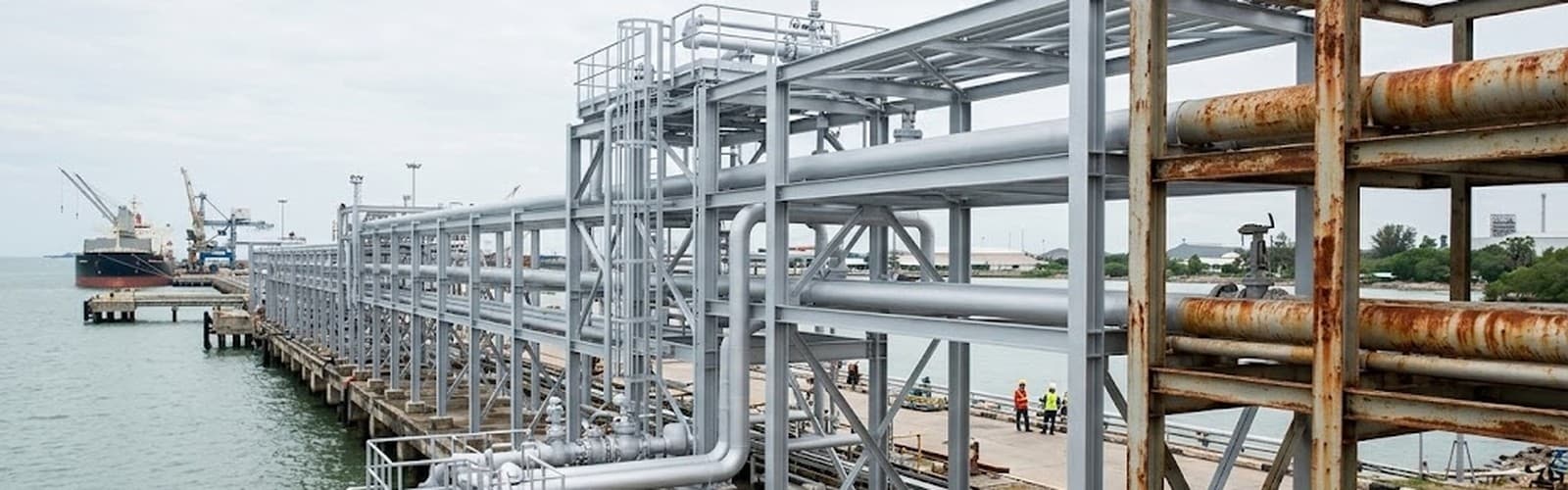
Im2 = the most frequently required class in Thai marine projects — ship hull above + below waterline, dock pile, offshore platform splash zone, sea water intake structure, jetty + pier.
3 Main Coating Systems
1. Chlorinated Rubber (CR)
Spec:
- Single-pack, solvent-borne
- DFT 75-200μm/coat (typically 3-4 coats total)
- Cure: solvent evaporation 6-24 hr
- Operating temp: -20°C to 70°C
Sweet spot: ship hull above water, splash zone topcoat, refurbishment.
Advantages:
- Cures at low temperatures — suitable for winter / cold ambient
- Good salt spray resistance
- Recoatable for up to 6 months without sanding
- Single-pack — minimum waste
Limitations:
- Low DFT per coat — requires many coats
- No immersion beyond the splash zone (Im2 max)
- Solvent-borne — high VOC
2. Coal Tar Epoxy (CTE)
Spec:
- 2K (amine/polyamide cure)
- DFT 200-500μm/coat
- Operating temp: -20°C to 95°C
- Volume solids 55-75%
Sweet spot: buried pipe, storage tank lining, sewer manhole, dock pile underwater.
Advantages:
- Best barrier protection in the group
- High DFT/coat → fewer coats → faster project
- Withstands immersion Im2 + Im3
Limitations:
- EU classified CTPV = carcinogen Cat 1B under REACH — banned for EU consumers in 2010
- Thailand: DIW Annex II lists CTPV as a controlled substance but phase-out is not yet complete
- No UV exposure (chalk + crack)
- The market is shifting to 2K epoxy mastic as a replacement
3. 2K Epoxy Mastic (Modern Replacement)
Spec:
- 2K bisphenol-A epoxy + amine cure
- DFT 150-400μm/coat
- Operating temp: -20°C to 120°C
- Volume solids 75-90% (high-solids low-VOC)
Sweet spot: modern replacement for every Im2 + Im3 application that previously used CTE.
Brand: Hempel Hempadur Mastic 4588, Jotun Jotamastic 90, Sigma SigmaShield 880, International Intershield 300.
Advantages:
- Safe — no carcinogen issue
- Low VOC — aligns with the Thai DIW phase-out roadmap
- High DFT/coat + fast cure
- Cost competitive — within 10-20% of CTE
Decision Matrix
graph TD
    Start[Marine project Im2] --> Q1{Application area?}
    Q1 -->|Above splash zone
UV exposed| CR[Chlorinated Rubber + epoxy primer
4 coats × 100μm = 400μm DFT]
    Q1 -->|Splash zone immerse| Q2{TOR specifies CTE?}
    Q1 -->|Permanent immersion| Q3{TOR cert?}
    Q2 -->|Yes| CTE[Coal Tar Epoxy
2 coats × 400μm = 800μm DFT]
    Q2 -->|No| Mastic1[2K Epoxy Mastic
2 coats × 300μm = 600μm DFT]
    Q3 -->|NORSOK M-501| Mastic2[Hempadur Mastic 4588
3 coats × 250μm = 750μm DFT]
    Q3 -->|Generic| Mastic3[Jotamastic 90 / SigmaShield
2 coats × 300μm + topcoat]
    style Mastic1 fill:#10b981,color:#fff
    style Mastic2 fill:#10b981,color:#fff
    style Mastic3 fill:#10b981,color:#fff
    style CR fill:#3b82f6,color:#fff
    style CTE fill:#f97316,color:#fff
Surface Preparation — Critical for Im2
SSPC-SP10 (near-white blast) mandatory for every system:
- Abrasive size 35-100μm Sa 2.5
- Salt contamination test ISO 8502-9: ≤ 50 mg/m²
- Humidity ≤ 85%
- Substrate temp 3°C above dew point
- Recoat window 4 hours max
Do not:
- Use hand tool prep (SSPC-SP2) for Im2
- Apply during rain or humidity > 85%
- Apply over flash rust > 1 hour old
QC + Inspection
- WFT (wet film thickness) per ASTM D4414 — at application
- DFT (dry film thickness) per ASTM D7091 (magnetic) — after cure
- Holiday test per ASTM D5162 — wet sponge low-voltage
- Adhesion per ASTM D4541 — pull-off ≥ 3 MPa for Im2
Inspector cert: a NACE Level 2 or ICorr Painting Inspector Level 2 must be on site during application + sign off the report.
Further Comparison
See the more detailed tables:
- /compare/chlorinated-rubber-vs-coal-tar-vs-bitumen-marine-coating — compare binder type
- /compare/iso-12944-c3-vs-c4-vs-c5-coating-selector — atmospheric class
- /compare/zinc-rich-vs-epoxy-vs-pu-coating — primer selection
Or calculate 20-year TCO at /tools/paint-tco-calculator.
Saha Service
Saha supplies + supervises marine coating across every system:
- Material: Hempel / Jotun / Sigma / International / TOA — every Im class
- Application contractor: SSPC-QP1 + ICorr Level 2 painter
- Surface prep: SSPC-SP10 abrasive blast + salt test
- QC: WFT + DFT + holiday test + adhesion + report
- Documentation: photo of every step + sign-off + 10-year warranty (with Hempel/Jotun spec)
Send your substrate spec + area + Im class + cert requirement → system recommendation + quotation within 48 hr.
Get this guide as a reference brief (PDF)
Summary + full section list + standards cited, Saha-branded for your memo/RFQ — emailed to you too.
Questions after reading? Talk to our engineers
Tell us what you need — our engineers help you spec it right, with a real quote. No charge.
Need help with this in your facility?
Our team handles full procurement and installation for the topics covered in this article. Free quote promptly during business hours.
Another line of ours — spreadsheet tools for SMEs
Quote Register + Win Rate (Thai + English editions)
For quotes that go silent — one row per quote, telling you which to chase today and what your real win rate is.
Related content
Holiday / Pinhole Detection in Coatings — Wet Sponge vs High-Voltage Spark per NACE/AMPP SP0188 & ASTM D5162
A guide to detecting holidays/pinholes (invisible discontinuities) in protective coating films: choosing low-voltage wet sponge (thin film < 500 µm) vs high-voltage spark/DC (thick film > 500 µm) per NACE/AMPP SP0188, SP0490 and ASTM D5162 — setting voltage by DFT (too low misses holidays, too high burns the film), which work requires it (tanks/pipes/immersion/marine), mark-repair-retest, and what a TOR must specify.
Coating Inspectors: NACE/AMPP CIP vs FROSIO — Who Needs Certification, Levels 1/2/3, and TOR Requirements
A comparison of the two main coating-inspector certification schemes: NACE/AMPP CIP (Coating Inspector Program — Levels 1/2/3, after NACE merged into AMPP in 2021) vs FROSIO (the Norwegian scheme — competence levels I/II/III) — what each level can do, which projects need which level, recognition in Thailand and abroad, and what a TOR must specify (level, independence, hold points, reporting) so coating work can actually be accepted.
Coating Application Conditions — The 'Surface ≥ Dew Point + 3°C' Rule, RH < 85% per ISO 8502-4 & ISO 12944-7
A guide to environmental conditions during protective-coating application: steel surface must be at least 3°C above the dew point, relative humidity RH < 85% (per the TDS), surface temperature within the product's range — how to measure the 4 readings (air temp, RH, dew point, surface temp) per ISO 8502-4 and ISO 12944-7, why painting in humid/near-dew-point conditions causes peeling/blistering/flash rust, and what a TOR must specify for Thailand's humid climate.
ISO 12944 Protective Paint Systems for Steel — Selecting Corrosivity C2–CX, Durability, and Primer/Intermediate/Topcoat for Thailand
How to select a protective coating system for steel structures per ISO 12944: corrosivity categories C1–C5/CX (2017/2018 revision), durability ranges L/M/H/VH, matching zinc-rich primer + epoxy MIO + PU topcoat systems to dry film thickness (DFT) per category, mapping to Thai environments (urban plants vs coastal Map Ta Phut/Laem Chabang), and the spec mistakes TOR writers make most.