
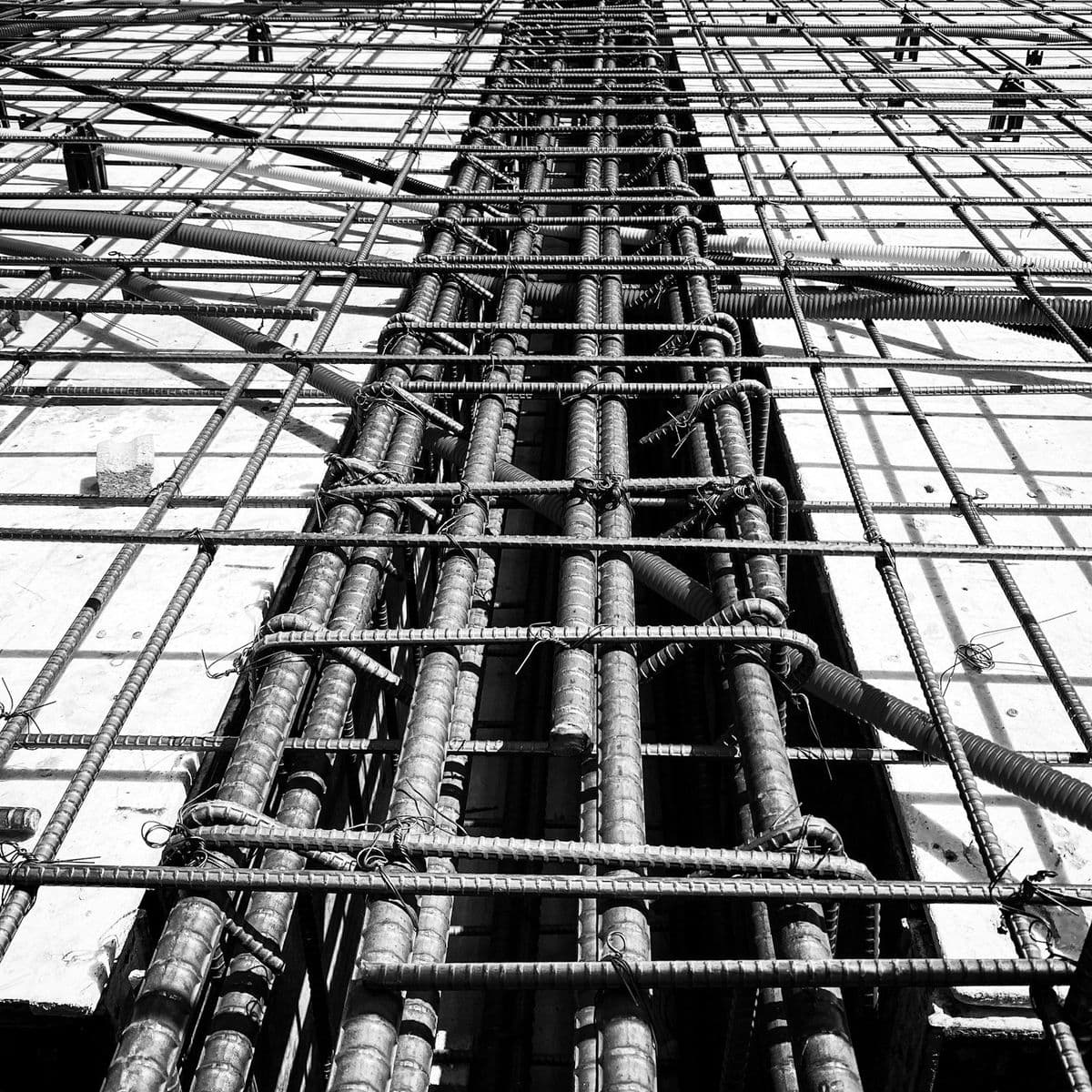
How Galvanic Cathodic Protection (GCP) embeds zinc anodes in concrete to protect rebar from corrosion under ASTM B418, TIS 3029-2563, and ISO 12696 — with practical guidance for Thai infrastructure projects.
In reinforced-concrete structures, the single biggest threat to service life is rebar corrosion — chloride or carbonate ingress reaches the steel, which rusts and expands, cracking the concrete. The damage is most visible on bridge piers, drainage structures, and coastal buildings.
Galvanic Cathodic Protection (GCP) addresses corrosion at the root cause. It embeds zinc anodes — a metal with lower electrochemical potential than steel — into the concrete near the rebar. The anode corrodes "sacrificially" in place of the rebar, allowing the steel to last 25–50 years even in aggressive environments.
How It Works
GCP relies on basic electrochemistry:
flowchart LR
  Zn["Zinc Anode
(-1.10 V)"] -- "galvanic current" --> Concrete["Concrete
(electrolyte)"]
  Concrete --> Rebar["Rebar
(-0.50 V) = Cathode"]
  Rebar -- "bond wire
continuity < 1Ω" --> Zn
  Zn -. "consumed in place of steel" .-> Sacrifice["Zn²⁺ dissolves
(sacrificial)"]
  Rebar -. "excess electrons" .-> Protected["rust reaction stops
25-50 yr life"]
- A zinc anode (potential ≈ -1.10 V vs. Cu/CuSO4) is embedded in the concrete near the rebar.
- The rebar (around -0.50 V) becomes a cathode.
- Galvanic current flows from anode → concrete → rebar → return wire → anode.
- Zinc is oxidised; the rebar receives excess electrons that suppress the rust reaction.
Crucially, the system needs no external power supply — unlike Impressed Current Cathodic Protection (ICCP), which requires permanent wiring and a control cabinet. Galvanic systems are install-and-forget.
Standards Coverage
| Standard | Scope |
|---|---|
| ASTM B418 Type II | Zinc anode chemistry and physical properties for cathodic protection |
| TIS 3029-2563 | Thai Industrial Standard for sacrificial anodes |
| ISO 12696:2022 | Design, install, test, monitor cathodic protection in concrete |
| ACI 222R-19 | Guide on protecting metals in concrete from corrosion |
| ASTM C876-22b | Half-cell potential test method for reinforcing steel |
Anodes specified for a project should carry a Certificate of Analysis (CoA) showing compliance with ASTM B418 Type II and a test report aligned with TIS 3029-2563.
When to Specify
flowchart TD
  Start{"Project
environment?"}
  Start -->|"marine / coastal
(C5-M)"| GCP["Galvanic Cathodic Protection
(embedded zinc anode)"]
  Start -->|"below-grade / submerged"| GCP
  Start -->|"rehabilitation
corroded piers"| GCP
  Start -->|"urban / low chloride"| Surface["Surface protection
polyurethane primer + topcoat"]
  GCP --> LifeSpan["target service life
25-50 yr"]
  Surface --> LifeSpan2["target service life
10-20 yr + recoat"]
GCP is appropriate where the project demands a long service life and the structure sits in a corrosive environment:
- Marine and coastal structures — bridges, jetties, piers exposed to chloride spray
- Below-grade or submerged structures — deep foundations, sub-grade box culverts
- Brackish water exposure — coastal drainage, Chao Phraya riverside development
- Rehabilitation work — fixing already-corroded bridge piers without full demolition
For new urban builds with low chloride exposure, surface-applied protection (single-component polyurethane primer + topcoat) may be sufficient and more cost-effective.
Practical Guidance
🧮 Get a preliminary concrete-anode count from the Anode Sizing Calculator — set the environment to rebar in concrete, and enter the reinforcement surface area, not the concrete face area (they differ by several times).
- Design electrically first — per ISO 12696, calculate required current density (typically 5-20 mA/m² of rebar surface) and anode spacing.
- Bond reliably — connections between anode and rebar must show electrical continuity below 1 Ω.
- Measure rebar potential before and after install via the half-cell potential method (ASTM C876). A negative shift > 100 mV confirms protection.
- Log readings every 6-12 months throughout the project life to confirm anodes remain active.
Summary
Galvanic Cathodic Protection is the standard answer for extending rebar life in aggressive environments under globally accepted ASTM / TIS / ISO frameworks. If your project targets a 50-year service life and sits in C5 (marine/industrial) exposure, GCP pays back from day one.
Sahawatthanakit (1988) has supplied galvanic cathodic protection systems to the Bangkok Metropolitan Administration, the State Railway of Thailand, and private developers. Talk to our engineering team for project-specific guidance.
Get this guide as a reference brief (PDF)
Summary + full section list + standards cited, Saha-branded for your memo/RFQ — emailed to you too.
Questions after reading? Talk to our engineers
Tell us what you need — our engineers help you spec it right, with a real quote. No charge.
Need help with this in your facility?
Our team handles full procurement and installation for the topics covered in this article. Free quote within 2 hours.
Another line of ours — spreadsheet tools for SMEs
Quote Register + Win Rate (Thai + English editions)
For quotes that go silent — one row per quote, telling you which to chase today and what your real win rate is.
Comparison tables related to this article
Related content
Cathodic Protection for Cooling Towers in Factories + Data Centers — Choosing Among 4 Anode Types and a TOR Guide
Cathodic protection for cooling towers, steel + concrete structures — comparing zinc, aluminium, magnesium anode + ICCP for circulating water in chiller plants and water-cooled data centers — NACE SP0388, ISO 12696 standards with a TOR template.
Zinc Anode / Cathodic Protection — Prices and Contractors in Thailand 2026: A Procurement Guide for Engineers
Zinc Anode, Magnesium Anode and Aluminum Anode prices in Thailand 2026, material comparison tables, ASTM B418 and ISO 12696 standards, and full-service Cathodic Protection contractors.
4 Sacrificial Anode Types — Concrete vs Aluminium vs Zinc vs Magnesium for Cathodic Protection
Field guide to selecting sacrificial anodes for Galvanic Cathodic Protection — Concrete Anode (standard/high-output) for reinforced concrete, Aluminium (Al-Zn-In) for marine seawater, Zinc 99.995% for ship hulls, Magnesium for fresh water. Standards: TIS 3029-2563, TIS 3359-2563, ASTM B418, ISO 12696, NACE SP0387, DNV-RP-B401.
Marine & Shipyard Corrosion Protection Field Guide — Choose the Whole System: Surface Prep (Sa 2.5) · ISO 12944 C5-M/CX/Im2 Paint Systems · Cathodic Protection (Anode/ICCP) · Safe Hot Work + How to Lock In Project Material Pricing
Field guide for shipyard, jetty, and coastal steel-structure maintenance: plan corrosion protection across the whole asset by zone (atmospheric/splash/immersed/buried) — abrasive blast Sa 2.5 per ISO 8501, select an ISO 12944 paint system for C5-M/CX and immersed Im2, design cathodic protection with sacrificial anodes (zinc/aluminium/magnesium) vs ICCP per DNV-RP-B401/ISO 12696, control hot work in confined spaces per NFPA 51B, and lubricate marine machinery — plus how to standardize materials to lock project pricing and delivery.