
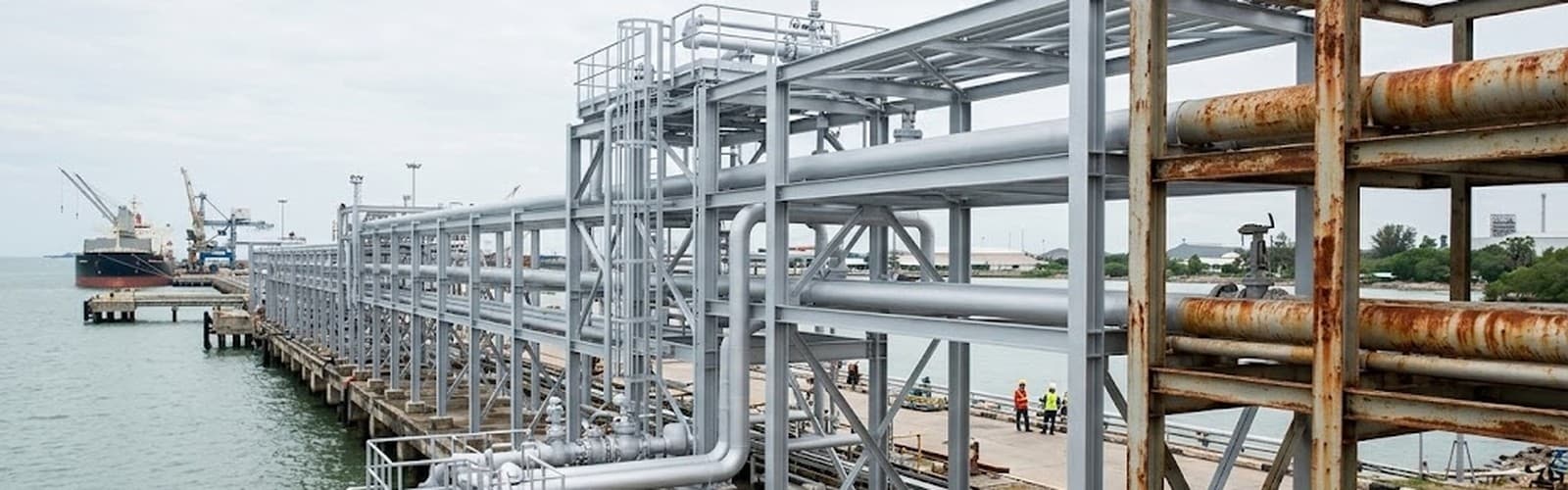

A guide to environmental conditions during protective-coating application: steel surface must be at least 3°C above the dew point, relative humidity RH < 85% (per the TDS), surface temperature within the product's range — how to measure the 4 readings (air temp, RH, dew point, surface temp) per ISO 8502-4 and ISO 12944-7, why painting in humid/near-dew-point conditions causes peeling/blistering/flash rust, and what a TOR must specify for Thailand's humid climate.
Coatings fail from "painting at the wrong time" about as often as from "poor surface prep" — and it's easily missed because the work looks fine at the time. But moisture condensing on the steel (invisible to the eye) stops the coating adhering, and it blisters/peels/rusts under the film within months.
This is the cheapest QA gate there is — just measure 4 readings before you start and you prevent the damage. This article covers the rules, the criteria, and how to specify them in a TOR for Thailand's humid, hot climate — the upstream gate that keeps your good surface prep (ISO 8501) and thickness (DFT/ISO 19840) from going to waste.
1. Why conditions ruin coatings most often
A coating film only adheres and cures well when the surface is dry and clean and temperature/humidity are within the product's design range. Outside those, however good the paint and prep, it fails:
- Surface near/below dew point → a thin water film condenses on the steel → no adhesion, blistering, flash rust under the coating
- RH too high → solvents / cure reaction go wrong; epoxy develops amine blush (a sticky bloom that blocks the next coat)
- Surface too hot → dry spray, solvent popping, a film that won't level
Conditions are an "invisible gate" — it passes the eye but not the physics. Measure with instruments, don't judge by feel.
2. The core rule — surface ≥ dew point + 3°C, RH < 85%
International standards (ISO 8502-4 / ISO 12944-7 and almost every product TDS) require:
| Criterion | Typical value |
|---|---|
| Surface temp − dew point | ≥ 3°C (during application + early cure) |
| Relative humidity RH | < 85% (per TDS — some stricter) |
| Surface temperature | within the coating's min–max (e.g. epoxy ≥ ~10°C) |
The "3-degree rule" is the heart of it: keep a 3°C margin above the dew point to absorb air changes during the work — a surface sitting exactly at the dew point (0°C margin) risks condensation the moment the air shifts.
3. Measure 4 readings every time — before and during the day
| # | Reading | Measured with |
|---|---|---|
| 1 | air temperature | thermo-hygrometer |
| 2 | relative humidity (RH) | thermo-hygrometer |
| 3 | dew point | computed from 1+2 / read from meter / ISO 8502-4 table |
| 4 | steel surface temperature | contact / IR thermometer |
A combined dew point meter reads all four at once and computes the surface − dew point margin automatically — record the values periodically (morning/afternoon, or every 2–4 h) because they change through the day.
4. The real working window + go / no-go
flowchart TD
  A[Measure air temp, RH, dew point, surface temp] --> B{surface temp − dew point ≥ 3°C?}
  B -->|No| X[Stop — wait for surface to warm / humidity to drop, or dehumidify]
  B -->|Yes| C{RH < 85% per TDS?}
  C -->|No| X
  C -->|Yes| D{surface temp within coating min-max?}
  D -->|No| X
  D -->|Yes| E[Apply — log all 4 readings in the report]
  E --> F[Re-measure periodically through the day]
For Thai outdoor work:
- Early morning / after rain — high RH + cold surface, likely no-go (wait for sun to warm the surface)
- Hot afternoon — steel can exceed 50°C, over many products' max (avoid, shade it, or coat in the evening)
- The best window is often mid-morning to early afternoon, when the surface is warm past the dew point but not yet too hot
5. What to put in the TOR
- Cite ISO 8502-4 + ISO 12944-7: surface ≥ dew point + 3°C, RH < 85% (or per TDS)
- Require measuring + logging 4 readings (air temp, RH, dew point, surface temp) before and periodically
- Require calibrated instruments (dew point meter + surface thermometer) + certificates
- Define a hold point: no application until the inspector confirms the readings pass (see the inspector article)
- Cite the product TDS for the specific min–max temp + RH
- Require an environmental report attached to DFT/adhesion per area + the working window
Tip: a good TOR doesn't leave it to "paint when ready" — it states the numeric criteria (3°C / 85%) + logging + a hold point so the inspector can stop work when conditions fail, because repairing failed coating costs far more than waiting half a day.
Summary
Application conditions are the cheapest QA gate yet the most often skipped — just measure 4 readings before you start and you prevent coating failure.
Hold the rule: surface ≥ dew point + 3°C, RH < 85% (per TDS), and surface within the coating's min–max, per ISO 8502-4 / ISO 12944-7 — log it every time and re-measure through the day. In Thailand's humid, hot climate, picking the right window is the difference between a coating that lasts 15 years and one that blisters in one.
Need protective coating work with environmental control to standard and full dew point/RH/surface-temp records — request a quote and our team works to ISO 12944-7 / ISO 8502-4 and logs the readings at every hold point.
Get this guide as a reference brief (PDF)
Summary + full section list + standards cited, Saha-branded for your memo/RFQ — emailed to you too.
Questions after reading? Talk to our engineers
Tell us what you need — our engineers help you spec it right, with a real quote. No charge.
Need help with this in your facility?
Our team handles full procurement and installation for the topics covered in this article. Free quote promptly during business hours.
Another line of ours — spreadsheet tools for SMEs
Quote Register + Win Rate (Thai + English editions)
For quotes that go silent — one row per quote, telling you which to chase today and what your real win rate is.
Frequently Asked Questions
1What is the 'surface ≥ dew point + 3°C' rule, and why 3 degrees?
+
2How do I find the dew point — what must I measure?
+
3At what RH must I stop?
+
4Are too-high or too-low surface temperatures a problem?
+
5Why does Thai work need to be especially strict about this?
+
Related content
Holiday / Pinhole Detection in Coatings — Wet Sponge vs High-Voltage Spark per NACE/AMPP SP0188 & ASTM D5162
A guide to detecting holidays/pinholes (invisible discontinuities) in protective coating films: choosing low-voltage wet sponge (thin film < 500 µm) vs high-voltage spark/DC (thick film > 500 µm) per NACE/AMPP SP0188, SP0490 and ASTM D5162 — setting voltage by DFT (too low misses holidays, too high burns the film), which work requires it (tanks/pipes/immersion/marine), mark-repair-retest, and what a TOR must specify.
Coating Inspectors: NACE/AMPP CIP vs FROSIO — Who Needs Certification, Levels 1/2/3, and TOR Requirements
A comparison of the two main coating-inspector certification schemes: NACE/AMPP CIP (Coating Inspector Program — Levels 1/2/3, after NACE merged into AMPP in 2021) vs FROSIO (the Norwegian scheme — competence levels I/II/III) — what each level can do, which projects need which level, recognition in Thailand and abroad, and what a TOR must specify (level, independence, hold points, reporting) so coating work can actually be accepted.
ISO 12944 Protective Paint Systems for Steel — Selecting Corrosivity C2–CX, Durability, and Primer/Intermediate/Topcoat for Thailand
How to select a protective coating system for steel structures per ISO 12944: corrosivity categories C1–C5/CX (2017/2018 revision), durability ranges L/M/H/VH, matching zinc-rich primer + epoxy MIO + PU topcoat systems to dry film thickness (DFT) per category, mapping to Thai environments (urban plants vs coastal Map Ta Phut/Laem Chabang), and the spec mistakes TOR writers make most.
Inspecting & Accepting Industrial Coating Work — DFT per ISO 19840 / SSPC-PA 2, the 80-20 Rule, Adhesion and Holiday
A guide to coating inspection and acceptance: measuring dry film thickness (DFT) per ISO 2808, acceptance criteria of ISO 19840 (mean ≥ NDFT, every reading ≥ 80%, the 80-20 rule) vs SSPC-PA 2 (gauge → spot → area, 80-120%), pull-off adhesion per ISO 4624, holiday/pinhole detection per NACE/ASTM, degradation rating per ISO 4628, and what to put in a TOR so coating work can actually be accepted.