
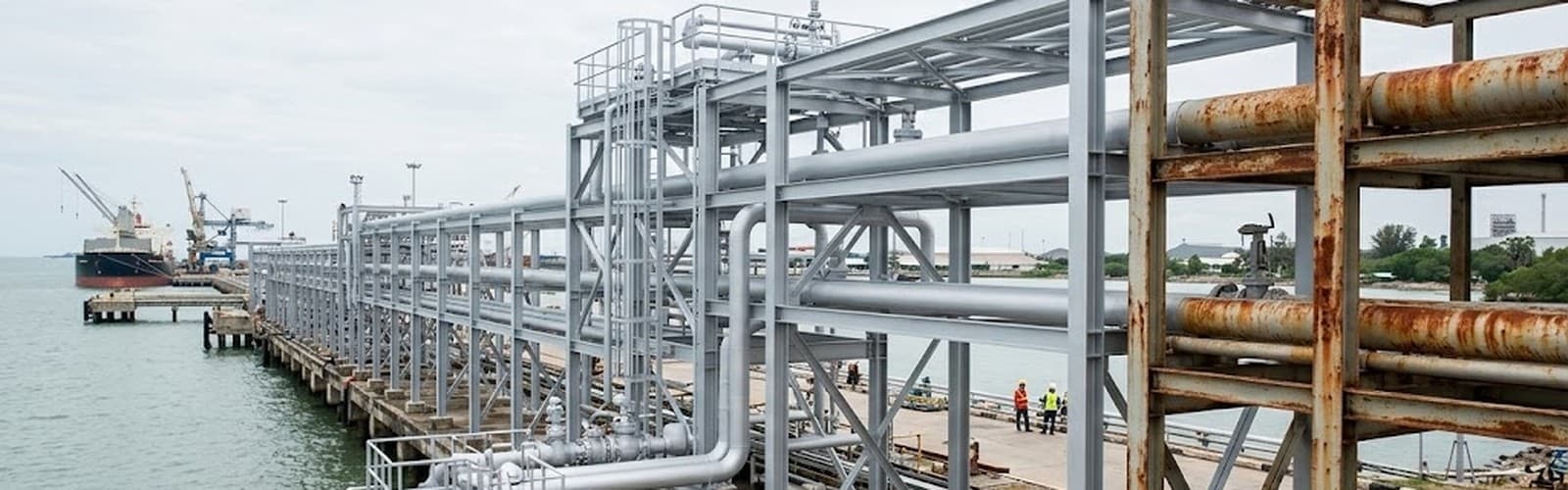
How to select a protective coating system for steel structures per ISO 12944: corrosivity categories C1–C5/CX (2017/2018 revision), durability ranges L/M/H/VH, matching zinc-rich primer + epoxy MIO + PU topcoat systems to dry film thickness (DFT) per category, mapping to Thai environments (urban plants vs coastal Map Ta Phut/Laem Chabang), and the spec mistakes TOR writers make most.
In structural-steel corrosion protection, the wrong question is "which brand, which paint, how many baht." The right question is "what corrosion category is this job in, and how many years must it last," because those two answers — not price — determine how many coats, of what type, and how thick.
The international standard that answers this is ISO 12944 — an 8-part series on "corrosion protection of steel structures by protective paint systems" that Thai government TORs and factory specs cite most often. This article explains how to read and apply ISO 12944 so you pick the right system from the start instead of guessing by price.
1. ISO 12944 has 8 parts — what each one answers
ISO 12944 is not a single standard but a set of 8 parts that work together:
| Part | Topic | When you use it |
|---|---|---|
| -1 | Introduction + durability range definitions | Planning the target service life |
| -2 | Corrosivity categories C1–CX / Im1–Im4 | Assessing the site environment |
| -3 | Designing structures to be coatable | Design (edges, corners, welds) |
| -4 | Surface types + surface preparation | Used together with ISO 8501 |
| -5 | Example paint systems + DFT | Choosing the actual coats |
| -6 | Laboratory test methods | Verifying paint properties |
| -7 | Execution + site supervision | Controlling application |
| -8 | Developing the specification | Writing the TOR/spec |
For the spec writer, the core is three parts: -2 (pick the category) → -1 (pick durability) → -5 (pick the system + DFT). The other five are supporting detail.
2. Corrosivity categories — C1 to CX (ISO 12944-2:2017)
The 2017/2018 revision classifies atmospheres into 6 levels, referencing first-year steel thickness loss per ISO 9223:
| Category | Severity | First-year steel loss | Example environment |
|---|---|---|---|
| C1 | Very low | ≤ 1.3 micron | Dry air-conditioned interiors |
| C2 | Low | > 1.3–25 micron | Rural, low pollution, unheated stores |
| C3 | Medium | > 25–50 micron | Urban, moderately polluted plants |
| C4 | High | > 50–80 micron | Industrial zones, moderate-salinity coast |
| C5 | Very high | > 80–200 micron | Heavy industry, high-salinity coast |
| CX | Extreme | > 200–700 micron | Offshore, severe humid-tropical industry |
CX is the new addition in the 2018 revision — it merges and replaces the former C5-I (industrial) and C5-M (marine) for offshore and severe humid-tropical work, which matches many Gulf-of-Thailand coastal sites.
Beyond atmospheres there are immersion/soil categories Im1 (fresh water), Im2 (sea/brackish water), Im3 (soil), Im4 (sea water with cathodic protection) for tanks, pipes, piles and submerged structures.
3. Durability range — "how long it lasts," not "how long it's warranted"
ISO 12944-1:2017 defines the expected time to first major maintenance in 4 levels:
| Level | Expected service life |
|---|---|
| Low (L) | less than 7 years |
| Medium (M) | 7–15 years |
| High (H) | 15–25 years |
| Very High (VH) | more than 25 years |
Durability range ≠ warranty period. It is the engineering basis for selecting coating thickness, not a contractual guarantee. Commercial warranties are usually shorter (e.g. 2–5 years) and are a separate matter. The 2017 revision added the new Very High > 25-year level (previously the scale stopped at High).
The more severe the category and the longer you want it to last, the thicker and more layered the system must be — which leads to Part -5.
4. Choosing the real system — primer + intermediate + topcoat + DFT (ISO 12944-5:2018)
Most industrial corrosion-protection systems are 3 coats with distinct jobs:
- Primer: adhesion + base corrosion protection —
zinc-rich epoxy(galvanic, sacrificial like zinc) orepoxy zinc phosphate - Intermediate / build coat: moisture/oxygen barrier thickness — high-build
epoxy MIO(micaceous iron oxide) - Topcoat: UV resistance + colour/gloss retention —
polyurethane (PUR)orpolysiloxane; interior/immersion can useepoxy
Approximate total Nominal Dry Film Thickness from ISO 12944-5 example systems, for High durability (15–25 years):
| Category | Approx. total DFT | Example system structure |
|---|---|---|
| C2 | 80–120 micron | primer + topcoat (2 coats) |
| C3 | 160–200 micron | EZn/epoxy primer + epoxy + PU |
| C4 | 240–280 micron | zinc-rich + epoxy MIO + PU |
| C5 | 280–320 micron | zinc-rich + epoxy MIO (build) + PU |
| CX | 350–500+ micron | zinc-rich + multi-coat epoxy MIO + PU/polysiloxane |
flowchart TD
  A[Assess site per ISO 9223 / 12944-2] --> B{Corrosivity category?}
  B -->|C3 urban plant| C[160-200 micron · primer+epoxy+PU]
  B -->|C4 industrial moderate coast| D[240-280 micron · zinc-rich+MIO+PU]
  B -->|C5 high-salinity coast| E[280-320 micron · zinc-rich+MIO build+PU]
  B -->|CX offshore severe tropical| F[350-500+ micron · multi-coat zinc-rich+MIO]
  C --> G{Required durability?}
  D --> G
  E --> G
  F --> G
  G -->|High 15-25 yr| H[Use DFT per table]
  G -->|Very High >25 yr| I[Add thickness/coats + mandatory zinc-rich]
The DFT figures above are approximate examples — a real system must reference the data sheet of a paint tested to ISO 12944-6 / NACE TM in the target category and durability before being written into a TOR.
Before any system, the surface must be prepared to standard — see Surface preparation Sa 2.5 / ISO 8501-1 and the zinc-primer choice at Zinc-rich primer vs hot-dip galvanizing.
5. Mapping to real Thai environments
The category on paper must translate correctly to the Thai site:
| Area / job | Typical category | Why |
|---|---|---|
| Steel inside air-conditioned buildings | C1–C2 | Dry, low pollution |
| Plants/warehouses in urban & peri-urban areas | C3–C4 | Urban pollution, year-round humidity |
| Inland industrial estates | C4 | SO2/dust from processes |
| Coastal-industrial Map Ta Phut / Laem Chabang | C5–CX | Salt spray + humidity + pollution combined |
| Offshore structures / deep-sea ports | CX, Im2/Im4 | Continuous salt mist + splash zone |
A common mistake: using a C3 system (because it is cheaper) on a C5 coastal job → rust within 2–3 years and a full re-do. Repair cost is many times the up-front cost because it must include removal plus downtime.
6. What TORs / specs most often get wrong (checklist)
Per ISO 12944-8, a good specification must cover all of these — omit one and contractors interpret it themselves, usually toward the cheapest option:
- State the corrosivity category (C3/C4/C5/CX) per ISO 12944-2 — not just "anti-rust paint"
- State the required durability range (Medium/High/Very High)
- State surface preparation (e.g. Sa 2.5 per ISO 8501-1) + blast profile
- State the generic type of each coat (zinc-rich epoxy / epoxy MIO / PU) — avoid single-brand lock for public work
- State total + per-coat NDFT and an acceptance rule per ISO 19840 (80-20 rule: mean ≥ NDFT, lowest single point ≥ 80%)
- State site conditions: do not apply when RH > 85% or steel is less than 3°C above dew point
- State acceptance tests: DFT gauge, adhesion (pull-off ISO 4624), holiday detection where required
The trick to a price-competitive but quality-locked TOR: bind on category + durability + DFT + generic type (the required outcome), not on a brand — letting multiple compliant manufacturers compete on price while quality stays fixed by the standard.
Summary
Selecting the right ISO 12944 corrosion-protection system takes 3 steps: (1) assess the site to a category C2–CX → (2) set the required durability (M/H/VH) → (3) match a primer/intermediate/topcoat system + DFT per Part -5, then write it fully into the TOR per Part -8.
The key is to stop thinking "which can of paint is cheapest" and start thinking "which system lasts for this environment and target life" — the annual cost of the correct system is usually far lower than repeated re-coating.
Order and request a quote (ISO 12944 corrosion-protection system)
Tell us the environment category (C3–CX) + area (m²) + required durability + delivery location and we promptly send a quote — our engineering team matches the coating system (zinc-rich primer / epoxy MIO / polyurethane topcoat) and film thickness (DFT) to your category before quoting.
- Request a quote online: open the form (spec goes straight to our engineers) →
- Direct line: 02-096-2118 / 081-866-8368 (Khun Navin)
- LINE OA: @sahawatt1988
- Email: info@sahawatthanakit1988.com
- Mon–Fri 08:00–17:00 · nationwide delivery
Get this guide as a reference brief (PDF)
Summary + full section list + standards cited, Saha-branded for your memo/RFQ — emailed to you too.
Questions after reading? Talk to our engineers
Tell us what you need — our engineers help you spec it right, with a real quote. No charge.
Need help with this in your facility?
Our team handles full procurement and installation for the topics covered in this article. Free quote promptly during business hours.
Another line of ours — spreadsheet tools for SMEs
Quote Register + Win Rate (Thai + English editions)
For quotes that go silent — one row per quote, telling you which to chase today and what your real win rate is.
Frequently Asked Questions
1What is the difference between ISO 12944 corrosivity categories C3, C4, C5 and CX?
+
2Is the ISO 12944 durability range a warranty period?
+
3How many coats does a corrosion-protection system have, and what does each do?
+
4Why specify dry film thickness (DFT) in a TOR, not just the paint brand?
+
5Which category fits a plant in Bangkok, and is coastal Rayong/Chonburi different?
+
Related content
Inspecting & Accepting Industrial Coating Work — DFT per ISO 19840 / SSPC-PA 2, the 80-20 Rule, Adhesion and Holiday
A guide to coating inspection and acceptance: measuring dry film thickness (DFT) per ISO 2808, acceptance criteria of ISO 19840 (mean ≥ NDFT, every reading ≥ 80%, the 80-20 rule) vs SSPC-PA 2 (gauge → spot → area, 80-120%), pull-off adhesion per ISO 4624, holiday/pinhole detection per NACE/ASTM, degradation rating per ISO 4628, and what to put in a TOR so coating work can actually be accepted.
Holiday / Pinhole Detection in Coatings — Wet Sponge vs High-Voltage Spark per NACE/AMPP SP0188 & ASTM D5162
A guide to detecting holidays/pinholes (invisible discontinuities) in protective coating films: choosing low-voltage wet sponge (thin film < 500 µm) vs high-voltage spark/DC (thick film > 500 µm) per NACE/AMPP SP0188, SP0490 and ASTM D5162 — setting voltage by DFT (too low misses holidays, too high burns the film), which work requires it (tanks/pipes/immersion/marine), mark-repair-retest, and what a TOR must specify.
Coating Inspectors: NACE/AMPP CIP vs FROSIO — Who Needs Certification, Levels 1/2/3, and TOR Requirements
A comparison of the two main coating-inspector certification schemes: NACE/AMPP CIP (Coating Inspector Program — Levels 1/2/3, after NACE merged into AMPP in 2021) vs FROSIO (the Norwegian scheme — competence levels I/II/III) — what each level can do, which projects need which level, recognition in Thailand and abroad, and what a TOR must specify (level, independence, hold points, reporting) so coating work can actually be accepted.
Coating Application Conditions — The 'Surface ≥ Dew Point + 3°C' Rule, RH < 85% per ISO 8502-4 & ISO 12944-7
A guide to environmental conditions during protective-coating application: steel surface must be at least 3°C above the dew point, relative humidity RH < 85% (per the TDS), surface temperature within the product's range — how to measure the 4 readings (air temp, RH, dew point, surface temp) per ISO 8502-4 and ISO 12944-7, why painting in humid/near-dew-point conditions causes peeling/blistering/flash rust, and what a TOR must specify for Thailand's humid climate.