
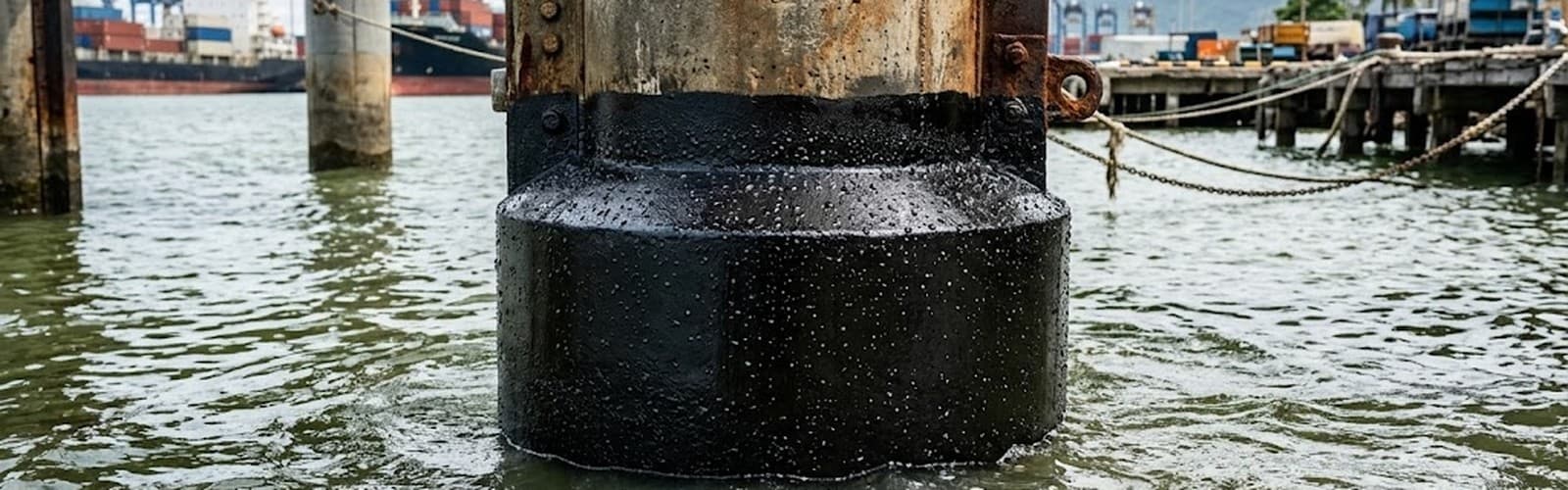
Chlorinated Rubber vs Coal Tar vs Bitumen
Heavy-duty coating — choose by ISO 12944 Im class
Three protective coatings for marine + buried + splash-zone service — DFT · cure mechanism · capex + immersion class
This is a knowledge page — we do not sell chlorinated rubber, coal tar or bitumen coatings.
Coatings we sellIn short — choose by immersion class
ISO 12944-2: Im1 = freshwater · Im2 = seawater + splash · Im3 = soil immersion + concrete. No UV exposure for CTE + bitumen
Chlorinated Rubber (CR)
- Good salt-spray resistance + cures at low temperature (-20°C)
- Used on ship hulls above the waterline + splash zones + coastal piping
- Recoat window up to 6 months without sanding — flexible maintenance
- Single-pack — no mix ratio + low waste
Ship hull above water, splash zone, refurbishment
Coal Tar Epoxy (CTE)
- DFT 200-500μm/coat — the best barrier protection of the three
- Suited to underground pipe + storage tanks + sewer manholes
- Banned in the EU (carcinogen Cat 1B) but still permitted by Thai DIW
- Saha recommends 2K epoxy mastic as the replacement (Hempadur/Jotamastic/SigmaShield)
Buried steel pipe, storage tank lining, sewer
Bitumen
- Lowest cost — capex ฿120-250/L
- High DFT 200-1,000μm/coat — thick barrier
- No UV exposure — buried + concrete applications only
- Hot-applied (180°C) or cold-applied solvent-borne
Buried steel pipe, concrete tank waterproofing, foundations
12-row comparison table
| Item | Chlorinated Rubber | Coal Tar Epoxy | Bitumen |
|---|---|---|---|
| Binder type | Chlorinated polyolefin (CR) | Bisphenol-A epoxy + coal tar | Petroleum asphalt (oxidised/blown) |
| Cure mechanism | Solvent evaporation | Chemical 2K cure (amine/polyamide) | Solvent evaporation / hot-applied |
| Typical DFT/coat (μm) | 75-200 | 200-500 | 200-1,000 |
| Volume solids (%) | 35-50 | 55-75 | 40-65 |
| Dry time (touch, 25°C) | 2-4 hr | 6-12 hr | 4-8 hr |
| Recoat interval (min/max) | 8 hr / 6 mo | 12-24 hr / 7 days | 12 hr / no limit |
| Operating temp range (°C) | -20 to 70 | -20 to 95 | -20 to 60 |
| ISO 12944 environment | C5-M / Im2 splash | Im1/Im2/Im3 immersion | Im3 buried + concrete |
| UV resistance | Fair (chalks but does not delaminate) | Poor (no UV exposure) | Poor (oxidises + cracks) |
| VOC (g/L typical) | 350-500 (solvent-based) | 200-350 | 300-500 |
| Capex (THB/L) | ฿280-450 | ฿320-550 | ฿120-250 |
| Main application | Ship hull above water, splash zone | Buried tank, underground pipe, sewer | Buried steel pipe + concrete waterproofing |
Specs per ISO 12944-1 to -9 + ASTM D4541 (adhesion) + ASTM D5162 (holiday test) (May 2026). Send us the substrate + Im class for a system recommendation
For steel that is wet or under water
We do not sell the three coatings on this page. What we do sell for wet and submerged steel is SGU-201, a two-part solvent-free epoxy that goes on damp or submerged surfaces, and its budget version NOVA Aqua Shield.
Decide with confidence — compare from several angles
Read the related comparison tables — full specs, real prices, and a recommendation for each use.
Common Questions
Q1.How do these three coatings differ in use?+
Q2.What does ISO 12944 Im1/Im2/Im3 cover?+
Q3.Is Coal Tar Epoxy really phased out in the EU?+
Q4.How to apply + measure thickness correctly?+
Q5.Does Sahawatthanakit sell the marine coatings on this page?+
Still not sure which one fits your job?
Tell us the job in a line — a Sahawatthanakit engineer checks the right industrial paint for you free, with a prompt quotation during business hours.
Used only to contact you · never shared with third parties