
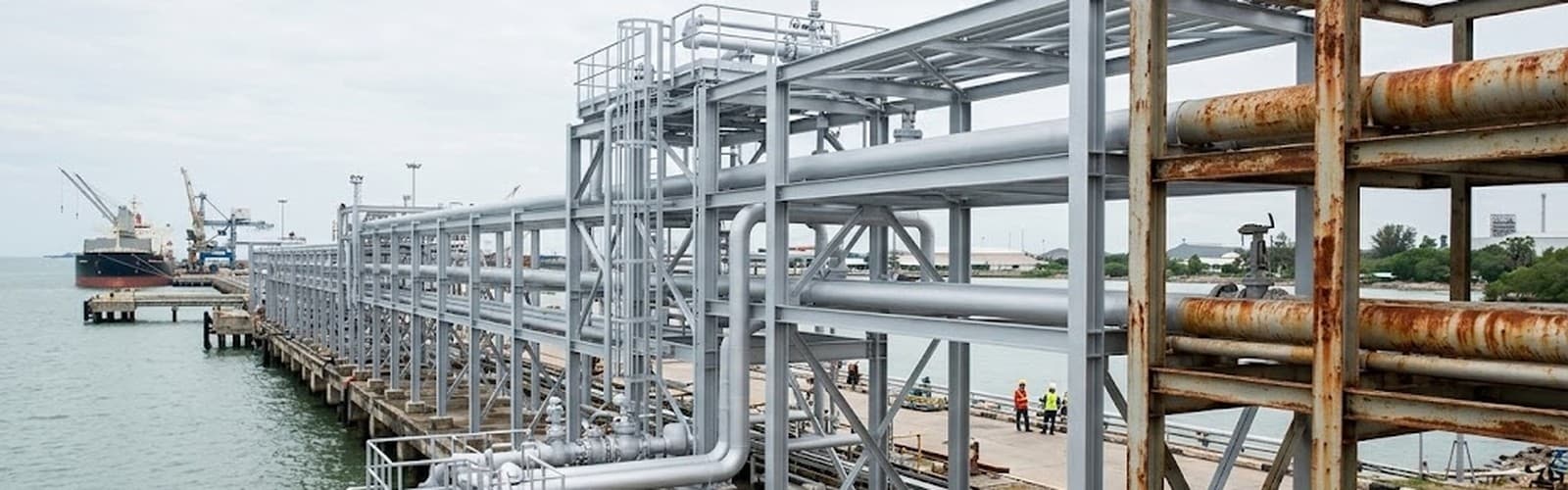
A comparison of the two main coating-inspector certification schemes: NACE/AMPP CIP (Coating Inspector Program — Levels 1/2/3, after NACE merged into AMPP in 2021) vs FROSIO (the Norwegian scheme — competence levels I/II/III) — what each level can do, which projects need which level, recognition in Thailand and abroad, and what a TOR must specify (level, independence, hold points, reporting) so coating work can actually be accepted.
High-value protective-coating TORs often contain one line that knocks out many contractors: "the inspector must hold a NACE/AMPP CIP or FROSIO certification" — yet many don't know what that is, how the two differ, or which level their own job needs.
This article explains the two coating-inspector certification schemes used worldwide, the levels in each, and how to specify them clearly in a TOR — building on how to inspect & accept coating work (DFT/ISO 19840), which covers "how to measure." This one covers "who is qualified to measure and sign off."
1. Why a TOR demands a "certified inspector"
Coating work differs from general construction in one way: its quality is invisible to the eye. A film that looks smooth may be under-thickness, applied over poorly cleaned steel, or full of pinholes (holidays) that start rust within a few years. You only find out when the coating fails — usually after the warranty expires.
So high-value work needs a qualified neutral party, because:
- Independence — a certified, independent inspector (not the contractor checking their own work) reduces self-serving inspection.
- Consistency — someone who completed the course and exam inspects to the same standard, reads values and passes/fails the same way.
- Defensible documentation — a report signed by a certified inspector can be used for warranty claims, project closeout, and disputes.
ISO 12944-7 (execution and supervision of paint work) is the international basis requiring systematic supervision of coating work — the certified inspector is the person who performs that role.
2. NACE / AMPP CIP — the Coating Inspector Program
Naming note: In 2021 NACE International + SSPC merged into AMPP (Association for Materials Protection and Performance). The former NACE CIP now sits under AMPP — an old TOR saying "NACE CIP" means the same level as today's "AMPP CIP."
CIP (Coating Inspector Program) has three levels:
| Level | What it can do | Suited to |
|---|---|---|
| CIP Level 1 | inspects under supervision, non-destructive measurements on general/structural work (not immersion) | assistant inspector, basic structures |
| CIP Level 2 | fully independent inspection, including immersion/tank/pipe work, specialised testing, complex specs | the level most specs ask for |
| CIP Level 3 (Peer Review) | highest level, via peer review after Level 2 experience | lead inspector, consultant, dispute arbiter |
CIP strengths: broad coverage of instruments and tests, plus strong recognition across Asia/Middle East/Americas — making inspectors easy to find and benchmark in Thailand.
3. FROSIO — Inspector of Surface Treatment (Norway)
FROSIO is the Norwegian certification scheme for "inspectors of surface preparation and coating," used widely in Northern Europe and oil & gas/offshore work.
FROSIO's structure differs slightly from CIP: candidates complete a course + exam, then receive a certificate stating a competence level (I / II / III) assigned from their exam score + documented real-world experience.
| Level | Summary |
|---|---|
| FROSIO Level I | meets the basic threshold, limited experience |
| FROSIO Level II | moderate experience |
| FROSIO Level III | highest score + experience — the level oil & gas specs usually ask for (commonly equated with CIP Level 2) |
FROSIO strengths: deep on surface preparation and offshore/marine work per Northern-European practice (e.g. NORSOK M-501 used on Norwegian projects).
4. CIP vs FROSIO — comparison and how to choose
| Topic | NACE/AMPP CIP | FROSIO |
|---|---|---|
| Origin | USA (AMPP) | Norway |
| Level structure | Level 1 / 2 / 3 (Peer Review) | Competence Level I / II / III |
| Common where | Americas, Middle East, Asia/Thailand | Northern Europe, oil & gas/offshore |
| Often equated | CIP Level 2 | ↔ FROSIO Level III |
| Usual companion standards | SSPC/AMPP, ISO 12944, ISO 8501–8503 | NORSOK M-501, ISO 12944, ISO 8501–8503 |
flowchart TD
  A[How critical is your coating work?] -->|Fence/light frame/general| B[QC person + calibrated gauges; cert not mandatory]
  A -->|Government structural steel/buildings/bridges| C[Independent certified inspector required]
  A -->|Tanks/immersion/marine/offshore| D[Higher-level inspector + immersion experience]
  C --> E[CIP Level 2 or FROSIO Level III]
  D --> F[CIP Level 2/3 or FROSIO Level III + immersion experience]
  E --> G[Specify independence + hold points + reporting in TOR]
  F --> G
Choosing principle: look at value + risk + the industry standard the owner cites, then specify that you accept both CIP and FROSIO at equivalent levels — so you don't exclude a qualified contractor merely for holding the "other" certificate.
5. What to put in the TOR so coating work can be accepted
- State the accepted inspector level, e.g. "NACE/AMPP CIP Level 2 or FROSIO Level III or higher"
- Require independence — the inspector must be independent of the painting contractor (third-party) for critical work
- Attach copies of certificates + number + expiry for the inspector who will actually be on site
- Define hold points — stages where work stops until the inspector passes it (e.g. after blast, before each coat)
- Cite the measurement criteria: surface prep ISO 8501/8502/8503, thickness ISO 19840 / SSPC-PA 2, coating system ISO 12944-5/7
- Define the report format — daily/stage report + environmental readings + DFT/adhesion + photos + signature
- Define authority to issue NCRs (Non-Conformance Reports) + the rework and re-inspection process
Tip: a good TOR specifies all three layers — who (cert level + independence), when (hold points), and on what criteria (measurement standards + reporting). Miss any one and even having an inspector won't settle the dispute at handover.
Summary
A "certified coating inspector" in a TOR isn't a formality — it's the mechanism that lets coating work, whose quality is invisible to the eye, be accepted neutrally.
The two main schemes are NACE/AMPP CIP (Levels 1/2/3 — common in Thailand/Asia) and FROSIO (Levels I/II/III — common in Northern Europe/oil & gas), accepted as equivalents (typically CIP Level 2 ↔ FROSIO Level III). Pick the level by project value/risk, and specify all three of who–when–on-what-criteria in the TOR.
Need protective coating work done to standard and ready for a certified inspector to accept, with full hold-point/DFT/adhesion documentation — request a quote and our team works to ISO 12944 / ISO 19840 and coordinates inspection as the TOR requires.
Get this guide as a reference brief (PDF)
Summary + full section list + standards cited, Saha-branded for your memo/RFQ — emailed to you too.
Questions after reading? Talk to our engineers
Tell us what you need — our engineers help you spec it right, with a real quote. No charge.
Need help with this in your facility?
Our team handles full procurement and installation for the topics covered in this article. Free quote promptly during business hours.
Another line of ours — spreadsheet tools for SMEs
Quote Register + Win Rate (Thai + English editions)
For quotes that go silent — one row per quote, telling you which to chase today and what your real win rate is.
Frequently Asked Questions
1Are NACE and AMPP different — old TORs still say NACE?
+
2What's the difference between CIP Level 1, 2 and 3?
+
3Which is better, FROSIO or NACE/AMPP CIP — which should I pick?
+
4Does my coating work need a certified inspector, or can the crew self-check?
+
5What does a certified inspector actually verify — not just thickness?
+
Related content
Inspecting & Accepting Industrial Coating Work — DFT per ISO 19840 / SSPC-PA 2, the 80-20 Rule, Adhesion and Holiday
A guide to coating inspection and acceptance: measuring dry film thickness (DFT) per ISO 2808, acceptance criteria of ISO 19840 (mean ≥ NDFT, every reading ≥ 80%, the 80-20 rule) vs SSPC-PA 2 (gauge → spot → area, 80-120%), pull-off adhesion per ISO 4624, holiday/pinhole detection per NACE/ASTM, degradation rating per ISO 4628, and what to put in a TOR so coating work can actually be accepted.
Tank Lining — Chemical-Resistant Internal Coatings: Epoxy Novolac vs Vinyl Ester per API 652 / NACE
A guide to chemical-resistant tank linings: epoxy, epoxy novolac (98% acid), vinyl ester (acids/alkalis/solvents, high temperature), immersion surface prep, holiday testing, and standards API 652 / NACE SP0178 / SP0188 — selecting by chemical and temperature for work in Thailand.
Holiday / Pinhole Detection in Coatings — Wet Sponge vs High-Voltage Spark per NACE/AMPP SP0188 & ASTM D5162
A guide to detecting holidays/pinholes (invisible discontinuities) in protective coating films: choosing low-voltage wet sponge (thin film < 500 µm) vs high-voltage spark/DC (thick film > 500 µm) per NACE/AMPP SP0188, SP0490 and ASTM D5162 — setting voltage by DFT (too low misses holidays, too high burns the film), which work requires it (tanks/pipes/immersion/marine), mark-repair-retest, and what a TOR must specify.
Coating Application Conditions — The 'Surface ≥ Dew Point + 3°C' Rule, RH < 85% per ISO 8502-4 & ISO 12944-7
A guide to environmental conditions during protective-coating application: steel surface must be at least 3°C above the dew point, relative humidity RH < 85% (per the TDS), surface temperature within the product's range — how to measure the 4 readings (air temp, RH, dew point, surface temp) per ISO 8502-4 and ISO 12944-7, why painting in humid/near-dew-point conditions causes peeling/blistering/flash rust, and what a TOR must specify for Thailand's humid climate.