
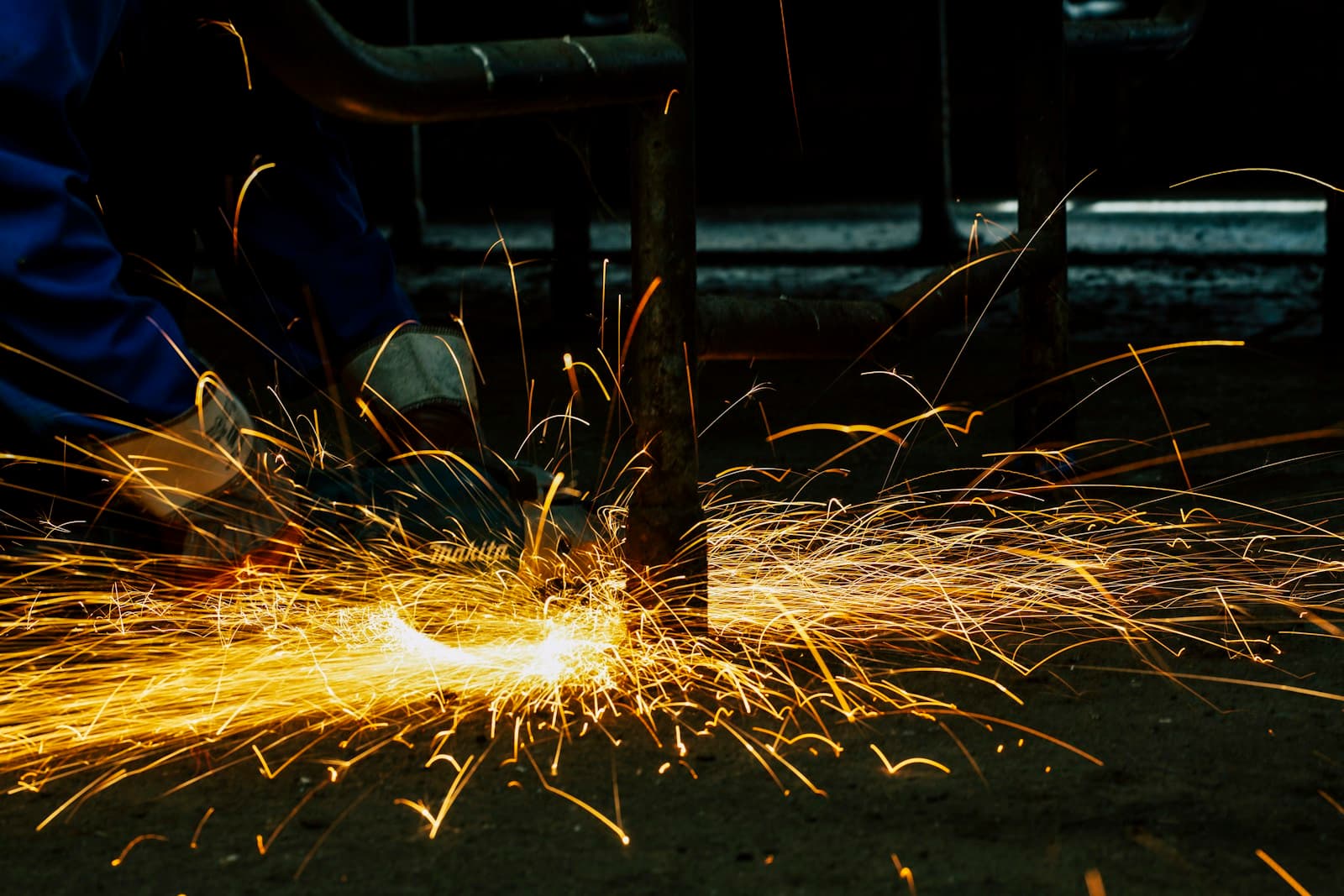
Procurement guide for industrial fire blankets and welding protection blankets. Covers EN 1869 Class 1/2/3, CE marking verification, fiberglass vs silica vs ceramic selection, and red flags for uncertified products.
The Problem With "Certified" Welding Blankets
Two blankets look identical. One costs ฿800 per square metre, the other ฿400. Both claim EN 1869 compliance. The difference? One passed an accredited third-party test. The other has a sticker applied by the importer.
For procurement officers sourcing fire protection materials for Thai factories, understanding what EN 1869 actually requires — and how to verify it — prevents both safety failures and wasted budget.
What EN 1869:2019 Tests
EN 1869 is the European standard for fire blankets. The 2019 revision tightened performance requirements significantly over the 1997 version.
The standard evaluates three properties:
1. Fire extinguishing effectiveness The blanket is used to extinguish a standardised Class F cooking oil fire (pan fire simulation). The blanket must fully suppress the fire within a defined time.
2. Heat transfer protection Temperature sensors measure how much heat passes through the blanket to the side facing the user. This matters when a blanket is used to wrap a person evacuating through a fire zone.
3. Post-use integrity After fire suppression, the blanket must hold together — it must not fragment, which could leave burning material exposed.
EN 1869 Class 1, 2 and 3
| Class | Intended Use | Minimum Size |
|---|---|---|
| Class 1 | Kitchen / small domestic fires | ≥ 1.0 × 1.0 m |
| Class 2 | Commercial kitchens, light industrial | ≥ 1.2 × 1.2 m |
| Class 3 | Full-body protection for evacuation | ≥ 1.8 × 1.8 m |
Important distinction for factories: EN 1869 classifies fire blankets for fire suppression. Most industrial welding protection blankets are weld-area protection products — a separate application. A blanket spec should reference both EN 1869 (if applicable) and the welding-specific performance test (e.g., NFPA 701 for flame spread).
How to Verify a Real Certificate
Genuine certification includes:
✓ Name and number of the Notified Body (NB) — e.g., TÜV SÜD (NB 0123), Bureau Veritas, SGS ✓ Specific standard version: "EN 1869:2019" not just "EN 1869" ✓ Test report number with accreditation number of testing lab ✓ Declaration of Conformity (DoC) matching the specific product SKU ✓ Certificate expiry date within validity period
Red flags:
✗ "Meets EN 1869" with no test report number ✗ CE marking with no DoC document available ✗ Notified Body number not found at ec.europa.eu/growth/tools-databases/nando ✗ Certificate covers a different product than what's being supplied ✗ Price 40%+ below market with no explanation
Material Selection: Match the Blanket to the Temperature
| Material | Max Temp | Relative Cost | Best For |
|---|---|---|---|
| Fiberglass | 550°C | ฿ | MIG/MAG welding, grinding sparks, general welding |
| Fiberglass + Vermiculite | 550°C | ฿฿ | Heavy slag and spatter |
| Fiberglass + Silicone | 550°C | ฿฿ | Combined chemical and spark protection |
| Silica (>96% SiO₂) | 1,000°C | ฿฿฿ | TIG/arc welding, foundry, oxy-fuel cutting |
| Ceramic Fiber | 1,260°C | ฿฿฿฿ | Furnace curtains, kilns, continuous high-temperature |
| Bio-Soluble Ceramic (BSC) | 1,260°C | ฿฿฿฿ | High-temp applications where RCF (refractory ceramic fiber) exposure is regulated |
Practical guidance for most Thai factories: Silica 1,000°C covers MIG, TIG, and arc applications at a price point that's reasonable. Fiberglass is adequate for light MIG/MAG work where maximum temperature rarely exceeds 400°C.
Standard Sizes and Custom Options
Standard stock sizes: 1×1m, 1×2m, 2×2m, 1×50m roll Custom widths: up to 2m standard, wider available by order Custom cuts: available for specific equipment shrouds or pipeline wrap applications
Procurement Checklist
Before ordering — request these documents:
- EN 1869:2019 test report from accredited lab
- DoC (Declaration of Conformity)
- SiO₂ content % specification (silica blankets must be >96%)
- Weight g/m² specification (thinner = lower performance)
- Safety Data Sheet (SDS) for any coating (silicone, vermiculite, PTFE)
On receipt inspection:
- Dimensions within ±2% of order spec
- No holes, tears, or scorch marks in the fabric
- Edges neatly finished — no loose fibres that indicate poor quality control
Request certificates and samples: +66 2-096-2118 | +66 83-494-6958 Sahawatthanakit (1988) Co., Ltd. — Nonthaburi, Thailand Request a Quote →
Get this guide as a reference brief (PDF)
Summary + full section list + standards cited, Saha-branded for your memo/RFQ — emailed to you too.
Questions after reading? Talk to our engineers
Tell us what you need — our engineers help you spec it right, with a real quote. No charge.
Need help with this in your facility?
Our team handles full procurement and installation for the topics covered in this article. Free quote within 2 hours.
Another line of ours — spreadsheet tools for SMEs
Quote Register + Win Rate (Thai + English editions)
For quotes that go silent — one row per quote, telling you which to chase today and what your real win rate is.
Comparison tables related to this article
Related content
Fire Watch Duration After Hot Work — OSHA 30 Minutes vs NFPA 51B 60 Minutes
Why fire watch requirements after hot work say both 30 and 60 minutes — comparing OSHA 1910.252 / 1915.504 / 1926.352 against NFPA 51B's 60-minute watch plus up to 3 hours of fire monitoring.
Metal Fabrication / Machine-Shop Fit-Out and Maintenance Field Guide — Safe Hot Work to NFPA 51B + Fire Blankets · Sa 2.5 Surface Prep to ISO 8501 · ISO 12944 Coating Systems + Zinc-Rich Primer · DFT/Holiday Inspection · Machine Lubrication + ISO 8573 Compressed Air + Electrical Safety + How to Lock In Material Pricing
Field guide for metal fabrication / machine-shop / structural-steel workshop owners and supervisors: plan the whole workshop by function — control hot work (weld/cut/grind) per NFPA 51B with the right fire-blanket grade (EN 1869/FM 4950), prepare steel to Sa 2.5 per ISO 8501 before coating, choose a corrosion coating system per ISO 12944 by environment class (C1-CX) with zinc-rich primer/powder/liquid, inspect dry film thickness (ISO 19840/SSPC-PA2) and holidays, lubricate machinery (hydraulic/gear/grease) + monitor oil/bearing condition, control compressed-air quality (ISO 8573) for abrasive blasting and spraying, and manage electrical safety (arc flash NFPA 70E) + cranes/hoists (ASME B30) — plus how to standardize materials to lock pricing and delivery.
Welding Blanket Grade Selection — Spatter / Slag / Molten Metal Scale by Application
Select a welding blanket by welding process (MIG/MAG/TIG/Arc/Plasma/Oxy-fuel) — spatter, slag, molten-metal heat load — standards EN 1869, NFPA 701, ASTM E2307, FM 4950 — comparing fiberglass 550°C, silica 1000°C, ceramic 1260°C.
Hot Work Permit OSHA 1910.252 + NFPA 51B — Flow and Documents Thai Factories Need
Hot Work Permit guide per OSHA 1910.252 + NFPA 51B + AWS F4.1 + ANSI Z49.1 — flow chart, signature requirements, fire watch duration, fire prevention checklist, application to Thai factories