
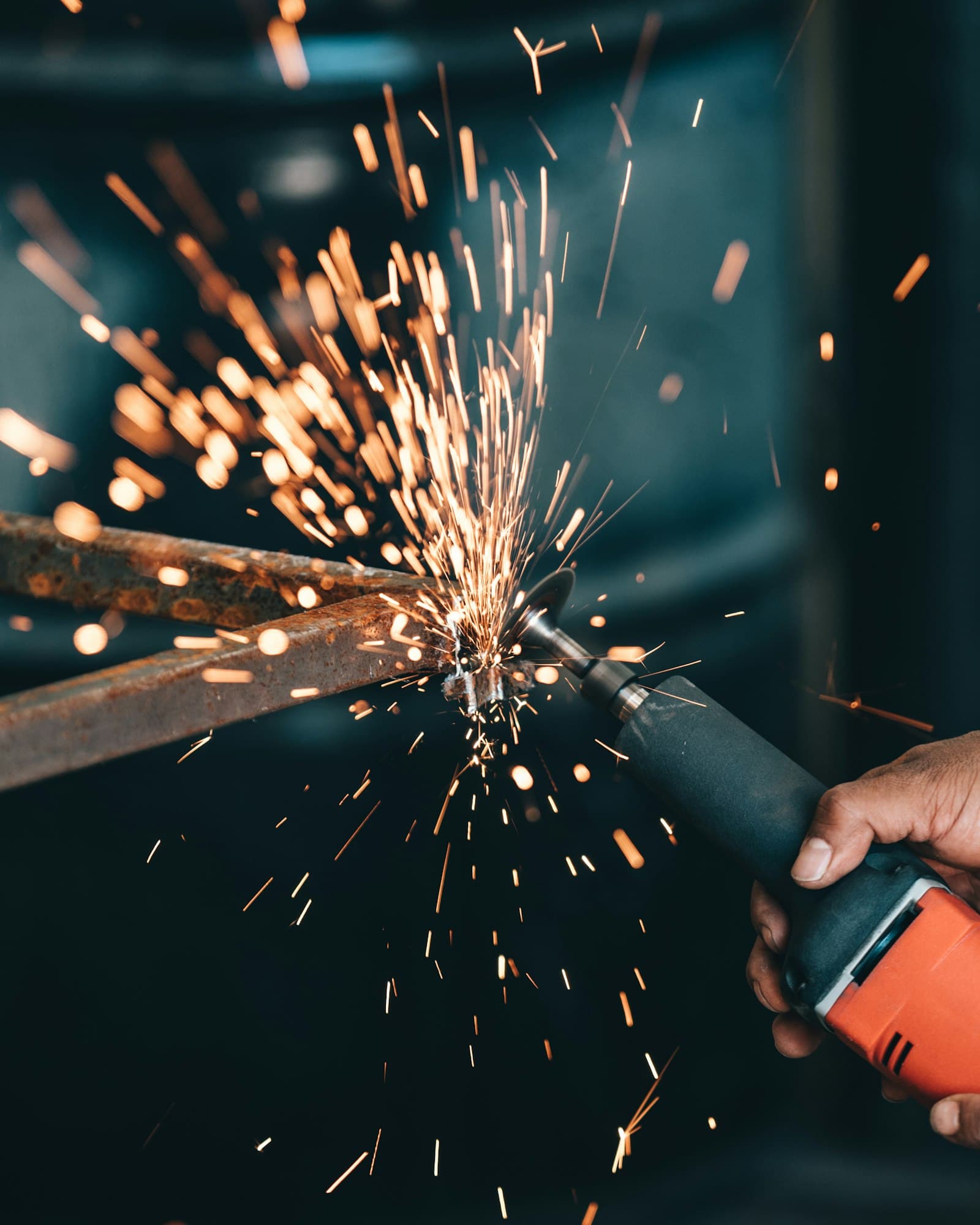
Why fire watch requirements after hot work say both 30 and 60 minutes — comparing OSHA 1910.252 / 1915.504 / 1926.352 against NFPA 51B's 60-minute watch plus up to 3 hours of fire monitoring.
Thai supervisors typically remember "watch the area for 30 minutes" from an older EHS manual, then get rejected in an audit because the client's specification cites NFPA 51B and its 60-minute figure. Both numbers come from real standards. This article shows where each comes from and which one to write into a permit.
When a fire watch is mandatory
OSHA 29 CFR 1910.252(a)(2)(iii)(A) requires fire watchers "whenever welding or cutting is performed in locations where other than a minor fire might develop," then defines four specific triggers.
flowchart TD
  A["Hot work starts
weld / cut / grind"] --> B{"Combustibles
within 35 ft
10.7 m ?"}
  B -- Yes --> F["Fire watch required"]
  B -- No --> C{"Beyond 35 ft but
easily ignited
by sparks ?"}
  C -- Yes --> F
  C -- No --> D{"Wall or floor openings
within 35 ft radius ?"}
  D -- Yes --> F
  D -- No --> E{"Combustibles on
opposite side of metal
wall / ceiling / roof ?"}
  E -- Yes --> F
  E -- No --> G["Not mandatory
extinguishing equipment
still required"]
The fourth trigger is the one most often missed. Welding on metal cladding conducts heat to the far side, so a welding blanket on the working face does not remove the requirement.
Three OSHA standards, three answers
| Standard | Scope | Duration after work ends |
|---|---|---|
| 29 CFR 1910.252(a)(2)(iii)(B) | General industry | ≥ 30 minutes — "at least a half hour after completion" |
| 29 CFR 1915.504(c)(2)(iv) | Shipyard employment | ≥ 30 minutes, unless a survey finds no remaining fire hazard |
| 29 CFR 1926.352(e) | Construction | No number — "a sufficient period of time" |
State rules do not settle it either. California Code of Regulations Title 8 § 6777(g)(6) only requires the permit to state "any special precautions or limitations to be observed before, during or after the use of the source of ignition, including the need for fire watch" — delegating the duration to the permit issuer.
NFPA 51B: 60 minutes, then monitoring
NFPA 51B splits the post-work period in two. CCOHS, the Canadian government occupational health agency, summarises the requirement as a trained fire watcher posted in the work area for at least 60 minutes after work has stopped, with the area monitored afterwards for up to 3 or more hours depending on the work until fire hazards no longer exist.
flowchart LR
  T0["T+0
work stops"] --> A["0–30 min
OSHA 1910.252
legal minimum"]
  A --> B["30–60 min
NFPA 51B
full fire watch"]
  B --> C["60 min – 3 hr
fire monitoring
periodic re-check"]
  C --> D["Close permit
sign area released"]
A fire watch means continuous presence with extinguishing equipment at hand. Fire monitoring means periodic re-inspection — typically every 30 minutes — which costs far less labour across a multi-job day. CCOHS also references CSA W117.2-12 (R2017) and ANSI Z49.1:2021 for welding safety.
The reason the post-work window matters at all is smouldering. OSHA states the purpose of the half-hour plainly: to "detect and extinguish possible smoldering fires." Sparks landing in dust, insulation or a floor void burn without flame for a long time, and that development time is governed by fuel and airflow, not by the number 30.
Practical guidance
- Set 60 minutes as the internal standard. It satisfies OSHA's ≥30 and NFPA 51B simultaneously, and prevents two internal documents from contradicting each other during an audit.
- Record watch start time, end time and the watcher's signature on the permit — not just a tick box. A missing clock time is the easiest finding for an inspector.
- Reserve the 3-hour monitoring rule for high-risk work: roof work over insulation, work near cable trays or duct penetrations, dusty areas, and thick-plate oxy-fuel cutting.
- Never let the welder be their own fire watch, per OSHA 1915.504(c)(2)(i) and (c)(3).
- Inspect welding blankets before each job. Burn-through holes let sparks reach places the fire watch cannot see, which defeats the watch period entirely.
- State the duration in the contract or tender specification. Otherwise a contractor can fall back on 1926.352(e), which carries no number, and pack up as soon as the weld cools.
Summary
Thirty minutes is the US legal floor for general industry and shipyards. Sixty minutes is the NFPA 51B benchmark most international specifications and insurers reference, followed by up to three hours of monitoring on high-risk work. Thai regulation does not fix this number directly, so it must be set by the organisation and written into the permit and the tender specification.
Sahawatthanakit (1988) supplies welding blankets and hot work equipment with standards-referenced specifications suitable for tender documents.
Get this guide as a reference brief (PDF)
Summary + full section list + standards cited, Saha-branded for your memo/RFQ — emailed to you too.
Questions after reading? Talk to our engineers
Tell us what you need — our engineers help you spec it right, with a real quote. No charge.
Need help with this in your facility?
Our team handles full procurement and installation for the topics covered in this article. Free quote within 2 hours.
Another line of ours — spreadsheet tools for SMEs
Quote Register + Win Rate (Thai + English editions)
For quotes that go silent — one row per quote, telling you which to chase today and what your real win rate is.
Frequently Asked Questions
1Is the fire watch 30 minutes or 60 minutes?
+
2Can the area be released once 60 minutes have passed?
+
3What does the OSHA construction standard require?
+
4When is a fire watch mandatory?
+
5Can the welder act as their own fire watch?
+
Comparison tables related to this article
Related content
Metal Fabrication / Machine-Shop Fit-Out and Maintenance Field Guide — Safe Hot Work to NFPA 51B + Fire Blankets · Sa 2.5 Surface Prep to ISO 8501 · ISO 12944 Coating Systems + Zinc-Rich Primer · DFT/Holiday Inspection · Machine Lubrication + ISO 8573 Compressed Air + Electrical Safety + How to Lock In Material Pricing
Field guide for metal fabrication / machine-shop / structural-steel workshop owners and supervisors: plan the whole workshop by function — control hot work (weld/cut/grind) per NFPA 51B with the right fire-blanket grade (EN 1869/FM 4950), prepare steel to Sa 2.5 per ISO 8501 before coating, choose a corrosion coating system per ISO 12944 by environment class (C1-CX) with zinc-rich primer/powder/liquid, inspect dry film thickness (ISO 19840/SSPC-PA2) and holidays, lubricate machinery (hydraulic/gear/grease) + monitor oil/bearing condition, control compressed-air quality (ISO 8573) for abrasive blasting and spraying, and manage electrical safety (arc flash NFPA 70E) + cranes/hoists (ASME B30) — plus how to standardize materials to lock pricing and delivery.
Welding Blanket Grade Selection — Spatter / Slag / Molten Metal Scale by Application
Select a welding blanket by welding process (MIG/MAG/TIG/Arc/Plasma/Oxy-fuel) — spatter, slag, molten-metal heat load — standards EN 1869, NFPA 701, ASTM E2307, FM 4950 — comparing fiberglass 550°C, silica 1000°C, ceramic 1260°C.
Welding Blankets — Prices and Suppliers in Thailand 2026 — Fiberglass / Silica / Ceramic
Compare the prices of 3 types of welding blanket in Thailand 2026, with a property table, how to choose by application, and standard-compliant suppliers meeting EN 1869 and FM4950
Hot Work Permit OSHA 1910.252 + NFPA 51B — Flow and Documents Thai Factories Need
Hot Work Permit guide per OSHA 1910.252 + NFPA 51B + AWS F4.1 + ANSI Z49.1 — flow chart, signature requirements, fire watch duration, fire prevention checklist, application to Thai factories