
Fiberglass 550°C 1×2m priced ฿380-650 — Silica 1000°C 1×2m ฿1,400-2,200 — Ceramic 1260°C 1×2m ฿2,800-4,500 — choose by welding process: MIG/MAG=fiberglass, Arc+oxy-cut=silica, Foundry+heavy plate=ceramic — standards EN 1869 + ASTM E2307
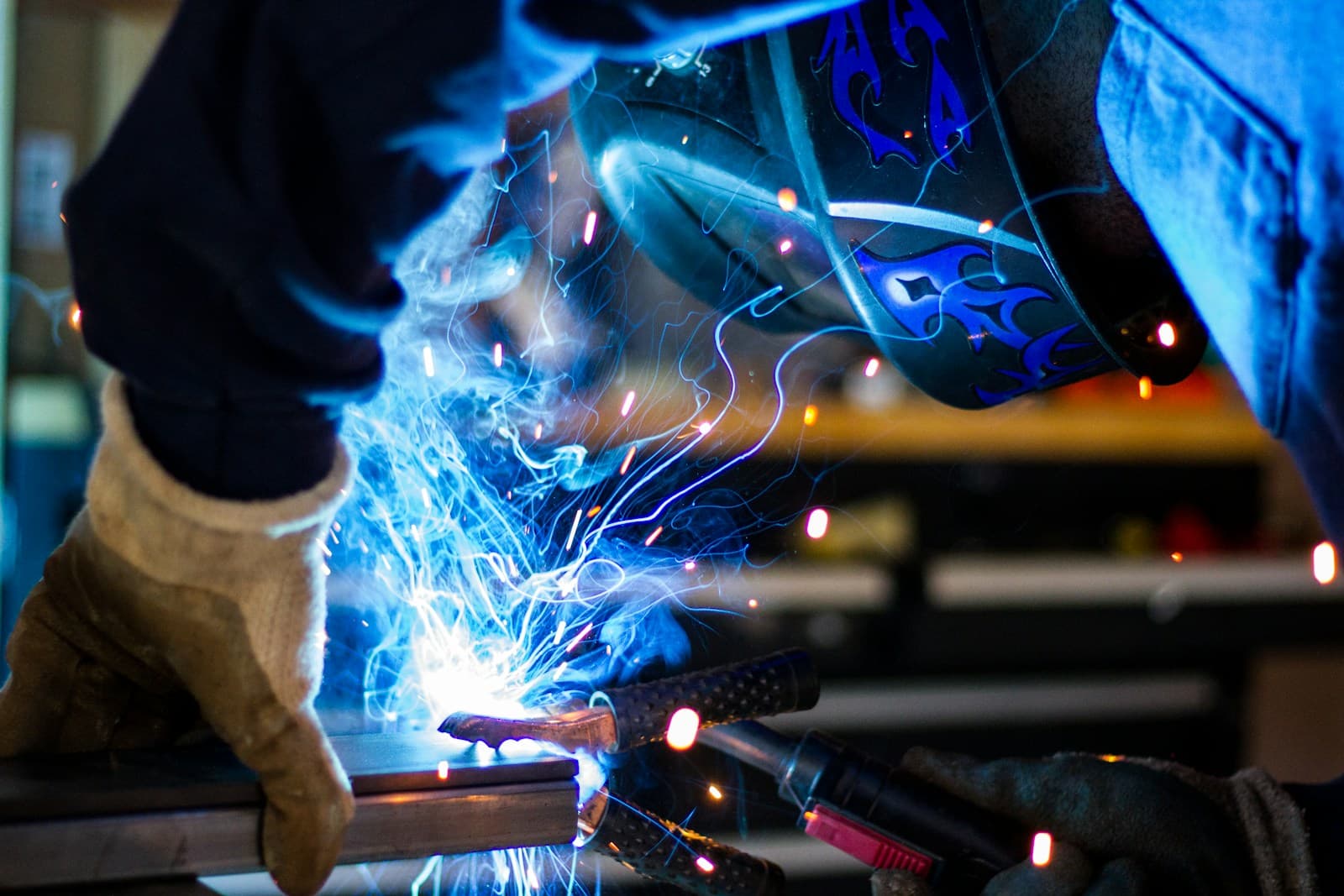
In metal welding, cutting, grinding, and any operation that produces sparks or high heat, the welding blanket is the most important protective layer for personnel, equipment, and surrounding structures.
Choosing the right welding blanket for the job is not easy, because the market offers many types at many price points with widely varying quality. This article helps buyers understand the differences, current market prices, and how to buy a product that is both cost-effective and safe.
How Many Types of Welding Blanket Are There?
Welding blankets in the Thai market are divided into 3 main types according to the material they are woven from:
1. Fiberglass
The most basic material, made from E-glass or C-glass fibers woven into a sheet. The cheapest of the three, it withstands temperatures of approximately 500–550°C continuously.
Suitable for: general MIG/MAG welding, steel cutting, splatter protection — shielding equipment and cables from flying sparks
2. Silica
Woven from High-Silica fibers (SiO₂ ≥ 96%), it withstands temperatures significantly higher than Fiberglass, up to 900–1,000°C continuously, and can withstand a short arc flash up to 1,600°C.
Suitable for: TIG welding, high-energy arc welding, work near metal casting furnaces, and work involving molten metal splash
3. Ceramic
The top material in the group, woven from ceramic fibers (Aluminosilicate or Bio-Soluble Ceramic), withstanding the highest temperatures up to 1,260°C continuously. Used in heavy industry and applications requiring high-grade heat insulation.
Suitable for: smelting furnaces, kilns, steel mills, casting processes, and high-temperature petrochemical work
Comparison Table of the 3 Types of Welding Blanket
| Property | Fiberglass | Silica | Ceramic |
|---|---|---|---|
| Material | E-glass / C-glass ≥ 70% SiO₂ | High-Silica ≥ 96% SiO₂ | Aluminosilicate / Bio-Soluble |
| Continuous temperature resistance | 500–550°C | 900–1,000°C | 1,100–1,260°C |
| Short-term (flash) temperature resistance | ~800°C | ~1,600°C | ~1,600°C+ |
| Approximate price (1×1 m) | 300–600 baht | 800–1,800 baht | 1,500–4,000 baht |
| Weight | Light | Medium | Heaviest |
| Flexibility | Good | Good | Medium–low |
| Reusable | Yes (limited) | Yes | Yes (if undamaged) |
| Main standards | EN 1869, NFPA 701 | EN 1869, FM4950 | ASTM C610, ISO 10635 |
🔥 Get the grade before the price. Grades differ in cost by several times over — run your temperature and job type through the Welding Blanket Selector first, then read the price band for that grade.
Welding Blanket Prices in the Thai Market 2026
Prices depend on material, size, thickness, and brand. Below are reference price ranges for the Thai market:
Fiberglass Welding Blanket
| Size | Weight per m² | Approximate price (baht/sheet) |
|---|---|---|
| 1 × 1 meter | 600 g/m² | 300–500 |
| 1 × 2 meter | 600 g/m² | 550–900 |
| 2 × 2 meter | 600 g/m² | 1,000–1,600 |
| 2 × 3 meter | 900 g/m² | 1,800–2,800 |
Silica Welding Blanket
| Size | Weight per m² | Approximate price (baht/sheet) |
|---|---|---|
| 1 × 1 meter | 1,000 g/m² | 800–1,400 |
| 1 × 2 meter | 1,000 g/m² | 1,400–2,500 |
| 2 × 2 meter | 1,200 g/m² | 2,500–4,500 |
| Roll (30 m long) | 1,000 g/m² | Special price — inquire |
Ceramic Blanket / Ceramic Fiber Blanket
| Size | Thickness | Approximate price (baht/sheet) |
|---|---|---|
| 600 × 900 mm | 25 mm (1 inch) | 1,500–2,500 |
| Roll 1 m × 7.2 m | 50 mm (2 inch) | 4,500–8,000 |
| 1 × 2 meter (Bio-Soluble) | 25 mm | 2,200–4,000 |
Note: The prices above are retail prices. Bulk-lot orders qualify for special pricing — inquire with the sales department.
How to Choose a Welding Blanket Suited to the Job
Basic Selection Rule
The maximum process temperature is the primary factor:
- Below 550°C (general MIG/MAG welding, general plasma cutting) → Fiberglass is sufficient and the most cost-effective
- 550–1,000°C (TIG welding, high arc flash, work near smelting furnaces) → Silica is required
- Above 1,000°C (kilns, steel mills, casting, petrochemical) → Ceramic only
Steps for Choosing the Size
- Measure the area to be covered — the blanket must extend beyond the work edge by at least 30 cm on every side.
- Consider reuse — for one-time jobs, use the cheaper Fiberglass; for recurring jobs, investing in Silica is more worthwhile in the long run.
- Check whether it must be hung or laid — long-term suspended applications require a blanket with greater mechanical strength (Silica > Fiberglass).
Standards to Know Before Buying
EN 1869:2019 — European Standard for Fire Blankets
EN 1869 specifies testing requirements for fire blankets, including welding blankets in certain applications, covering:
- Resistance to direct flame
- Ability to extinguish small fires (for fire blankets)
- Marking and packaging requirements
NFPA 701 — Standard for Flame Propagation Testing in Textiles
NFPA 701 specifies flame-propagation test methods for textiles and films. Used as a reference for welding blankets used in buildings and high-risk areas.
FM 4950 — Factory Mutual Standard
FM Global sets the FM 4950 standard for thermal barrier materials. Welding blankets that pass FM Approval are considered to have fire-resistance and heat-barrier properties at a level acceptable for areas insured by FM Global.
OSHA 1910.252 — Welding Safety Requirements
OSHA requires that welding, cutting, and grinding work areas have appropriate protection, including the use of protective blankets to prevent sparks from flying onto flammable materials or personnel in the vicinity.
Standard Sizes Available in Thailand
| Blanket size (width × length) | Common use |
|---|---|
| 0.5 × 0.5 meter | Protecting small points, cables, valves |
| 1 × 1 meter | General welding, pipe protection |
| 1 × 2 meter | Under-vehicle work, in-pipe work, protecting wide floors |
| 1.5 × 1.5 meter | Construction work, ship repair |
| 2 × 2 meter | Medium-sized structural welding |
| 2 × 3 meter | Large structural work, factories |
| Roll (30–50 m long) | Cut to the required size |
Sahawatthanakit imports welding blankets from manufacturers certified to ISO standards and holding EN 1869 test certificates — a Test Report can be requested for every item.
Common Mistakes When Buying
1. Choosing Fiberglass for a Job That Requires Silica
Many factories buy Fiberglass because it is cheap but use it on high-energy arc welding. The result is that the blanket deteriorates quickly, ending up costing more in frequent repurchases than if Silica had been invested in from the start.
2. Buying a Size Too Small for the Job
A welding blanket must fully cover the work area with a margin. A blanket that is too small leaves gaps for sparks to pass through.
3. Not Checking Lot Number and Documentation
Low-quality welding blankets from unreliable sources are mixed into the market. Always request a Test Certificate and SDS.
4. Layering to Substitute for a Higher Grade
Stacking 2–3 layers of Fiberglass does not provide a result equivalent to a single layer of Silica, because the maximum temperature resistance of each fiber type is a fixed limit.
Maintenance and Service Life
- Fiberglass: typical service life of 6–18 months in general welding; inspect for tears, holes, or loose fibers before every use.
- Silica: more durable, with a service life of 2–5 years in normal use, but beware of oil/chemical contamination that reduces its properties.
- Ceramic: long service life, but more brittle when degraded; must be stored in a dry place and protected from impact.
Ordering and Price Inquiries
Sahawatthanakit (1988) Co., Ltd. distributes welding blankets nationwide, with tax invoices.
- Tel: 02-096-2118 / 061-541-6939 (Khun Chin)
- Email: info@sahawatthanakit1988.com
- LINE: @sahawatt1988
- Web: sahawatthanakit1988.com
- Monday–Saturday 08:00–17:00
- Nationwide delivery | Express delivery to Bangkok / Nonthaburi / Pathum Thani
Provide the size, quantity, and type of work to receive advice from our engineering team and a quotation within 24 hours.
Get this guide as a reference brief (PDF)
Summary + full section list + standards cited, Saha-branded for your memo/RFQ — emailed to you too.
Questions after reading? Talk to our engineers
Tell us what you need — our engineers help you spec it right, with a real quote. No charge.
Need help with this in your facility?
Our team handles full procurement and installation for the topics covered in this article. Free quote within 2 hours.
Another line of ours — spreadsheet tools for SMEs
Quote Register + Win Rate (Thai + English editions)
For quotes that go silent — one row per quote, telling you which to chase today and what your real win rate is.
Comparison tables related to this article
Related content
Welding Blanket Grade Selection — Spatter / Slag / Molten Metal Scale by Application
Select a welding blanket by welding process (MIG/MAG/TIG/Arc/Plasma/Oxy-fuel) — spatter, slag, molten-metal heat load — standards EN 1869, NFPA 701, ASTM E2307, FM 4950 — comparing fiberglass 550°C, silica 1000°C, ceramic 1260°C.
Fire Watch Duration After Hot Work — OSHA 30 Minutes vs NFPA 51B 60 Minutes
Why fire watch requirements after hot work say both 30 and 60 minutes — comparing OSHA 1910.252 / 1915.504 / 1926.352 against NFPA 51B's 60-minute watch plus up to 3 hours of fire monitoring.
Metal Fabrication / Machine-Shop Fit-Out and Maintenance Field Guide — Safe Hot Work to NFPA 51B + Fire Blankets · Sa 2.5 Surface Prep to ISO 8501 · ISO 12944 Coating Systems + Zinc-Rich Primer · DFT/Holiday Inspection · Machine Lubrication + ISO 8573 Compressed Air + Electrical Safety + How to Lock In Material Pricing
Field guide for metal fabrication / machine-shop / structural-steel workshop owners and supervisors: plan the whole workshop by function — control hot work (weld/cut/grind) per NFPA 51B with the right fire-blanket grade (EN 1869/FM 4950), prepare steel to Sa 2.5 per ISO 8501 before coating, choose a corrosion coating system per ISO 12944 by environment class (C1-CX) with zinc-rich primer/powder/liquid, inspect dry film thickness (ISO 19840/SSPC-PA2) and holidays, lubricate machinery (hydraulic/gear/grease) + monitor oil/bearing condition, control compressed-air quality (ISO 8573) for abrasive blasting and spraying, and manage electrical safety (arc flash NFPA 70E) + cranes/hoists (ASME B30) — plus how to standardize materials to lock pricing and delivery.
Hot Work Permit OSHA 1910.252 + NFPA 51B — Flow and Documents Thai Factories Need
Hot Work Permit guide per OSHA 1910.252 + NFPA 51B + AWS F4.1 + ANSI Z49.1 — flow chart, signature requirements, fire watch duration, fire prevention checklist, application to Thai factories