
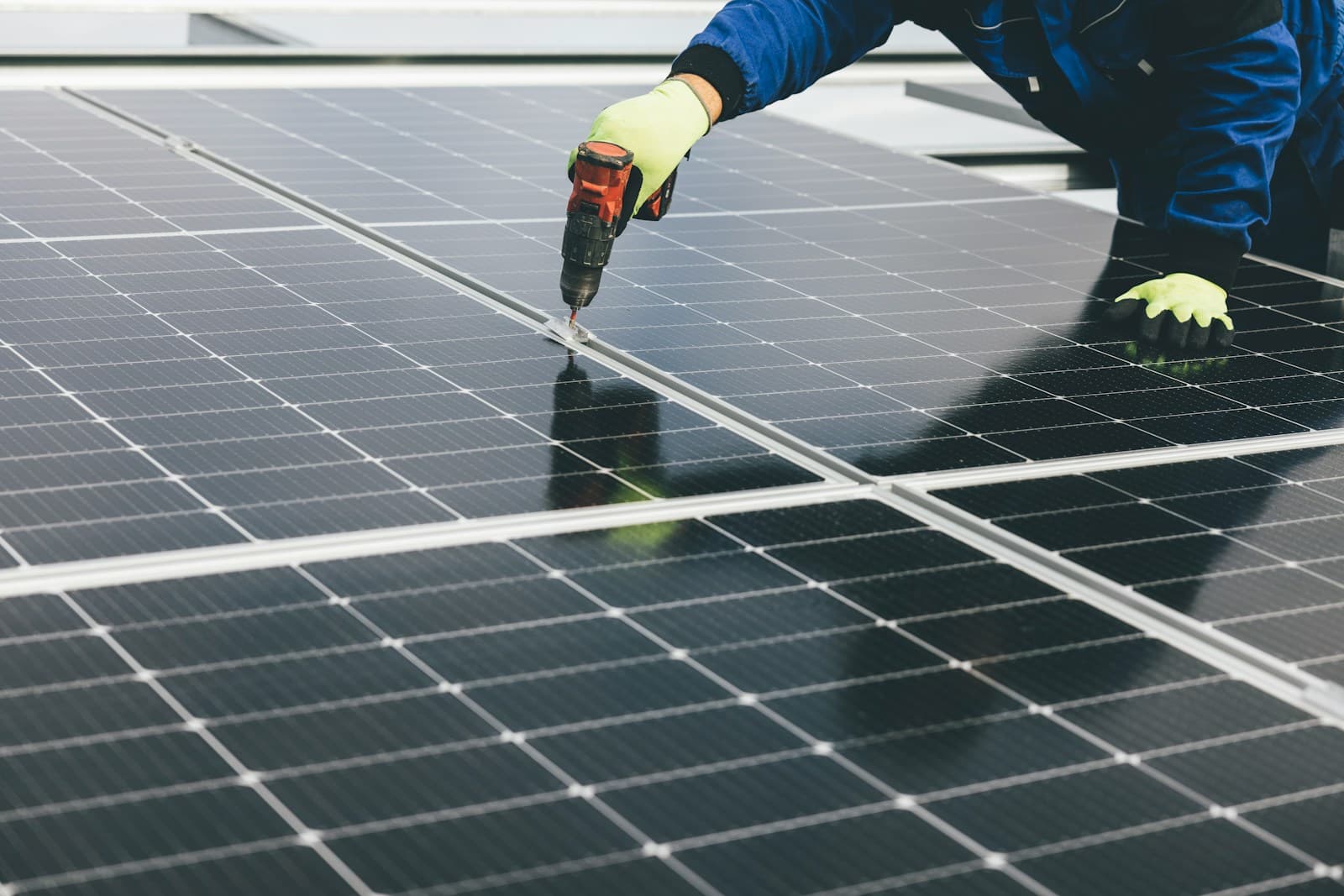
Compare Tier 1 vs Tier 2 PV modules per BNEF (BloombergNEF) classification — meaning, Top brands 2024, bankability, IEC 61215 + IEC 61730 standards, degradation rates, 25-year ROI selection
Why Tier 1 vs Tier 2 Matters for Factory Owners
500 kWp Solar Rooftop project:
- Investment: ฿7-9M
- Project life: 25 years
- Risk: If panel manufacturer fails in first 10 years → warranty worthless + replacement panels hard to source
Tier 1 = insurance policy that manufacturer will exist + warranty stays enforceable. Not technical quality per se.
Real example: Solar farm 1 MWp in Nakhon Ratchasima, installed Tier 2/3 Chinese panels in 2014 — manufacturer closed in 2019 — replacement cost ฿2.8M (original ฿4.5M) + 18 months to find suitable substitute.
BNEF Tier 1 Criteria
flowchart TD
    A[PV Manufacturer Applies] --> B{Manufactures own panels?}
    B -->|No - OEM/rebrand| Reject1[Disqualify]
    B -->|Yes| C{Sales to projects
with non-recourse loans?}
    C -->|No| Reject2[Disqualify - no bankability]
    C -->|Yes - ≥1 project| D{From ≥6 different commercial banks?}
    D -->|No - 1-5 banks| Tier2[Tier 2 - acceptable but not bankable]
    D -->|Yes - 6+ banks| E{Within past 2 years?}
    E -->|No - older deals| Tier2
    E -->|Yes - recent| Tier1[BNEF Tier 1 Status]
    Tier1 --> Recheck[Re-verified each quarter]
Key insight: No official "Tier 3" exists — only Tier 1 (bankable) vs Non-Tier 1 (everything else). "Tier 2" is informal trade terminology.
Top BNEF Tier 1 Manufacturers 2024
By Global Shipment (2023 data)
| Rank | Brand | Country | 2023 Shipment (GW) | Tech Focus |
|---|---|---|---|---|
| 1 | LONGi Green Energy | China | 67.5 | Mono PERC + N-type HJT |
| 2 | JinkoSolar | China | 56.0 | Mono PERC + TOPCon |
| 3 | JA Solar | China | 47.3 | Mono PERC + TOPCon |
| 4 | Trina Solar | China | 42.0 | Mono PERC + TOPCon |
| 5 | Canadian Solar | Canada/China | 30.8 | Mono PERC + Hi-MO |
| 6 | Risen Energy | China | 17.5 | Mono PERC |
| 7 | Tongwei Solar | China | 17.0 | Mono PERC + HJT |
| 8 | First Solar | USA | 13.2 | CdTe thin-film |
| 9 | Yingli | China | 7.5 | Mono PERC |
| 10 | Q CELLS (Hanwha) | S.Korea/Germany | 7.0 | Q.ANTUM PERC + DUO Z |
Thailand Pricing (latest month)
| Brand | Power Class | Price (฿/Wp installed) | Stock Lead Time |
|---|---|---|---|
| JinkoSolar Tiger Neo | 580W N-type TOPCon | 16-18 | 7-14 days |
| LONGi Hi-MO 6 | 580W Mono PERC | 15-17 | 5-10 days |
| JA Solar DeepBlue 4.0 | 570W Mono PERC | 15-17 | 7-14 days |
| Trina Vertex N | 590W N-type TOPCon | 17-19 | 10-14 days |
| Canadian Solar TOPHiKu | 580W TOPCon | 16-18 | 14-21 days |
| First Solar Series 6 Plus | 470W CdTe | 22-26 | 21-28 days |
Tier 1 vs Tier 2 — Side-by-Side
| Feature | Tier 1 | Tier 2 | No-Name |
|---|---|---|---|
| BNEF status | Listed | Not listed | Not listed |
| Bank financing | ✓ Yes | Case-by-case | ✗ Usually rejected |
| IEC 61215 cert | ✓ Standard | ✓ Most have | Often fake/missing |
| IEC 61730 safety | ✓ Standard | ✓ Most have | Often missing |
| Linear 25-yr warranty | ✓ Standard | Step warranty common | ✗ 5-10 yr only |
| Degradation rate | 0.5-0.7%/yr | 0.7-1.2%/yr | 2-5%/yr |
| Power output tolerance | +0/+5% positive | ±3% bilateral | Up to -10% |
| Insurance coverage | Easy | Premium higher | Hard |
| Manufacturer survival risk | Low | Medium | High |
| Price premium vs No-Name | +20-40% | +10-20% | baseline |
Critical Test Standards
IEC 61215 — Design Qualification
- Thermal cycling 200 cycles (-40°C to +85°C)
- Damp heat 1,000 hours @ 85°C/85% RH
- Hail impact test (25mm ice at 23 m/s)
- Mechanical load 2,400 Pa snow + 5,400 Pa wind
- Pass: >95% power output after all tests
IEC 61730 — Safety
- Fire safety (UL 1703 cross-ref)
- Electrical safety (insulation, dielectric strength)
- Mechanical safety (frame, junction box)
IEC 61853 — Energy Rating
- 5 measurements at different temperature/irradiance
- Realistic energy yield prediction
PVEL Module Reliability Scorecard (annual)
Independent extended tests:
- Thermal cycling 600 cycles (vs IEC 200)
- Damp heat 2,000 hr (vs IEC 1,000)
- Dynamic mechanical load (DML)
- Potential Induced Degradation (PID) extended
- "Top Performer" badge = pass all 6
Real-World Degradation Data
Fraunhofer ISE Study (2024)
| Technology | Year-1 LID | Annual degradation | 25-yr Remaining |
|---|---|---|---|
| Mono PERC (older) | -2 to -3% | -0.6 to -0.8%/yr | 76-80% |
| Mono PERC (new, 2020+) | -1 to -1.5% | -0.45 to -0.55%/yr | 82-86% |
| N-type TOPCon | -0.5 to -1% | -0.35 to -0.45%/yr | 87-91% |
| N-type HJT | -0.3 to -0.8% | -0.25 to -0.35%/yr | 89-93% |
| Thin-film (CdTe) | -1.5 to -2% | -0.45 to -0.6%/yr | 82-85% |
Implication: Newer N-type TOPCon costs 5-10% more but yields 5-8% more over 25 yr.
Saha Thai Customer Cases (2018-2024)
- LONGi Mono PERC (Bangkok): 0.62%/yr · 4.0% after 6 yr
- JinkoSolar Tiger (Rayong): 0.58%/yr · 3.7% after 6 yr
- Trina Vertex N TOPCon (Chonburi): 0.42%/yr · 2.5% after 6 yr
All within Fraunhofer prediction range.
Common Mistakes
1. "All panels are the same" — WRONG
Compare on LCOE (Levelized Cost of Energy) over 25 yr, not unit price.
2. "Buy cheap, replace early"
Replacement labor expensive + downtime. Panel life is 25+ yr; don't plan for early replacement.
3. "Generic spec — let installer choose"
Installer picks highest margin to themselves. Spec at TIS 1843 + IEC 61215 + IEC 61730 minimum + BNEF Tier 1 in TOR.
4. "Tier 1 too expensive for SME"
On 100 kWp project, Tier 1 premium is ฿200-400K but produces 15-20% more energy = ฿1.5-2M extra revenue over 25 yr.
5. "Used Tier 1 to save"
Unknown degradation history + reduced warranty + no insurance. Only buy new Tier 1 with factory cert.
Selection Framework
flowchart TD
    Start[Project Size?] --> Q1{< 50 kWp residential?}
    Q1 -->|Yes| Resi[Tier 1 mono PERC
LONGi Hi-MO 6]
    Q1 -->|No| Q2{50-500 kWp SME?}

    Q2 -->|Yes| SME[Tier 1 N-type TOPCon
JinkoSolar Tiger Neo
better 25-yr ROI]
    Q2 -->|No| Q3{> 500 kWp commercial?}

    Q3 -->|Yes| Comm{Bank loan needed?}
    Q3 -->|No| Q4{> 5 MWp utility?}

    Comm -->|Yes| Tier1Strict[Tier 1 MANDATORY
+ 25-yr linear warranty
+ BOI if applicable]
    Comm -->|No - self-funded| Tier1Flex[Tier 1 preferred
Tier 2 ok if IEC+PVEL]

    Q4 -->|Yes| Utility[Tier 1 N-type HJT
or First Solar CdTe]
    Q4 -->|No| Specific[Consult Saha team]
ROI Impact — Tier 1 vs Tier 2 vs No-Name
Project: 100 kWp commercial rooftop, 25-yr analysis
| Tier 1 (LONGi) | Tier 2 (mid-China) | No-Name | |
|---|---|---|---|
| Installed cost | ฿1,700,000 | ฿1,400,000 | ฿1,100,000 |
| Year 1 production | 150,000 kWh | 145,000 kWh | 140,000 kWh |
| Annual degradation | 0.55%/yr | 0.9%/yr | 2.5%/yr |
| Year 25 production | 132,000 kWh | 116,000 kWh | 75,000 kWh |
| 25-yr cumulative | 3,510,000 kWh | 3,265,000 kWh | 2,712,000 kWh |
| Revenue @ ฿4/kWh self-consume | ฿14,040,000 | ฿13,060,000 | ฿10,848,000 |
| Net | ฿12,340,000 | ฿11,660,000 | ฿9,748,000 |
| NPV (8% discount) | ฿5.8M | ฿5.1M | ฿3.9M |
| IRR | 22.4% | 21.7% | 18.5% |
Verdict: Tier 1 ROI +15-50% vs lower tier despite higher upfront cost.
Saha Solar Panel Procurement
Authorized distribution partners:
- LONGi Solar (Hi-MO Tier 1 mono PERC + Hi-MO 7 TOPCon)
- JinkoSolar (Tiger Series + Tiger Neo N-type)
- Trina Solar (Vertex S + Vertex N TOPCon)
- Canadian Solar (HiKu + TOPHiKu N-type)
Original certs IEC 61215 + 61730 + linear warranty 25 yr + BNEF Tier 1 documentation. Authorized distributor advantages include enforceable warranty, 24-48 hr replacement support in Thailand, insurance partnerships, and BOI promotion package.
Summary
- BNEF Tier 1 = bankability, not quality per se
- Real quality measured by IEC 61215 + 61730 + 61853 + PVEL Top Performer
- Tier 1 brands in Thailand: LONGi · JinkoSolar · JA Solar · Trina · Canadian Solar
- Linear 25-yr warranty beats step warranty
- Degradation: 0.5-0.7%/yr Tier 1 vs 2-5%/yr No-Name
- ROI difference: Tier 1 vs No-Name = 15-50% better over 25 yr
- For bank-financed: Tier 1 mandatory · for self-funded: Tier 1 still better LCOE
Saha service: Design + permit + install Tier 1 modules + 25-yr warranty support — contact 02-096-2118 or /solar landing page.
Get this guide as a reference brief (PDF)
Summary + full section list + standards cited, Saha-branded for your memo/RFQ — emailed to you too.
Questions after reading? Talk to our engineers
Tell us what you need — our engineers help you spec it right, with a real quote. No charge.
Need help with this in your facility?
Our team handles full procurement and installation for the topics covered in this article. Free quote within 2 hours.
Another line of ours — spreadsheet tools for SMEs
Job Costing & Pricing Calculator (Thai + English editions)
For work sold as jobs — enter materials, on-site hours and freight, and get the cash floor, the break-even, and the price you should quote.
Frequently Asked Questions
1What is BNEF Tier 1?
+
2Does Tier 1 mean better quality than Tier 2?
+
3How to use Tier 1 effectively in Thailand?
+
4Tier 1 brands available in Thailand 2024?
+
5Linear vs Step warranty difference?
+
Comparison tables related to this article
Related content
Factory Rooftop Solar: CAPEX vs PPA vs Leasing — Which Investment Model Wins
A decision-ready comparison of the three rooftop-solar investment models for Thai factories: CAPEX (own it outright, one-time payment, 4–6 year payback, claim BOI + depreciation), PPA (developer funds it free, you buy the power at 20–40% below grid for 10–25 years, zero capex), and Leasing (fixed monthly payment, you keep all the power). Includes a side-by-side comparison table, a 10-year cash-flow example for a 100 kWp system, 5 deciding factors (budget/tax/roof ownership/risk/time horizon), and the 6 PPA contract clauses to read before signing (escalation, buyout, REC/carbon credits, performance, building-sale transfer) per ERC/BOI/MEA and TFRS 16.
Can Your Factory Roof Take Solar? — Structural Load, the 20 kg/m² Rule, and Wind Uplift (มยผ. 1311) Before Installing PV
How to assess a factory roof before installing rooftop solar in Thailand: the dead load a PV system adds (panel + rails + ballast), the 20 kg/m² legal threshold (2023 ministerial regulation exempting it from a building-modification permit), the real weak point of metal-sheet roofs (purlins + fixings) vs concrete decks, wind uplift per มยผ. 1311-50 / AS-NZS 1170, and the checklist a licensed civil engineer must sign off.
String vs Central vs Micro Inverter + Power Optimizer — Choosing Solar Inverter Architecture
Comparing four solar inverter architectures for Thai factory roofs and commercial buildings: string inverter, central inverter, microinverter and power optimizer (DC optimizer) — covering MPPT granularity, shading/mismatch tolerance, panel-level monitoring, rapid-shutdown safety, cost per watt, maintenance, standards IEC 62109 / IEC 62116 anti-islanding, and how to match the architecture to the job.
Solar Carport Structure Design — Wind Load Engineering per Thai DPT / AS/NZS 1170
A design guide for solar carport structures for Thai factories and commercial buildings — focused on wind uplift as the critical load, standards มยผ. 1311 (DPT) / AS/NZS 1170.2 / ASCE 7, balancing tilt angle against wind, vehicle clearance + EV charger, hot-dip galvanized steel for corrosion, foundations that resist overturning, and the building permit (Aor.1) + licensed-engineer sign-off requirement.