
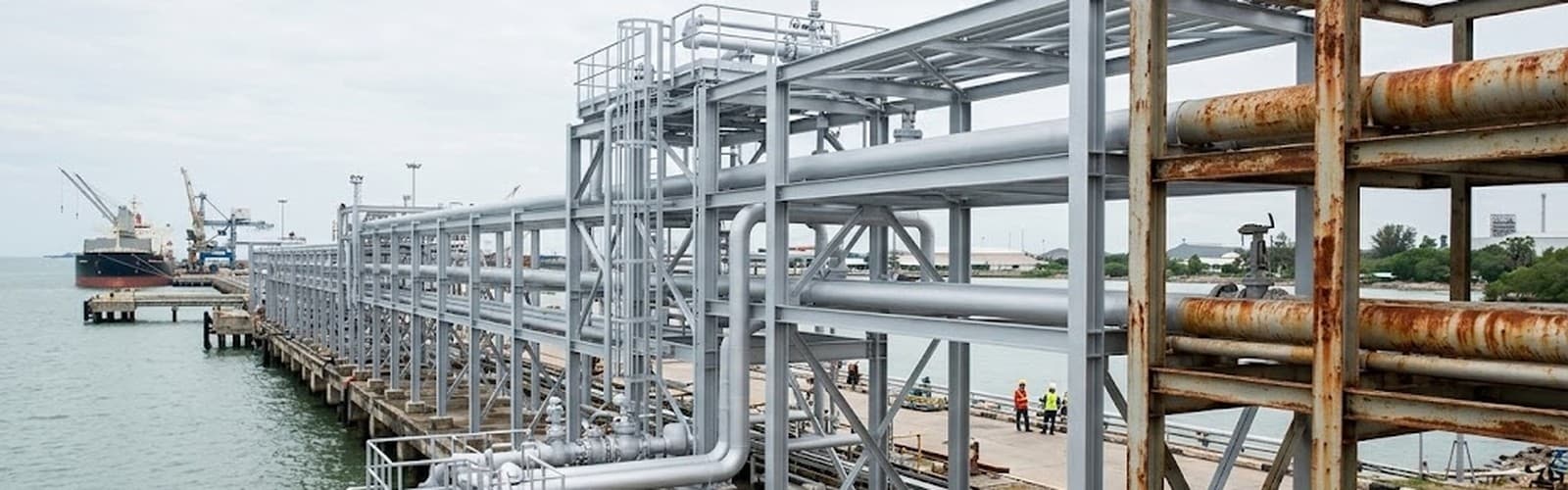
Comparing powder coating and liquid (wet) paint for metal finishing: ASTM B117 salt-spray durability, film thickness, VOC, part size, the Qualicoat / AAMA / ISO 8130 standards, and how to choose for factory fabrication and architectural work in Thailand.
Metal parts made in a factory — steel frames, electrical enclosures, racks, brackets, steel furniture, aluminium profiles — need a surface finish for corrosion protection, appearance, and service life. The question at order time: "powder coating or liquid (wet) paint?"
Both finish metal, but the process and properties differ clearly — choose wrong and the finish fails, or you overpay. This article compares them by standards and real use.
1. The Difference Is in the Process
Powder coating = a thermoset powder (epoxy/polyester) applied electrostatically to the part, then baked at ~180-200°C to melt and cure into a hard film.
Liquid (wet) paint = a liquid sprayed/applied, then air- or low-bake-dried — epoxy, PU, acrylic, fluoropolymer, etc.
2. Property Comparison
| Property | Powder Coating | Liquid Paint |
|---|---|---|
| Thickness/pass | 60-80µm (1 pass) | 15-20µm/coat (needs 3-4 coats) |
| Durability (ASTM B117 salt spray) | 500-2,000 h | 300-500 h |
| VOC | virtually none (overspray recyclable) | yes (solvent) |
| Part size | limited (must fit oven) | unlimited / field-applicable |
| Substrate | must withstand bake (metal) | varied |
| Color/shade choice | narrower | very wide / matchable |
| Touch-up | hard (needs bake) | easy |
| High volume, single color | more cost-effective | — |
3. How to Choose
flowchart TD
  A[Metal part] --> B{Fits the oven?
+ withstands 180-200C}
  B -->|No - large/installed/heat-sensitive| C[Liquid Paint]
  B -->|Yes| D{Need multi-color/
special shade/matching?}
  D -->|Yes| C
  D -->|No - single color, high volume| E{Need high durability
+ no VOC?}
  E -->|Yes| F[Powder Coating]
  E -->|Not essential| G[Choose by cost/lead time]
  F --> H[Reference Qualicoat/AAMA
by required life]
  C --> H
Selection summary:
- Large/installed/multi-color/matching → liquid paint
- Single color, high volume, high durability, no VOC → powder coating
- Sun-exposed architectural aluminium → reference AAMA 2604/2605 or Qualicoat
4. Standards Used to Reference Quality
- ASTM B117 — salt spray (corrosion resistance)
- ISO 8130 — coating powder test methods
- ASTM D3359 — adhesion (tape test)
- AAMA 2603/2604/2605 + Qualicoat — durability grades for architectural aluminium (2605/Qualicoat Class 2-3 = fluoropolymer, highest sun resistance)
5. Checklist Before Ordering Metal Finishing
- Measure the part against the oven — over-size = must use liquid
- State the environment (indoor/outdoor/coastal) → set grade/salt-spray
- Choose color/shade — multi-color/matching = liquid suits better
- Specify the grade (AAMA/Qualicoat) for sun-exposed work
- Ask for test results salt spray / adhesion + surface pre-treatment before coating
We supply and coordinate complete metal finishing — both powder coating and liquid paint to ASTM B117 / Qualicoat / AAMA — with guidance on choosing the system by part size, environment, color, and required life, including pre-treatment and test results for acceptance.
Talk to our engineering team to choose a cost-effective, durable finishing system — call 02-096-2118 or LINE OA @sahawatt1988.
Summary
- Powder coating = thicker, more durable (B117 500-2,000 h), no VOC, but needs an oven (size limit) and offers fewer colors
- Liquid paint = works on large/installed parts, multi-color/matching, easy repair, but thinner and has VOC
- Decide by part size + color + durability + VOC + volume
- Sun-exposed architectural aluminium → reference AAMA 2604/2605 or Qualicoat
- Reference quality with ASTM B117 (salt spray) + ASTM D3359 (adhesion)
Match the system to the job for a durable, cost-effective finish — neither overpaying nor peeling early.
Get this guide as a reference brief (PDF)
Summary + full section list + standards cited, Saha-branded for your memo/RFQ — emailed to you too.
Questions after reading? Talk to our engineers
Tell us what you need — our engineers help you spec it right, with a real quote. No charge.
Need help with this in your facility?
Our team handles full procurement and installation for the topics covered in this article. Free quote promptly during business hours.
Another line of ours — spreadsheet tools for SMEs
Quote Register + Win Rate (Thai + English editions)
For quotes that go silent — one row per quote, telling you which to chase today and what your real win rate is.
Frequently Asked Questions
1Which is more durable — powder coating or liquid paint?
+
2Why does powder coating need an oven?
+
3Which grade for architectural aluminium?
+
4Can powder coating do two-tone or gradients?
+
Related content
Holiday / Pinhole Detection in Coatings — Wet Sponge vs High-Voltage Spark per NACE/AMPP SP0188 & ASTM D5162
A guide to detecting holidays/pinholes (invisible discontinuities) in protective coating films: choosing low-voltage wet sponge (thin film < 500 µm) vs high-voltage spark/DC (thick film > 500 µm) per NACE/AMPP SP0188, SP0490 and ASTM D5162 — setting voltage by DFT (too low misses holidays, too high burns the film), which work requires it (tanks/pipes/immersion/marine), mark-repair-retest, and what a TOR must specify.
Coating Inspectors: NACE/AMPP CIP vs FROSIO — Who Needs Certification, Levels 1/2/3, and TOR Requirements
A comparison of the two main coating-inspector certification schemes: NACE/AMPP CIP (Coating Inspector Program — Levels 1/2/3, after NACE merged into AMPP in 2021) vs FROSIO (the Norwegian scheme — competence levels I/II/III) — what each level can do, which projects need which level, recognition in Thailand and abroad, and what a TOR must specify (level, independence, hold points, reporting) so coating work can actually be accepted.
Coating Application Conditions — The 'Surface ≥ Dew Point + 3°C' Rule, RH < 85% per ISO 8502-4 & ISO 12944-7
A guide to environmental conditions during protective-coating application: steel surface must be at least 3°C above the dew point, relative humidity RH < 85% (per the TDS), surface temperature within the product's range — how to measure the 4 readings (air temp, RH, dew point, surface temp) per ISO 8502-4 and ISO 12944-7, why painting in humid/near-dew-point conditions causes peeling/blistering/flash rust, and what a TOR must specify for Thailand's humid climate.
ISO 12944 Protective Paint Systems for Steel — Selecting Corrosivity C2–CX, Durability, and Primer/Intermediate/Topcoat for Thailand
How to select a protective coating system for steel structures per ISO 12944: corrosivity categories C1–C5/CX (2017/2018 revision), durability ranges L/M/H/VH, matching zinc-rich primer + epoxy MIO + PU topcoat systems to dry film thickness (DFT) per category, mapping to Thai environments (urban plants vs coastal Map Ta Phut/Laem Chabang), and the spec mistakes TOR writers make most.