
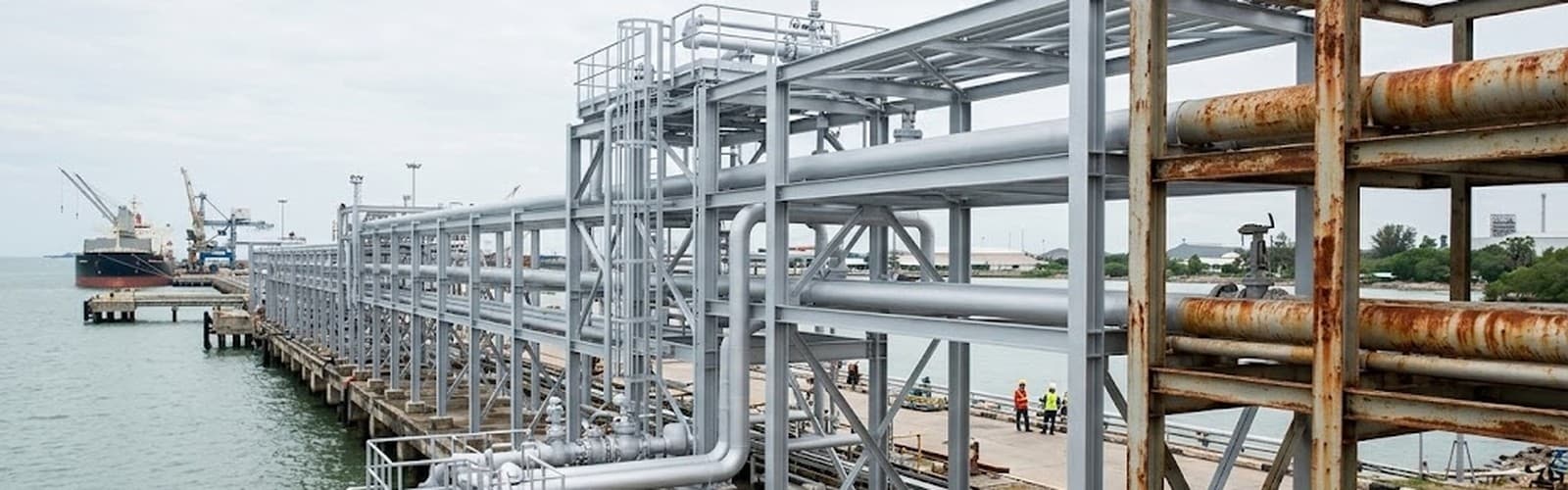
A guide to intumescent coatings for structural steel: how they intumesce into an insulating char, 30-120 minute fire-resistance ratings, EN 13381-8 / ASTM E119 / UL 263, section factor (Hp/A) vs DFT, cellulosic vs hydrocarbon fire, and Thai building requirements.
Structural steel is strong at room temperature, but in a fire it loses about 50% of its strength at ~550°C and softens until the structure can collapse within minutes. This is why building-control law specifies a fire-resistance rating for primary structure — so people have time to escape and firefighters can respond.
Intumescent coating is the most popular passive fire protection for exposed steel because it is thin, aesthetic, and follows the steel profile. This article explains the principle, the standards, and how to choose the right thickness.
1. The Principle — A Thin Paint That Swells into Insulation
An intumescent coating is a thin film (measured in microns) that, when heated, undergoes a chemical reaction and intumesces — expanding many times into a porous char layer that insulates:
- Delays the steel reaching its critical temperature (often ~550°C) within the required time
- Provides a rating in minutes: 30 / 60 / 90 / 120 / 180
- Thin and profile-following, unlike thick/heavy boards or spray cementitious (vermiculite)
2. Test and Certification Standards
| Standard | Used for |
|---|---|
| EN 13381-8 | Method to assess a reactive coating's contribution to steel fire resistance |
| ASTM E119 / UL 263 | Building fire test methods (US) — cellulosic curve |
| BS 476 / EN 1363 | Fire test methods (UK/EU) |
| AS 1530.4 | Fire test method (Australia) |
| Thai Ministerial Regulation | Structural fire-resistance rating by building type |
Thailand work typically references EN 13381-8 or UL/ASTM results + states minutes per the Ministerial Regulation, with an engineer/specialist certifying.
3. The Heart of It — DFT Depends on Section Factor
flowchart TD
  A[Structural steel] --> B[Compute section factor Hp/A
per section]
  A --> C[Set required rating
30-120 min per regulation]
  B --> D[Open manufacturer loading table
EN 13381-8]
  C --> D
  D --> E[Get required DFT
per member]
  E --> F[Select fire curve
cellulosic vs hydrocarbon]
  F --> G[Apply + verify actual DFT
per member + topcoat if needed]
DFT (dry film thickness) is not fixed:
- Section factor (Hp/A) = heated perimeter / cross-section area — higher (thin steel) heats faster and needs more DFT
- Manufacturers provide a loading table from EN 13381-8 results to select DFT per section factor + minutes
- Verify actual DFT on every member — under-applied = fails the rating
4. Choose the Fire Curve to Match the Risk
- Cellulosic fire (ASTM E119/EN 1363) — fire from typical building contents → offices/warehouses/general factories
- Hydrocarbon fire — petroleum-fuel fire, far hotter/faster → refineries/petrochemical/offshore require a hydrocarbon-grade intumescent
Choosing the wrong curve = no real protection in that building's fire event.
5. Fire-Coating Spec Checklist
- State the rating (minutes) per regulation/building type
- Choose the fire curve (cellulosic vs hydrocarbon)
- Compute section factor per section → set DFT from the loading table
- Surface prep + primer compatible with the intumescent
- Verify actual DFT per member + keep test results/cert for acceptance
We supply and coordinate intumescent fire-protection systems for structural steel — computing section factor → DFT from the loading table (EN 13381-8), selecting the fire curve to suit the building type, compatible primers, and verifying actual DFT with test results for acceptance and permitting.
Talk to our engineering team to set passive fire protection that meets the requirements — call 02-096-2118 or LINE OA @sahawatt1988.
Summary
- Steel loses ~50% strength at ~550°C → law specifies a fire-resistance rating for structure
- Intumescent = a thin paint that swells into an insulating char, delaying heat, giving 30-120 minute ratings
- Standards: EN 13381-8 (assessment) + ASTM E119/UL 263 (test)
- DFT depends on section factor (Hp/A) + minutes from the manufacturer's loading table — verify per member
- Choose cellulosic vs hydrocarbon curve to match the building's risk
Fire coating is not "just paint" — it is an engineered system with per-member DFT calculation, accepted on test evidence.
Get this guide as a reference brief (PDF)
Summary + full section list + standards cited, Saha-branded for your memo/RFQ — emailed to you too.
Questions after reading? Talk to our engineers
Tell us what you need — our engineers help you spec it right, with a real quote. No charge.
Need help with this in your facility?
Our team handles full procurement and installation for the topics covered in this article. Free quote promptly during business hours.
Another line of ours — spreadsheet tools for SMEs
Quote Register + Win Rate (Thai + English editions)
For quotes that go silent — one row per quote, telling you which to chase today and what your real win rate is.
Frequently Asked Questions
1Does structural steel need fire-protective coating?
+
2How does an intumescent coating work?
+
3How is the coating thickness (DFT) determined?
+
4What is the difference between cellulosic and hydrocarbon fire?
+
Related content
Holiday / Pinhole Detection in Coatings — Wet Sponge vs High-Voltage Spark per NACE/AMPP SP0188 & ASTM D5162
A guide to detecting holidays/pinholes (invisible discontinuities) in protective coating films: choosing low-voltage wet sponge (thin film < 500 µm) vs high-voltage spark/DC (thick film > 500 µm) per NACE/AMPP SP0188, SP0490 and ASTM D5162 — setting voltage by DFT (too low misses holidays, too high burns the film), which work requires it (tanks/pipes/immersion/marine), mark-repair-retest, and what a TOR must specify.
Coating Inspectors: NACE/AMPP CIP vs FROSIO — Who Needs Certification, Levels 1/2/3, and TOR Requirements
A comparison of the two main coating-inspector certification schemes: NACE/AMPP CIP (Coating Inspector Program — Levels 1/2/3, after NACE merged into AMPP in 2021) vs FROSIO (the Norwegian scheme — competence levels I/II/III) — what each level can do, which projects need which level, recognition in Thailand and abroad, and what a TOR must specify (level, independence, hold points, reporting) so coating work can actually be accepted.
Coating Application Conditions — The 'Surface ≥ Dew Point + 3°C' Rule, RH < 85% per ISO 8502-4 & ISO 12944-7
A guide to environmental conditions during protective-coating application: steel surface must be at least 3°C above the dew point, relative humidity RH < 85% (per the TDS), surface temperature within the product's range — how to measure the 4 readings (air temp, RH, dew point, surface temp) per ISO 8502-4 and ISO 12944-7, why painting in humid/near-dew-point conditions causes peeling/blistering/flash rust, and what a TOR must specify for Thailand's humid climate.
ISO 12944 Protective Paint Systems for Steel — Selecting Corrosivity C2–CX, Durability, and Primer/Intermediate/Topcoat for Thailand
How to select a protective coating system for steel structures per ISO 12944: corrosivity categories C1–C5/CX (2017/2018 revision), durability ranges L/M/H/VH, matching zinc-rich primer + epoxy MIO + PU topcoat systems to dry film thickness (DFT) per category, mapping to Thai environments (urban plants vs coastal Map Ta Phut/Laem Chabang), and the spec mistakes TOR writers make most.