
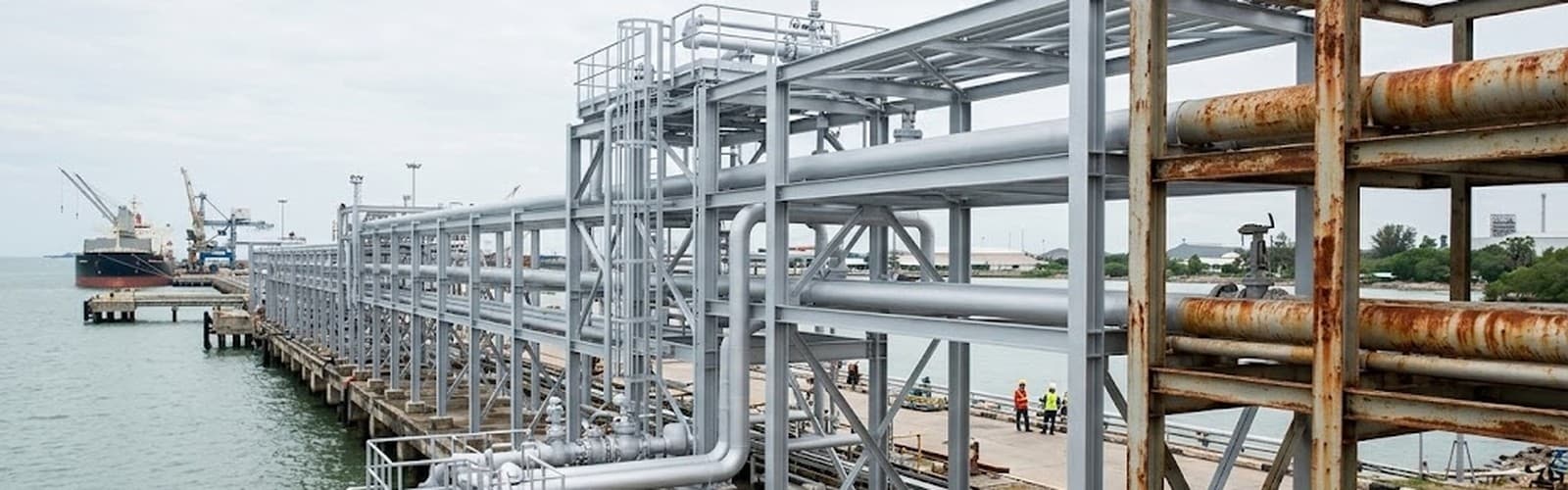

Guide to selecting heat-resistant coatings: silicone-aluminium up to 600°C, the 200/400/600°C temperature bands, heat curing, the CUI (corrosion under insulation) trap and inert multipolymer matrix coatings per ISO 12944-9 / CINI, and matching the system to stacks, exhaust pipe, and furnaces in Thailand.
Equipment that runs hot — stacks, exhaust pipe, furnaces, steam lines, process vessels — destroys ordinary anti-corrosion paint quickly: the resin burns, peels, yellows, and cracks, and the steel then rusts. Ordinary coatings are designed for room temperature, not surfaces at 300-600°C.
Hot service requires heat-resistant coatings, with resin and thickness matched to the actual surface temperature band — and you must watch out for the most dangerous trap of all: CUI, the invisible corrosion under insulation. This article summarizes how to choose the right system.
1. Choose the Resin by Temperature Band
The key is the maximum surface temperature actually reached (not the surrounding air temperature):
| Surface temp band | Suitable system | Notes |
|---|---|---|
| up to ~200°C | silicone-acrylic / modified epoxy | wide range of choices |
| ~200-400°C | silicone (heat-resistant) | heat cure starts to matter |
| ~400-600°C | silicone-aluminium | standard for stacks/exhaust |
| 600-1000°C | ceramic/inorganic, thermal spray (aluminizing) | beyond ordinary paint |
Wrong band = the coating burns/peels within weeks. Spec from the equipment's maximum operating + cyclic temperature.
2. Heat Curing
Many heat-resistant silicone coatings must first reach ~200-260°C to fully cross-link:
flowchart TD
  A[Prep Sa 2.5-3
ISO 8501-1] --> B[Apply silicone-Al
thin DFT 25-50 micron/coat]
  B --> C[Film still green
not truly hardened]
  C --> D[Equipment first runs
surface reaches ~200-260°C]
  D --> E[Silicone cross-links
film truly hardens]
  C -.caution.-> F[Before cure: no
water/chemicals/impact]
- Before curing the film is still soft and easily scraped — watch during transport/installation
- In real service the film cures itself once the equipment runs — but plan protection during the wait
- DFT must be thin (usually 25-50 micron/coat) — a film too thick cracks during heat-cool cycling
3. The Most Dangerous Trap — CUI
CUI (Corrosion Under Insulation) is rust beneath thermal insulation, occurring when water penetrates the insulation of pipe/vessels in the risk temperature band:
- Risk band ~ -4°C to 175°C — water sits against warm steel, accelerating rust
- Invisible from outside — you must remove insulation to find it → usually discovered only after a leak/rupture
- Prevent with a dedicated CUI coating (e.g. inert multipolymer matrix) per NACE SP0198 / CINI
| Ordinary HR coating (silicone-Al) | CUI coating | |
|---|---|---|
| Designed for | high steady temperature | wide/cyclic temperature + wet under insulation |
| Wet-dry cycling | limited | good |
| Use on | bare stacks/exhaust | insulated pipe/vessels |
Don't use ordinary heat-resistant paint under insulation — insulated pipe in the CUI temperature band must specify a dedicated CUI system.
4. Surface Prep + DFT — Why It's Strict
Heat-resistant coatings adhere harder than normal paint because of constant thermal expansion-contraction:
- Specify blast Sa 2.5 to Sa 3 (near-white to white metal) per ISO 8501-1 — see our surface preparation Sa 2.5 guide
- Profile to the maker's spec (heat-resistant coatings are often profile-sensitive)
- Keep DFT thin — too thick = cracking on thermal cycling
- Don't use ordinary primer under heat-resistant paint (it will burn) — use only a compatible heat-resistant primer
5. Heat-Resistant Coating Spec Checklist
- Specify max operating + cyclic surface temperature — match the resin band (200/400/600°C)
- Separate insulated vs bare work — insulated → CUI system, bare → silicone-Al
- Surface prep Sa 2.5-3 + profile to the maker's spec
- Keep DFT thin to spec — do not over-apply
- Plan the heat cure + protect the film before curing (water/chemicals/impact)
- Primer must be heat-resistant and compatible — never use ordinary primer
- Record the ITP — temperature/DFT/profile for hand-over
We supply and coordinate heat-resistant coating systems for stacks, exhaust pipe, and furnaces, and CUI systems for insulated pipe/vessels — selecting resin by the actual temperature band, specifying surface prep and DFT so the film survives thermal cycling, with an ITP for hand-over.
Talk to our engineering team to match a heat-resistant system to your temperature and service conditions — call 02-096-2118 or LINE OA @sahawatt1988.
Summary
- Choose resin by actual surface temperature: ~200°C (silicone-acrylic) · 400-600°C (silicone-aluminium) · >600°C (ceramic/thermal spray)
- Silicone coatings need a first heat cure ~200-260°C — before curing the film is soft, handle with care
- CUI = invisible rust under insulation (-4 to 175°C band) — insulated pipe needs a dedicated CUI system, not ordinary heat-resistant paint
- Surface prep Sa 2.5-3 + thin DFT because thermal cycling cracks thick films
- Reference standards: ASTM D2485, NACE SP0198, CINI, ISO 12944-9
Heat-resistant coating is not "fireproof paint" — choose by actual surface temperature and separate insulated work correctly, or it fails both ways.
Get this guide as a reference brief (PDF)
Summary + full section list + standards cited, Saha-branded for your memo/RFQ — emailed to you too.
Questions after reading? Talk to our engineers
Tell us what you need — our engineers help you spec it right, with a real quote. No charge.
Need help with this in your facility?
Our team handles full procurement and installation for the topics covered in this article. Free quote promptly during business hours.
Another line of ours — spreadsheet tools for SMEs
Quote Register + Win Rate (Thai + English editions)
For quotes that go silent — one row per quote, telling you which to chase today and what your real win rate is.
Frequently Asked Questions
1What resin do 600°C heat-resistant coatings use?
+
2Why must heat-resistant silicone coatings be heat-cured?
+
3What is CUI (corrosion under insulation) and why is it dangerous?
+
4How do heat-resistant coatings differ from CUI coatings?
+
5What surface preparation do heat-resistant coatings need?
+
Related content
Holiday / Pinhole Detection in Coatings — Wet Sponge vs High-Voltage Spark per NACE/AMPP SP0188 & ASTM D5162
A guide to detecting holidays/pinholes (invisible discontinuities) in protective coating films: choosing low-voltage wet sponge (thin film < 500 µm) vs high-voltage spark/DC (thick film > 500 µm) per NACE/AMPP SP0188, SP0490 and ASTM D5162 — setting voltage by DFT (too low misses holidays, too high burns the film), which work requires it (tanks/pipes/immersion/marine), mark-repair-retest, and what a TOR must specify.
Coating Inspectors: NACE/AMPP CIP vs FROSIO — Who Needs Certification, Levels 1/2/3, and TOR Requirements
A comparison of the two main coating-inspector certification schemes: NACE/AMPP CIP (Coating Inspector Program — Levels 1/2/3, after NACE merged into AMPP in 2021) vs FROSIO (the Norwegian scheme — competence levels I/II/III) — what each level can do, which projects need which level, recognition in Thailand and abroad, and what a TOR must specify (level, independence, hold points, reporting) so coating work can actually be accepted.
Coating Application Conditions — The 'Surface ≥ Dew Point + 3°C' Rule, RH < 85% per ISO 8502-4 & ISO 12944-7
A guide to environmental conditions during protective-coating application: steel surface must be at least 3°C above the dew point, relative humidity RH < 85% (per the TDS), surface temperature within the product's range — how to measure the 4 readings (air temp, RH, dew point, surface temp) per ISO 8502-4 and ISO 12944-7, why painting in humid/near-dew-point conditions causes peeling/blistering/flash rust, and what a TOR must specify for Thailand's humid climate.
ISO 12944 Protective Paint Systems for Steel — Selecting Corrosivity C2–CX, Durability, and Primer/Intermediate/Topcoat for Thailand
How to select a protective coating system for steel structures per ISO 12944: corrosivity categories C1–C5/CX (2017/2018 revision), durability ranges L/M/H/VH, matching zinc-rich primer + epoxy MIO + PU topcoat systems to dry film thickness (DFT) per category, mapping to Thai environments (urban plants vs coastal Map Ta Phut/Laem Chabang), and the spec mistakes TOR writers make most.