
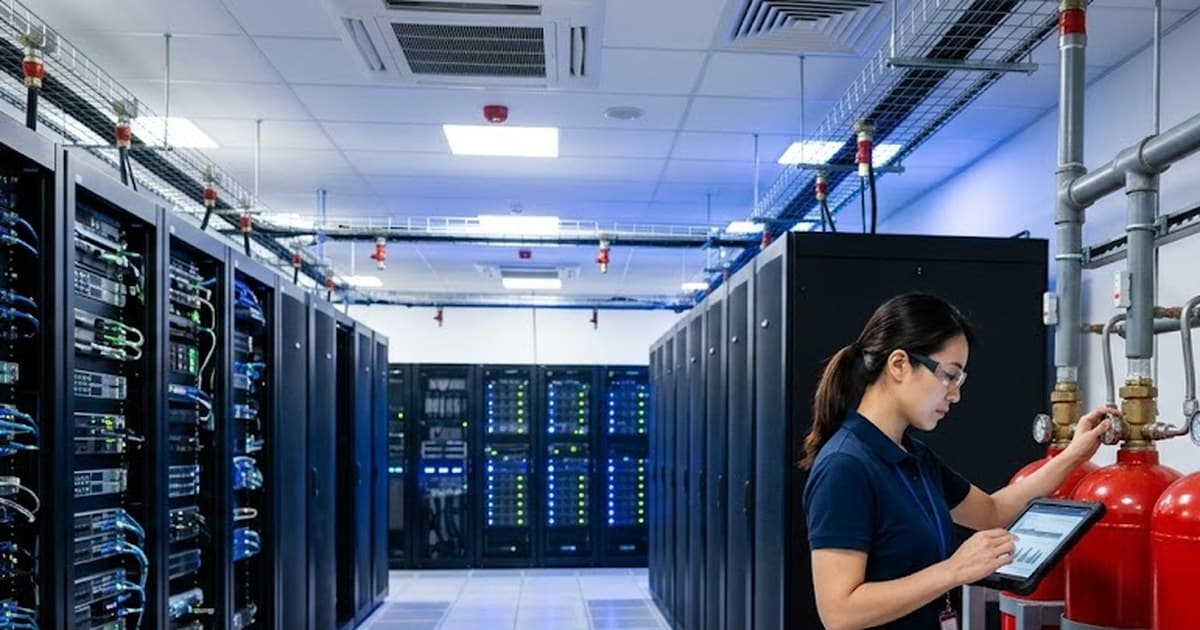
Compare server-room fire suppression systems FM-200 (HFC-227ea) vs Novec 1230 (FK-5-1-12) vs CO2 — NFPA 2001 + NFPA 12 standards, GWP, agent concentration, occupant safety, and cost in Thailand
Why Server Room Fire Suppression Differs from Other Rooms
Server rooms + telecom + critical electronics:
- Must: use a dry agent (no water at all)
- Must: be clean (no residue that permanently damages electronics)
- Must: be electrically non-conductive
- Must: evaporate within 10 seconds (extinguish before the fire propagates)
- Must: be safe for occupants (people entering and leaving)
NFPA 75 + NFPA 76 specify: critical server rooms = use clean agent OR pre-action sprinkler (water released only if smoke + heat are detected together)
Clean agent options: FM-200 (legacy) · Novec 1230 (new standard) · Inert gas (Argonite, Inergen) · CO2 (special cases only)
Agent Comparison Table
| Parameter | FM-200 (HFC-227ea) | Novec 1230 (FK-5-1-12) | CO2 | Inergen (IG-541) |
|---|---|---|---|---|
| Type | HFC clean agent | Fluoroketone clean agent | Inert gas | Inert gas mix |
| GWP | 3,220 | 1 | 1 | 0 |
| ODP | 0 | 0 | 0 | 0 |
| Design concentration | 7-9% | 5-6% | 34% | 37-43% |
| NOAEL (safe for human) | 9% | 10% | 4% LC50 | 43% (low O2) |
| Occupied space safe? | ✓ Yes | ✓ Yes (best) | ✗ NO (lethal) | Limited (low O2 risk) |
| Discharge time | 10 sec | 10 sec | 60 sec | 60 sec |
| Residue | None | None | None | None |
| Electrical conductive | No | No | No | No |
| Storage pressure | 25-42 bar | 25 bar | 50-60 bar | 200-300 bar |
| Cylinder size | Medium | Slightly larger | Larger | Largest (high pressure) |
| Refill cost | ฿80-150K | ฿150-280K | ฿20-50K | ฿100-180K |
| Install cost (100 m²) | ฿650K-1.2M | ฿850K-1.5M | ฿400K-700K | ฿900K-1.6M |
| Phase-out status | Kigali phase-down 2024+ | ✓ Active, future-proof | ✓ Active | ✓ Active |
| NFPA standard | NFPA 2001 | NFPA 2001 | NFPA 12 | NFPA 2001 |
Decision Framework
flowchart TD
    Start[Type of room?] --> Q1{Occupied space?}
    Q1 -->|Yes - human entry| Q2{Existing system?}
    Q1 -->|No - unmanned| Q3{Concerned about long-term cost?}

    Q2 -->|Yes FM-200| MaintainFM[Maintain FM-200
plan replacement 5-10 yr]
    Q2 -->|No - new install| Novec[Install Novec 1230
future-proof + safer]
    Q2 -->|Inert gas existing| MaintainIG[Maintain Inergen/Argonite
good for long-term]

    Q3 -->|Yes - tight budget| CO2[CO2 acceptable
but NEVER occupied]
    Q3 -->|No - prefer safety| Novec2[Novec 1230 still preferred]
NFPA 2001 Sizing Calculation
Step 1: Determine room volume
- Length × Width × Height (in meters → m³)
- Subtract: non-flooded volume (large equipment, raised floor space if not sealed)
Step 2: Apply design concentration
- FM-200: 7% (Class A) → 9% (Class B liquid)
- Novec 1230: 4.5-6% (Class A)
- Apply safety factor: +10% (manufacturer recommendation)
Step 3: Compute agent mass
For FM-200:
Agent mass (kg) = Volume (m³) × Concentration (%) / 100 × Density (1.41 kg/m³)
Example: 300 m³ × 7% × 1.41 = 29.6 kg
With safety factor: 29.6 × 1.10 = 32.6 kg
For Novec 1230:
Agent mass (kg) = Volume (m³) × Concentration (%) / 100 × Density (1.60 kg/m³)
Example: 300 m³ × 5.5% × 1.60 = 26.4 kg
With safety factor: 26.4 × 1.10 = 29 kg
Step 4: Cylinder selection
- A 67-liter standard cylinder holds ~70-80 kg FM-200 → 1 cylinder for 300 m³ OK
- An 80-liter cylinder holds ~110-130 kg Novec 1230 → 1 cylinder OK
- Multiple cylinders for >500 m² (cascade discharge)
Step 5: Piping + nozzle design
- Per NFPA 2001 + ISO 14520 hydraulic calculation
- Velocity 1.5-3 m/s in distribution piping
- Nozzle placement: every 12-15 m² of floor area
- Discharge time 10 sec max for clean agents
Real Project Example
Project: Data Center Bangkok (180 m² server room + 15 m² UPS room)
Server room (180 m² × 3m = 540 m³):
| Option | FM-200 | Novec 1230 |
|---|---|---|
| Concentration | 7.5% | 5.5% |
| Agent mass | 57 kg | 47 kg |
| Cylinder | 2 × 67L | 1 × 80L |
| Total system cost | ฿1.1M | ฿1.3M |
| 20-yr TCO (assume 1 discharge) | ฿1.3M | ฿1.6M |
UPS room (15 m² × 3m = 45 m³ unmanned):
| Option | CO2 | FM-200 |
|---|---|---|
| Design concentration | 34% | 7.5% |
| Agent mass | 28 kg | 5 kg |
| System cost | ฿180K | ฿380K |
Verdict for this project:
- Server room: Novec 1230 (occupied, future-proof, ฿200K premium worth it over 20 yr)
- UPS room: CO2 (unmanned, save ฿200K)
Detection + Activation
Smoke Detection (VESDA — Very Early Smoke Detection)
- Continuously samples air through pipes from the ceiling
- Detects smoke at the ppb level (much earlier than a spot detector)
- Reduces false discharge by 60-80%
- Cost: ฿80-150K per 200 m² zone
Combined Detection
- Standard: 2-zone cross-detection (smoke + heat) — minimizes false alarms
- Required: Manual abort button (30 sec delay) inside the protected room
- Required: Audible + visual alarm 60 sec before discharge
Activation Sequence
sequenceDiagram
    Smoke detector->>+Control Panel: Alarm signal
    Heat detector->>+Control Panel: Alarm signal
    Control Panel->>+Control Panel: Cross-zone confirm
    Control Panel->>+Audible alarm: 60 sec warning
    Audible alarm->>+Personnel: Evacuate
    alt Abort button pressed
        Personnel->>+Control Panel: Manual abort
        Control Panel->>+System: HOLD discharge
    else No abort
        Control Panel->>+Solenoid valve: Open
        Solenoid valve->>+Cylinder: Release agent
        Cylinder->>+Piping: 10-sec discharge
        Piping->>+Nozzles: Distribute agent
        Nozzles->>+Room: Suppress fire
    end
Maintenance Requirements (per NFPA 2001 + NFPA 12)
Daily
- ✓ Visual check of control panel — all green status
Monthly
- ✓ Visual inspection of cylinders + piping (no damage, no leaks)
- ✓ Verify pressure gauge readings (FM-200 25-42 bar at 21°C)
- ✓ Test alarm + warning lights
Semi-Annual
- ✓ Hydrostatic test of cylinders (NFPA 2001 §4.3)
- ✓ Discharge test of piping integrity (without releasing agent)
- ✓ Smoke detector sensitivity calibration
Annual
- ✓ Comprehensive system inspection by a qualified technician
- ✓ Weight check of cylinders (NFPA 2001: refill if loss > 5%)
- ✓ Detection system functional test (all sensors trigger correctly)
- ✓ Control panel battery + UPS test
5-Yearly
- ✓ Cylinder valve overhaul
- ✓ Piping hydrostatic test
12-Yearly
- ✓ Complete cylinder hydrostatic re-test (DOT 4BA cert)
Cost: Annual maintenance 5-8% of install cost = ฿35-100K/yr for a typical 100-200 m² room
Common Installation Mistakes
1. Insufficient room sealing
- Agent escapes through cable trays, raised floor gaps, AC ducts
- Result: Concentration drops below design % → fire reignites
- Fix: Conduct a Door Fan Test (NFPA 2001) before commissioning + seal all openings
2. Wrong concentration calculation
- Using empty-room volume, not the actual furniture-occupied volume
- Result: Over-design (waste) or under-design (failure)
- Fix: Subtract large equipment volume if non-flooded
3. Skipping smoke detection upgrade
- A standard ceiling-mounted smoke detector misses early-stage fires
- Result: Fire detected late, agent discharges but the fire is already large
- Fix: Use VESDA for critical rooms (data center, fab)
4. Mixing agent types
- One zone with FM-200, the next zone with Novec 1230 (different concentrations)
- Result: Operator confusion, wrong refill type causes failure
- Fix: Standardize on one agent per facility
5. No manual abort
- Personnel inside cannot stop discharge before evacuation
- Result: Property damage during a false alarm
- Fix: NFPA 2001 §5.1 requires manual abort with a 30-sec delay
6. Cylinders in the wrong location
- Cylinders inside the protected room — fire damages cylinders before discharge
- Result: System failure when it's needed most
- Fix: Cylinders in a separate room or an outdoor protected enclosure
Saha Service Packages
Tier 1: Design + Engineering (฿80-200K)
- Site survey + room volume measurement
- Risk assessment (Class A/B/C fire hazards)
- Door Fan Test recommendation
- NFPA 2001 sizing + cylinder selection
- Single-line piping diagram
Tier 2: Procurement + Installation (฿650K-1.6M for 100 m²)
- Agent supply (FM-200/Novec 1230/CO2)
- Cylinders + valves (UL approved)
- Piping + nozzles + detection
- Control panel + integration with BMS
- Commissioning + Door Fan Test
Tier 3: Maintenance Contract (฿35-100K/yr)
- Monthly + semi-annual + annual inspection
- Refill agent after discharge
- Cylinder hydrostatic re-test (every 5 yr)
- 24/7 emergency response
Tier 4: Compliance Audit (฿30-80K)
- NFPA 2001/12 compliance review of existing system
- Insurance audit support
- Permit renewal assistance (Department of Industrial Works + Department of Disaster Prevention and Mitigation)
Summary
- 3 common clean agents: FM-200 (legacy, phase-out), Novec 1230 (current standard), CO2 (unmanned only)
- Novec 1230 = future-proof — GWP = 1, safe for occupants, NFPA 2001 approved
- FM-200 still acceptable for existing systems but plan migration
- CO2 lethal in occupied space — only for unmanned electrical rooms
- Sizing per NFPA 2001: room volume × concentration × density × safety factor
- Detection: VESDA recommended for critical rooms
- Maintenance: annual 5-8% of install cost
- 6 common mistakes to avoid (sealing, sizing, detection, mixing agents, abort, cylinder location)
- Cost for a 100 m² room: Novec 1230 ฿850K-1.5M · FM-200 ฿650K-1.2M · CO2 ฿400-700K
Customers who need fire suppression system design + installation + compliance — contact Saha at 02-096-2118 or LINE OA @sahawatt1988
Get this guide as a reference brief (PDF)
Summary + full section list + standards cited, Saha-branded for your memo/RFQ — emailed to you too.
Questions after reading? Talk to our engineers
Tell us what you need — our engineers help you spec it right, with a real quote. No charge.
Need help with this in your facility?
Our team handles full procurement and installation for the topics covered in this article. Free quote within 2 hours.
Another line of ours — spreadsheet tools for SMEs
Quote Register + Win Rate (Thai + English editions)
For quotes that go silent — one row per quote, telling you which to chase today and what your real win rate is.
Frequently Asked Questions
1Why don't server rooms use water sprinklers?
+
2Has FM-200 been phased out yet?
+
3Is Novec 1230 really better than FM-200?
+
4Can CO2 be used?
+
5What is used to size the system?
+
6What are the prices in Thailand in 2024?
+
Comparison tables related to this article
Related content
Hot Work Permit OSHA 1910.252 + NFPA 51B — Flow and Documents Thai Factories Need
Hot Work Permit guide per OSHA 1910.252 + NFPA 51B + AWS F4.1 + ANSI Z49.1 — flow chart, signature requirements, fire watch duration, fire prevention checklist, application to Thai factories
Welding Blanket FM 4950 Class A vs B vs C — How to Choose per Hot Work Permit NFPA 51B
Comparing the three ANSI/FM 4950 types — Welding Curtain, Welding Blanket, Welding Pad — temperature ratings, application scenarios, service life, and NFPA 51B / OSHA 1910.252 requirements for work in Thailand
Fire Watch Duration After Hot Work — OSHA 30 Minutes vs NFPA 51B 60 Minutes
Why fire watch requirements after hot work say both 30 and 60 minutes — comparing OSHA 1910.252 / 1915.504 / 1926.352 against NFPA 51B's 60-minute watch plus up to 3 hours of fire monitoring.
Metal Fabrication / Machine-Shop Fit-Out and Maintenance Field Guide — Safe Hot Work to NFPA 51B + Fire Blankets · Sa 2.5 Surface Prep to ISO 8501 · ISO 12944 Coating Systems + Zinc-Rich Primer · DFT/Holiday Inspection · Machine Lubrication + ISO 8573 Compressed Air + Electrical Safety + How to Lock In Material Pricing
Field guide for metal fabrication / machine-shop / structural-steel workshop owners and supervisors: plan the whole workshop by function — control hot work (weld/cut/grind) per NFPA 51B with the right fire-blanket grade (EN 1869/FM 4950), prepare steel to Sa 2.5 per ISO 8501 before coating, choose a corrosion coating system per ISO 12944 by environment class (C1-CX) with zinc-rich primer/powder/liquid, inspect dry film thickness (ISO 19840/SSPC-PA2) and holidays, lubricate machinery (hydraulic/gear/grease) + monitor oil/bearing condition, control compressed-air quality (ISO 8573) for abrasive blasting and spraying, and manage electrical safety (arc flash NFPA 70E) + cranes/hoists (ASME B30) — plus how to standardize materials to lock pricing and delivery.