
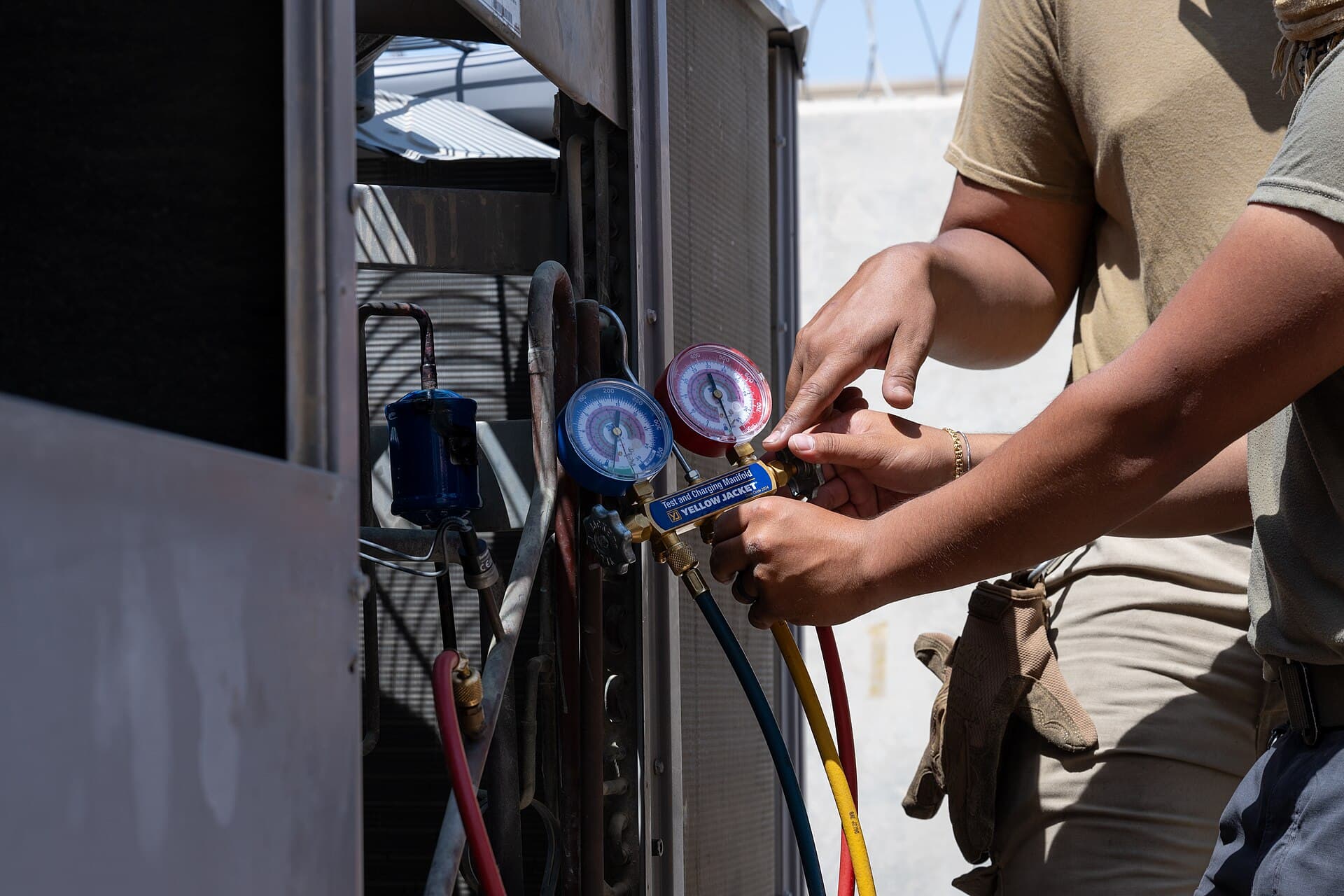
Start-up proves the machine runs. TAB proves air and water flows match the design. Commissioning proves the whole system does what the owner asked for — across every operating mode, including controls sequences, failure modes, documentation and operator training. In the ASHRAE family, Standard 202-2018 is the minimum acceptable process and belongs in the specification as a requirement; Guideline 0-2019 recommends measures beyond that minimum; Guideline 1.4-2019 defines the Systems Manual, which is the same kind of document Thai building-inspection law already expects at the five-yearly major inspection.
A factory takes delivery of a new chiller plant or air-handling system, the paperwork is complete, and the contractor confirms that testing passed. Then the hot season arrives, the production line does not hold temperature, the electricity bill runs above forecast, and nobody on the maintenance team knows how the control sequences were set. The root cause is rarely faulty equipment. It is that what the contract called "testing" was start-up, not commissioning.
Three different activities
Start-up proves that equipment can be energised without damaging itself. It is the installer's baseline duty. Testing, adjusting and balancing (TAB) measures and adjusts air and water flow rates so they match the designer's values, and produces a report per terminal and per machine.
Commissioning sits above both. ASHRAE Technical Committee 7.9 describes its own scope as concerning the methods of developing and executing the commissioning process needed to deliver HVAC and related systems that conform to design intent and project requirements. The decisive phrase is "project requirements": the process starts from the Owner's Project Requirements, a statement of what the building must be able to do, and every later test is measured against that document rather than against the drawings alone.
flowchart LR
  OPR["Owner's Project
Requirements"] --> BOD["Basis of Design"]
  BOD --> PLAN["Commissioning Plan"]
  PLAN --> PRE["Prefunctional
checklists"]
  PRE --> TAB["TAB
air & water balanced"]
  TAB --> FPT["Functional testing
all modes + failure modes"]
  FPT --> SM["Systems Manual
+ operator training"]
  SM --> WAR["Warranty period
+ seasonal retest"]
Standard 202 is the floor, Guideline 0 is the ceiling
ASHRAE's own committee structure settles the question of which document to cite. SSPC 300 states that the purpose of Standard 202-2018 is to identify the minimum acceptable commissioning process for new buildings and new systems, while Guideline 0-2019 recommends measures exceeding the requirements of Standard 202 and covers project delivery from predesign through expiry of the warranty. In contract language, the first is enforceable acceptance criteria and the second is quality guidance.
| Document | Applies to | Contract role |
|---|---|---|
| ANSI/ASHRAE/IES 202-2018 | New buildings and new systems | Mandatory minimum, citable for acceptance |
| Guideline 0-2019 | New builds, major renovations, additions | Recommended practice beyond the minimum |
| Guideline 0.2-2015 | Existing systems and assemblies | Same principles applied to buildings in use |
| Guideline 1.1-2007R | New HVAC&R systems | Technical detail supplementing the above |
| Guideline 1.2-2019 | Existing HVAC&R systems | Energy, O&M and indoor environmental focus |
| Guideline 1.3-2018 | Operator training | Defines the training deliverable |
| Guideline 1.4-2019 | Systems Manual | Defines the documentation deliverable |
| Guideline 1.5-2017 | Smoke control systems | For fire-related scope |
Guideline 1.6P covers data centres and Guideline 1.7P addresses ongoing commissioning for buildings that have already been commissioned once.
The Systems Manual is the highest-value line item
If only one requirement can be added to a specification, make it the Systems Manual under Guideline 1.4-2019. ASHRAE describes the guideline's purpose as providing procedures for producing a Systems Manual as a resource for training, operations, maintenance and upgrading of facilities, drawing on information from planning, design, construction, testing and training, for new, renovated and existing facilities alike.
For a Thai owner this is doubly worth having, because local law already asks for the same kind of document. The Department of Public Works and Town & Country Planning states that building inspection under the Building Control Act B.E. 2522 consists of a major inspection every five years plus annual inspections in between, and that at every major inspection the inspector must prepare a maintenance action plan for the building and its equipment, together with an operating manual and an annual inspection plan, and hand these to the owner. Nine building categories fall under the requirement, including factory buildings of more than one storey with a floor area of 5,000 m² or more, extra-large buildings of 10,000 m² or more, and high-rise buildings of 23 m or more.
The manual will therefore be produced either way. The only question is whether it arrives at handover, paid for inside the contractor's price, or is reconstructed years later when nobody remembers the original set points.
What the numbers support
Evan Mills' Lawrence Berkeley National Laboratory study of 643 US commercial buildings found median commissioning costs of $0.30/ft² for existing buildings and $1.16/ft² for new construction, the latter equal to roughly 0.4% of total construction cost. Median whole-building energy savings were 16% for existing buildings and 13% for new construction, with payback of 1.1 and 4.2 years and benefit-cost ratios of 4.5 and 1.1 respectively.
Thai labour and electricity prices differ, so treat these as orders of magnitude rather than transferable figures. The robust conclusion is directional: existing buildings pay back far faster, because what is found there is usually a wrong set point or a valve left in one position for years — engineering time, not new equipment.
Practical guidance
- Write the Owner's Project Requirements before the tender documents, even if it runs to two pages: temperature and humidity per area, production hours, acceptable noise, and the conditions that must never occur.
- Cite ANSI/ASHRAE/IES Standard 202-2018 as the mandatory minimum and Guideline 0-2019 as supporting guidance. Do not reverse the two roles.
- Require that whoever writes the commissioning plan and reports sits outside the installing contractor's chain of command and reports to the owner.
- Require the TAB report to be complete and accepted before functional performance testing starts, otherwise the results only describe a temporary condition.
- Tie the final payment or retention to delivery of the Systems Manual under Guideline 1.4-2019 and evidence of operator training under Guideline 1.3-2018.
- Reserve the right to retesting at the contractor's cost for any failed item, and specify at least one seasonal retest for systems that behave differently in the hot and rainy seasons.
Commissioning does not make equipment better than what was purchased. It makes sure the owner actually receives what was already paid for, and leaves the in-house team able to run the plant without depending permanently on the original installer. Sahawatthanakit (1988) advises on this scope alongside the supply of cooling and related building systems.
Frequently asked questions
If we already pay for TAB, why pay for commissioning as well?
TAB answers whether flows match the design. Commissioning answers whether the system as a whole meets what the owner asked for, including control sequences, mode changes, behaviour on power failure or fire alarm, documentation and training. The TAB report is evidence used inside the commissioning process, not a replacement for it, and it should be finished first.
Should the specification cite Standard 202 or Guideline 0?
Both, in different roles. Standard 202-2018 is stated by ASHRAE to define the minimum acceptable commissioning process for new buildings and systems, which is what makes it usable as acceptance criteria. Guideline 0-2019 recommends measures beyond that minimum. Citing them the wrong way round invites the argument that guidance is not binding.
Can existing systems be commissioned?
Yes. Guideline 0.2-2015 covers existing buildings, systems and assemblies; Guideline 1.2-2019 covers technical requirements for existing HVAC&R systems with an emphasis on energy use, operations and maintenance, and indoor environmental quality; and Standard 230P for existing buildings and systems is in development.
Does the commissioning provider have to be independent?
Not by physics, but by prudence. When the installer tests its own work the evidence collapses in any dispute. Independence costs less than one day of lost production caused by a cooling system that does not perform as assumed.
On a tight budget, what should be cut last?
The Owner's Project Requirements, functional testing of the primary systems, and the Systems Manual with training. Those three retain value after the contractor leaves — and in Thailand the manual and maintenance plan are expected anyway at the five-yearly major inspection.
Get this guide as a reference brief (PDF)
Summary + full section list + standards cited, Saha-branded for your memo/RFQ — emailed to you too.
Questions after reading? Talk to our engineers
Tell us what you need — our engineers help you spec it right, with a real quote. No charge.
Need help with this in your facility?
Our team handles full procurement and installation for the topics covered in this article. Free quote within 2 hours.
Another line of ours — spreadsheet tools for SMEs
Job Costing & Pricing Calculator (Thai + English editions)
For work sold as jobs — enter materials, on-site hours and freight, and get the cash floor, the break-even, and the price you should quote.
Frequently Asked Questions
1If we already pay for TAB, why pay for commissioning as well?
+
2Should the specification cite Standard 202 or Guideline 0?
+
3Can existing systems be commissioned?
+
4Does the commissioning provider have to be independent of the installer?
+
5On a tight budget, what should be cut last?
+
Comparison tables related to this article
Related content
BMS Protocol Selection: BACnet vs Modbus vs KNX — and How to Spec It Without Vendor Lock-In
A standards-based comparison of BACnet (ANSI/ASHRAE 135 / ISO 16484-5), Modbus and KNX, with selection criteria by system layer, cybersecurity requirements, and specification language that keeps a building maintainable.
Thailand's Building Energy Code (BEC): OTTV, RTTV and LPD Limits — and Whether Factories Are Covered
The 2020 Ministerial Regulation made energy compliance a building-permit condition in Thailand from 13 March 2023 for all nine building types over 2,000 m². Full OTTV/RTTV/LPD table, HVAC criteria, and the whole-building compliance path.
Selecting an Industrial Process Pump + Preventing Cavitation (NPSH): Centrifugal vs Positive Displacement, BEP, and VFD Energy Savings per ANSI/HI–ISO for Thai Plants
Buyer's guide to industrial process pumps: differentiate Centrifugal vs Positive Displacement → calculate NPSHa to prevent cavitation → operate within BEP (70–120%) → cut electricity with VFD (Affinity Laws) → supplier checklist + ANSI/HI–ISO 13709/API 610/API 682 standards for plants in Thailand.
Industrial Water Treatment: Boiler Feedwater, Cooling Water, RO/Process Water, and Wastewater Compliance — Selection + Thai Effluent/ASME/WHO Standards for Plants
Buyer's guide to industrial water treatment: separate boiler feedwater–cooling water–process/RO water–wastewater streams → choose the right treatment process for each stream → worked cycles-of-concentration example → contractor checklist + ASME/ABMA/WHO/Thai DIW/PCD standards for factories in Thailand.