
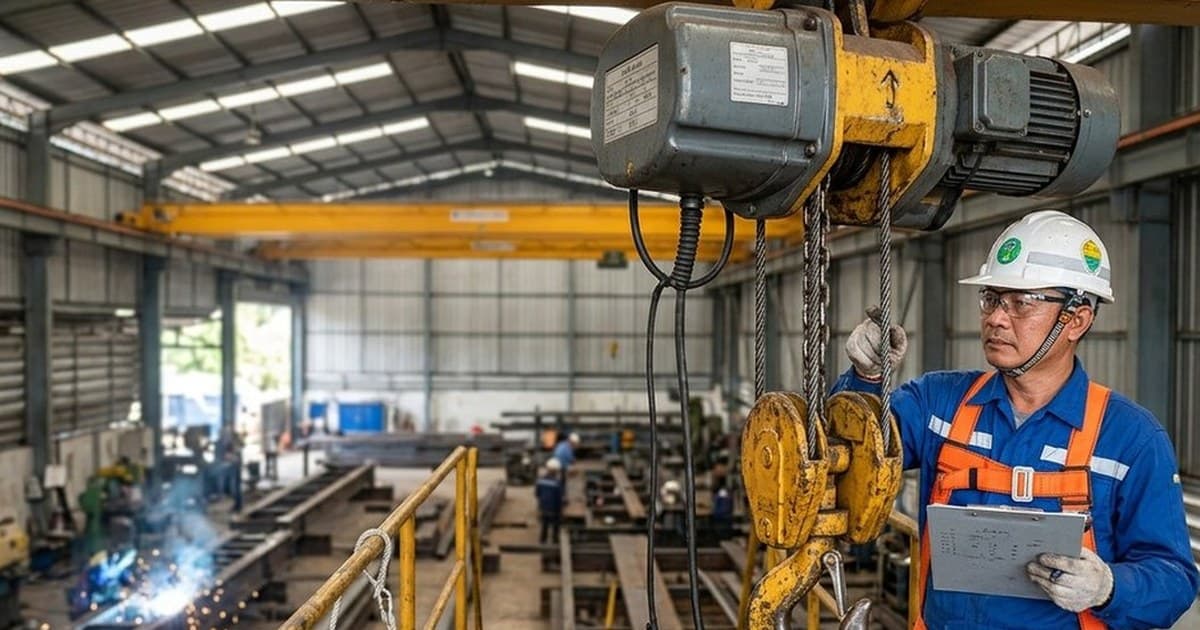
Inspection guide for Overhead Cranes, Jib Cranes, and Electric Hoists per OSHA 1910.179 + ASME B30.2 / B30.16 / B30.17 — frequent/periodic intervals, load test, sling, hook, brake
Overhead cranes + hoists in Thai factories typically lift loads of 0.5-50 tons — critical equipment whose failure can be catastrophic (a dropped load = fatality, structural damage, fire if lifting molten metal). OSHA 1910.179 + the ASME B30 series are the international standards that EPC contractors (Saudi Aramco, Chevron, ExxonMobil, Marubeni) enforce through contract clauses on suppliers in Thailand. This article interprets the inspection schedule, load test, and hook/rope/brake criteria.
OSHA 1910.179 + ASME B30 — Standard Mapping
| System | OSHA | ASME B30 | Applies to |
|---|---|---|---|
| Overhead/Gantry Crane | 1910.179 | B30.2 | Top-running bridge crane |
| Underhung Crane / Monorail | (general duty) | B30.11 / B30.17 | Underhung trolley/bridge |
| Jib Crane | (general duty) | B30.18 | Pivot-mounted arm crane |
| Electric Hoist | 1910.179 | B30.16 | Chain/Wire rope hoist (suspended) |
| Manual Hoist | (general duty) | B30.16 / B30.21 | Hand chain hoist, lever hoist |
| Crane Hook | (with above) | B30.10 | Hook on all lifting devices |
| Wire Rope / Chain Sling | (general duty) | B30.9 / B30.30 | Rigging hardware |
| Mobile Crane | 1910.180 | B30.5 | Truck-mounted, crawler, RT crane |
In Thailand these apply through:
- Occupational Safety and Health Act B.E. 2554
- Ministerial Regulation on Dangerous Machinery B.E. 2552
- TIS (มอก.) 1985 (Mobile crane), TIS (มอก.) 2562-2557 (Tower crane)
- EPC contract clauses (use OSHA + ASME directly)
Inspection Frequency — OSHA 1910.179(j)
flowchart TD
  A[Crane Inspection] --> B{Daily before use}
  B --> C[Operator visual check
5 items]
  C --> D{Monthly}
  D --> E[Frequent inspection
15 items — record deficiency]
  E --> F{Usage level?}
  F -->|Heavy > 70%
capacity| G[Periodic monthly
40+ items full record]
  F -->|Normal 30-70%| H[Periodic 3-6 months]
  F -->|Light < 30%| I[Periodic 12 months]
  G --> J[Annual Load Test
125% rated]
  H --> J
  I --> J
  J --> K[4-Yearly Re-cert
Major load test]
Daily Pre-Use Check (Operator) — 5 items
- Limit switches — Upper limit works, Lower limit works
- Hook + safety latch — not twisted, not cracked, latch self-closes
- Wire rope / chain — no kink, no visible broken wire, no corrosion
- Push-button / control — Up/Down/Left/Right/Stop all buttons responsive, emergency stop works
- Warning device — siren / horn works before starting movement + during movement
Frequent (Monthly) Inspection — 15 items
1-5. All items in the daily check (formal record) 6. Brake hold capability — lift half the load → release switch → observe whether the load drops 7. Hook wear + opening — measure throat opening + saddle wear 8. Wire rope tension — sag check + lubrication 9. Trolley / bridge wheel — no derailment, smooth movement 10. End stops / bumpers — present on all sides, soft contact 11. Electrical contacts — corrosion at contactor, panel cleanliness 12. Hour meter reading — track usage 13. Capacity placard — readable, permanently mounted 14. Hand signal chart — posted where the operator can see it 15. First aid + emergency contact — emergency phone nearby
Periodic (1-12 month) — 40+ items
Adding to the monthly check: 16-25. Structural — beam, end truck, bridge girder, runway rail wear measurement 26-30. Mechanical — gear box oil, sheave bearing, drum cracking, pillow block 31-35. Electrical — motor insulation, panel tightness, festoon cable, slip ring 36-40. Safety device — overload limit (LMI) test, anti-collision sensor, limit switch trip test
Periodic inspection must:
- Be performed by a "Qualified Person" — engineer / certified inspector
- Be recorded as a formal report + signed
- Be retained ≥ 2 years
Load Test (Annual + 4-Year)
Per ASME B30.2 4.3.2 + OSHA 1910.179(k):
Annual Load Test:
- Rated load × 1.00 (functional check) — verify all motions work under load
- Hold position + measure beam deflection
4-Yearly Full Load Test:
- 125% of rated capacity (OSHA 1910.179(k)(2) = 125%, ASME = 100% in some variants)
- Lift to mid-span of bridge + hold 10 minutes
- Measure permanent deflection — > 1/1000 of span → re-evaluate
- Test all motions under load
- No one may stand under the load test area
Equipment requiring re-test sooner than scheduled:
- Modification of structural / electrical
- Major repair (replacing gear box, motor)
- Damage from an overload incident
- After relocation
Hook Inspection Criteria (ASME B30.10)
| Factor | OK value | Reject |
|---|---|---|
| Throat opening increase | ≤ 15% from manufactured spec | > 15% — replace |
| Twist (axial rotation) | ≤ 10° | > 10° — replace |
| Saddle wear | ≤ 10% of cross-section | > 10% — replace |
| Visible cracks | None | Any — replace immediately |
| Heat damage / discoloration | None | Any — investigate |
| Safety latch | Closes positively | Sticky / non-closing — repair |
Test with dye penetrant (PT) or magnetic particle inspection (MPI) per ASME E165 / ASTM E709 at every periodic inspection.
Wire Rope Criteria (ASME B30.9 / B30.30)
| Factor | Reject Threshold |
|---|---|
| Broken wire | > 6 in 1 lay (= 6 × rope diameter), or > 3 in 1 strand |
| Wear (diameter loss) | > 10% from nominal diameter |
| Corrosion | External: > 1/3 of wire diameter. Internal: any visible |
| Kink | Any — replace |
| Bird-caging / strand displacement | Any — replace |
| Heat damage (above 200°C) | Any — investigate metallurgical |
| End attachment | Loose, slipping, corrosion — replace |
Chain sling (ASME B30.9):
- Stretch > 5% of original length → reject
- Bent / twisted link → reject
- Wear of link diameter > 10% → reject
Brake Test (ASME B30.16 / 30.17)
Static Brake Test:
- Lift rated load (or test load) to mid-span
- Release power
- Observe ≥ 10 minutes
- Load may drop ≤ 1% of lift height
Dynamic Brake Test:
- Lift rated load
- Bring up to full speed (up/down)
- Activate emergency stop
- Measure stop distance — typical ≤ 60 cm
Brake fail = remove from service immediately, no exceptions
Training Requirements
OSHA 1910.179(b)(8) mandates training before operating. Minimum curriculum:
- Crane operation theory
- Load chart reading + capacity at boom angle
- Standard hand signals (ASME B30.5)
- Rigging fundamentals (sling angle, load center, weight estimation)
- Daily / monthly inspection procedure
- Emergency procedure
- Practical operating evaluation
- Recertification every 3 years (ANSI/ASSP recommendation)
EPC + ISO 45001 audits will check:
- Operator certificate + recertification date
- Training record per operator
- Practical evaluation by Qualified Person
- Hand signal chart posted
TCO + Compliance Cost (factory with 1× 10-ton crane)
| Item | THB/year |
|---|---|
| Daily check (in-house operator time) | 10,000 |
| Monthly frequent (qualified person, 2 hr) | 30,000 |
| Periodic 3-month (certified inspector) | 60,000 |
| Annual load test | 25,000-50,000 |
| 4-yearly major load test | 80,000-150,000 (amortized 20,000-37,500/yr) |
| Operator training + recert | 15,000 |
| Wire rope replacement (avg) | 30,000-80,000 |
| Hook replacement (1-2 times per crane life) | 10,000-25,000 |
| Total annual | ~150,000-300,000 THB |
Inspection + maintenance combined < 5% of the crane's replacement cost (~5-15 million) but prevents a catastrophic failure that could shut down the factory for 1-3 months.
6 Procurement Guidelines
- Specify OSHA 1910.179 + ASME B30.2 / B30.16 in the TOR for overhead crane + hoist
- Permanently mounted capacity placard — showing rated capacity + serial number + manufacture date
- Pre-shipment load test 125% + factory certificate
- On-site commissioning load test before acceptance
- Operator training included + Thai-language manual
- Service network in Thailand — Konecranes, Demag/Terex, ABUS, Street Crane have dealer service. Don't buy a brand with no service center.
Summary
Crane + hoist inspection is critical safety + compliance at 3 levels: Daily (operator, 5 items) → Frequent monthly (15 items) → Periodic 1-12 month (40+ items, qualified person). Annual load test 100%, 4-yearly major test 125%. Reject a hook at throat > 15% / twist > 10° / wear > 10% / crack. Reject wire rope at broken wire > 6/lay or wear > 10% diameter. Operator training + recertification every 3 years per EPC + ISO 45001.
Sahawatthanakit provides crane inspection + load test + training per OSHA 1910.179 + ASME B30 — consult our team to request an inspection schedule + qualified person certification.
Frequently Asked Questions
How often is inspection? Daily (operator), Frequent monthly (15 items), Periodic 1-12 month (40+ items, qualified person). Heavy use > 70% → periodic monthly. Light < 30% → 12 months.
When is the Load Test? New install 125%, Major repair 125%, 4-yearly 125%, Annual 100%. No one under the load.
How worn before a hook is rejected? Throat > 15%, twist > 10°, wear > 10%, crack any (PT/MPI test). Some operators are stricter at > 5%.
How does wire rope degrade? Broken wire > 6/lay or > 3/strand. Diameter wear > 10%. Kink, bird-caging, internal corrosion = reject immediately.
How is a brake test done? Static: lift load → release → load drops ≤ 1% lift height in 10 minutes. Dynamic: full speed → e-stop → stop within 30-60 cm.
What training is required? Theory + load chart + ASME B30.5 hand signals + rigging + inspection + emergency + practical eval + recert every 3 years.
Get this guide as a reference brief (PDF)
Summary + full section list + standards cited, Saha-branded for your memo/RFQ — emailed to you too.
Questions after reading? Talk to our engineers
Tell us what you need — our engineers help you spec it right, with a real quote. No charge.
Need help with this in your facility?
Our team handles full procurement and installation for the topics covered in this article. Free quote within 2 hours.
Another line of ours — spreadsheet tools for SMEs
Job Costing & Pricing Calculator (Thai + English editions)
For work sold as jobs — enter materials, on-site hours and freight, and get the cash floor, the break-even, and the price you should quote.
Frequently Asked Questions
1How often should an overhead crane be inspected?
+
2When must a Load Test be done?
+
3How worn must a crane hook be before replacement?
+
4How does a wire rope (sling) degrade?
+
5How is a brake test performed?
+
6What training must an operator pass?
+
Comparison tables related to this article
Related content
Warehouse & Distribution Center (DC) Fit-Out and Maintenance Field Guide — Select Racking to AS 4084/EN 15512 · Epoxy/PU Floors · Steel Corrosion Protection · Rooftop Solar · Forklift Oils · Cold Storage · Safe Hot Work + How to Lock In Project Material Pricing
Field guide for warehouse and distribution-center (DC) owners and maintenance teams: plan the whole building by function — choose a racking system (Selective/Drive-In/Push-Back/Cantilever) to AS 4084/EN 15512, design for seismic loads (DPT 1311/ASCE 7), guard rack uprights and inspect annually per EN 15635, coat floors (epoxy/PU/PU-cement) to the load, protect steel from corrosion, put solar on the roof only after a structural load assessment, select forklift/MHE hydraulic-gear-grease oils, run cold storage, and control hot work during rack install/expansion per NFPA 51B — plus how to standardize materials to lock project pricing and delivery.
Warehouse Automation ASRS / AGV / AMR: How to Choose, Calculate ROI, Storage Density, and ISO 3691-4 Safety for Thai Plants & DCs
Buyer's guide to warehouse automation: compare ASRS unit-load/mini-load/shuttle/VLM → choose AGV vs AMR by layout → calculate real ROI (labour + density vs capex) → contractor checklist → ISO 3691-4 / EN 528 / NFPA sprinkler standards for Thai factories and distribution centres.
Rack Protection — Column Guards / End Barriers / Row Guards per EN 15512, EN 15620 & EN 15635 to Cut Forklift Damage
A guide to selecting pallet-rack protection against forklift impact: column/upright guards, end-of-aisle barriers, guard rails, guide rails — EN 15512 (0.5 kN accidental horizontal force at up to 0.4 m), column guards ≥ 400 mm high absorbing ≥ 400 Nm, EN 15620 clearances, EN 15635 GREEN/AMBER/RED damage assessment + PRRS, and what a TOR must specify to prevent rack collapse in Thai warehouses.
Seismic Design of Storage Racks — DPT 1311, ASCE 7-22, FEM 10.2.08 for Warehouses in Thailand
A guide to seismic design of pallet racking in Thailand: DPT standard 1311-50, ASCE/SEI 7-22, FEM 10.2.08 / EN 16681, ANSI MH16.1-2023, Bangkok soft-soil amplification, base plate + anchor + bracing, and what government TORs require.