
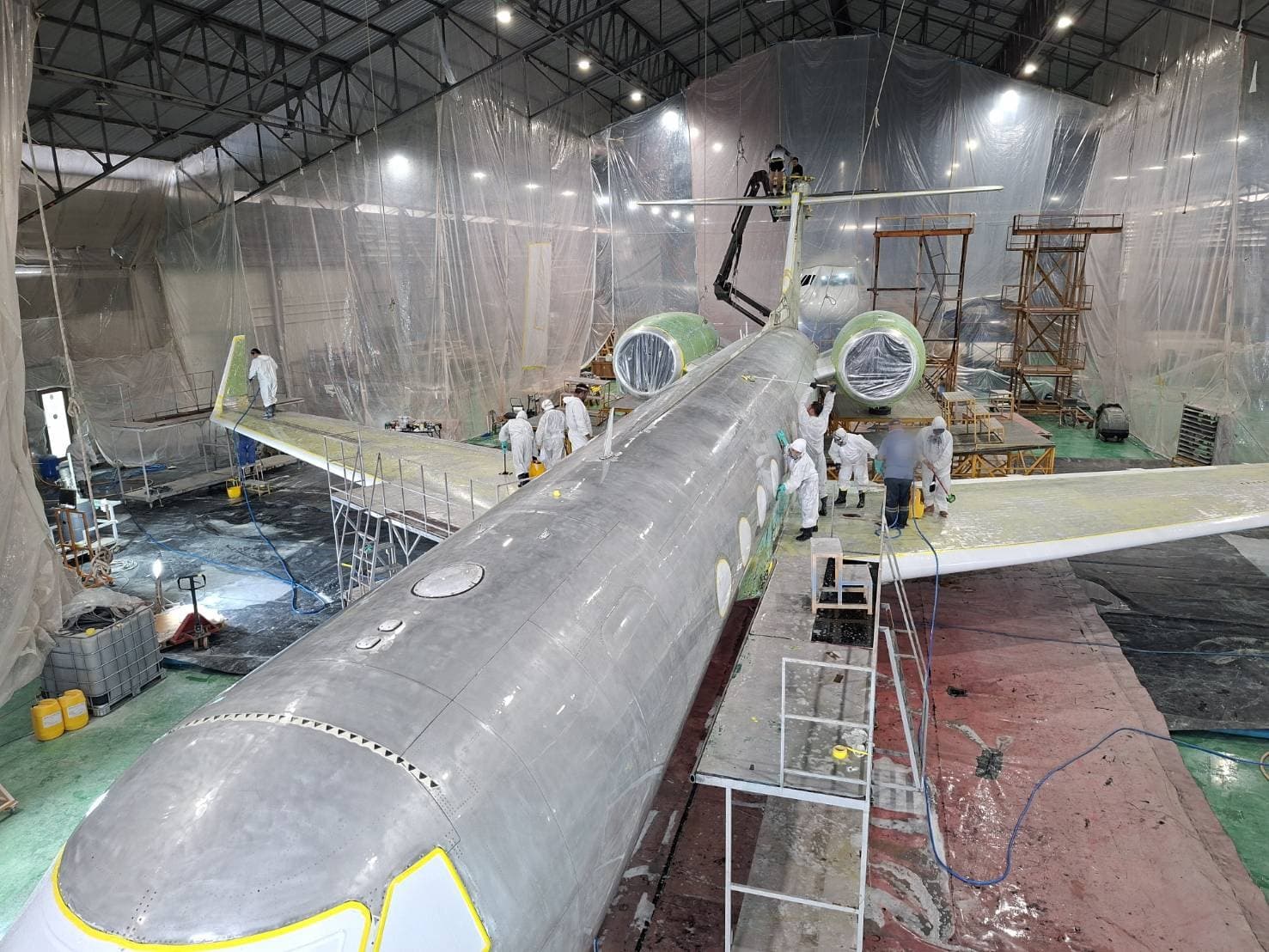
Materials usually fail goods inspection on shelf life, not on specification. MIL-T-81772B Type I carries one year from date of manufacture, so 'new stock' as a condition still admits material already ten months old. State a measurable remaining shelf life at the buyer's receipt, and state the type and grade — MIL-T-81772B covers three types and TT-I-735 has several grades.
When an aircraft repaint stops to wait for materials, the cause is usually neither late delivery nor a wrong specification.
It is something found at goods inspection: every specification number matches, but there is not enough remaining shelf life to finish the job — or the thinner that arrived is a different type from the coating system on the floor. In both cases the supplier delivered exactly what the enquiry asked for. The gap was in the enquiry.
Here is what has to be added, using specifications that can be read in full.
1. A specification number alone is not a specification
Thinner is the clearest example.
MIL-T-81772B is the military specification covering thinner for reducing aircraft coatings, and it covers three types, not one.
- Type I is the polyurethane thinner, intended for two-component polyurethane systems to specifications such as MIL-DTL-53039 and MIL-PRF-85285.
An enquiry that says only "MIL-T-81772B" lets the supplier choose any of the three, and what arrives still matches what was written. The complete line is "MIL-T-81772B Type I", with the pack size.
The same holds for other solvents. TT-I-735, the specification for isopropyl alcohol, is divided into grades — Grade A and Grade B among them, at differing concentrations. The grade is part of the specification, not a detail to settle later.
2. Shelf life: "new stock" is not a unit of measurement
This is the condition that stops work most often, and the one a single added line fixes.
MIL-T-81772B Type I carries a shelf life of one year from date of manufacture.
Put that figure into a real case. If the enquiry says "new stock, not old inventory", material manufactured ten months ago satisfies the condition completely — and leaves two months of usable life. If the job runs on as maintenance work does, what remains in the store expires before it is used and has to be written off.
The way to close it is to write a condition that can be measured, stating all three together:
- Date of manufacture, shown on the delivery documents
- Minimum remaining shelf life at the buyer's receipt — for example, not less than 70%
- A certificate of conformance (COC) from the manufacturer or the supplying company
The important words are "at the buyer's receipt", not at despatch from the supplier's store. Imported material spends time in transit and in customs clearance; measured at origin, the life lost on the way becomes the floor's problem.
Many aviation units already carry this rule in their own regulations. Where yours does, state it at enquiry stage so lots can be selected against it from the start, rather than discovering the problem at inspection and returning the goods.
3. Some specifications have stopped being maintained
Purchasing documents handed down over years tend to carry the same specification numbers, with nobody going back to check whether those specifications are still live.
AMS3180 is an SAE International specification covering industrial-grade toluene in liquid form, originally issued in 1940 and held by the AMS B Finishes, Processes and Fluids committee.
What is worth knowing is that the current revision, AMS3180G, was stabilized in 2015. SAE's own definition of that status is a document that will no longer be updated and may no longer represent standard industry practice, because it covers technology for which the expertise no longer exists in a technical committee.
The opposite caution applies too — old is not the same as obsolete. TT-I-735A is dated 1963, older than much of what is in daily use, yet Notice 4 was issued in 2019 confirming the specification remains valid for acquisition. What matters is the document's status, not the year on its cover.
Citing AMS3180 is not wrong, and material made to it is still sold. But it should be cited in the knowledge that it is a frozen specification rather than one still under review — particularly where solvents intersect with volatile organic compound (VOC) limits and safety requirements, both of which have moved considerably since 2015.
4. Solvents are flammable goods, which shapes transport and storage
The figure to read alongside the specification is flash point. For MIL-T-81772B Type I it is about −5 °C.
That is not an academic number. It determines that the material ships as dangerous goods, is stored in an area designated for flammable liquids, and is limited in how much the site may hold at one time. Ordering in bulk to bring the unit price down can therefore run into the unit's own storage rules rather than its budget.
5. Abrasives: order the sequence, not one grit
Real surface preparation does not use a single grit. It works from coarse to fine in stages, according to the surface and the coating system going over it.
At enquiry stage, stating which grits and how many of each gets a set that matches the work, rather than a large quantity of one grade. The disc format should match the backing pads in use — 6-inch, 45-hole, for instance — because a hole pattern that does not line up stops the extraction working as designed, and dust left on the surface is what produces defects in the coat sprayed over it.
6. Waste containers have to be there first
Cleaning down equipment and making work good produces paint waste that has to be segregated and disposed of under the unit's own regulations.
200-litre steel drums therefore belong on the same order as the materials, rather than being ordered afterwards once work has started — otherwise the floor stops to wait for a container at the moment the waste already exists.
7. What we need in order to quote accurately
Three things:
- The specification or manufacturer code — MIL-T-81772B Type I, AMS3180, TT-I-735A, or codes such as C25/90S and C28/15
- The pack size and unit you want (gallon, pail, roll, sheet)
- The quantity and the date you need it
If an RFQ or an earlier purchase order already exists, send it as it is — we will quote against your own line numbers so your purchasing side can check it line for line.
And where the unit sets a minimum remaining shelf life, stating it with the enquiry helps more than anything else on this list.
Our role in this work
Sahawatthanakit (1988) supplies and delivers the materials for aircraft paint and surface-preparation work. We do not spray aircraft and we do not manufacture the chemicals.
The application and the quality of the finished surface belong to the maintenance unit or its approved contractor. Our job is that the materials they need are to the right specification, fully documented, and there on time.
COC, date of manufacture, and remaining shelf life certified at the buyer's receipt are standard delivery conditions for us rather than extras, and new stock only.
Send the list to 02-096-2118 or 081-866-8368.
Get this guide as a reference brief (PDF)
Summary + full section list + standards cited, Saha-branded for your memo/RFQ — emailed to you too.
Questions after reading? Talk to our engineers
Tell us what you need — our engineers help you spec it right, with a real quote. No charge.
Need help with this in your facility?
Our team handles full procurement and installation for the topics covered in this article. Free quote promptly during business hours.
Another line of ours — spreadsheet tools for SMEs
Quote Register + Win Rate (Thai + English editions)
For quotes that go silent — one row per quote, telling you which to chase today and what your real win rate is.
Frequently Asked Questions
1Is writing MIL-T-81772B on the enquiry enough?
+
2Why set remaining shelf life at the buyer's receipt rather than just asking for new stock?
+
3What is AMS3180, and why treat it with care?
+
4Can we order a single grit of sanding disc?
+
5Does Sahawatthanakit carry out the painting as well?
+
Related content
Surface Preparation Before Industrial Painting — Sa 2.5, ISO 8501-1, Blast Profile, and Why 80% of Coating Failures Start Here
Guide to steel surface preparation before anti-corrosion painting: cleanliness grades Sa 1/2/2.5/3 per ISO 8501-1, SSPC-SP / NACE equivalents, abrasive blast profile (Rz/anchor pattern) per ISO 8503, soluble salt testing, dew point vs RH 85%, and a blast-cleaning inspection checklist for Thailand.
Specifying a Ground Power Unit — 400 Hz, 28 VDC, and the Figures a TOR Usually Leaves Out
How to specify an aircraft ground power unit against standards that can be checked — MIL-STD-704 (115/200 V 400 Hz AC and 28 V DC), ISO 6858:2017, which measures the output at the aircraft attaching connector rather than at the machine's own terminals, and EN 2282. Explains why a line reading 'GPU, 90 kVA' is not yet an order, and how output, number of outlets, power source and tow tractor class are actually decided.
3D LiDAR Scanning + Cathodic Protection: Find the 'Symptom' Before Failure, Stop the 'Cause' at the Rebar
Why modern structural inspection pairs two things: 3D LiDAR scanning that measures settlement, cracking and spalling down to millimeter level, then Cathodic Protection that stops the rebar corrosion that is the real cause. The scan → diagnose → protect → monitor lifecycle for bridges, buildings and railways — with the realistic accuracy (cm/mm) achievable, no overclaiming.
Very-Low / Ultra-Low Temperature Refrigerant Retrofit — Replacing R-13B1 / R-503 / R-13 in Freeze Dryers & Cascade Systems with R-508B, Done Right
A guide to very-low / ultra-low temperature (VLT/ULT) refrigerant retrofits for freeze dryers (lyophilizers), environmental chambers, blast freezers and cascade systems in Thailand: why R-13B1 (halon), R-503 and R-13 (CFC) are obsolete/unobtainable, the modern replacement R-508B across −40 to −80°C, the most-missed core of the job — changing compressor oil (mineral/AB → POE) and low-temperature oil return, how glide/azeotrope affects charging and the TXV, retrofitting both stages of a cascade, the correct procedure (recover → flush → change drier/seals → deep vacuum < 500 micron → charge by weight → pulldown), and why moisture is the deadly enemy at ULT — plus the high GWP of R-508B/R-23, lower-GWP options, and refrigerant import licensing via Thailand's DIW under Montreal/Kigali obligations.