
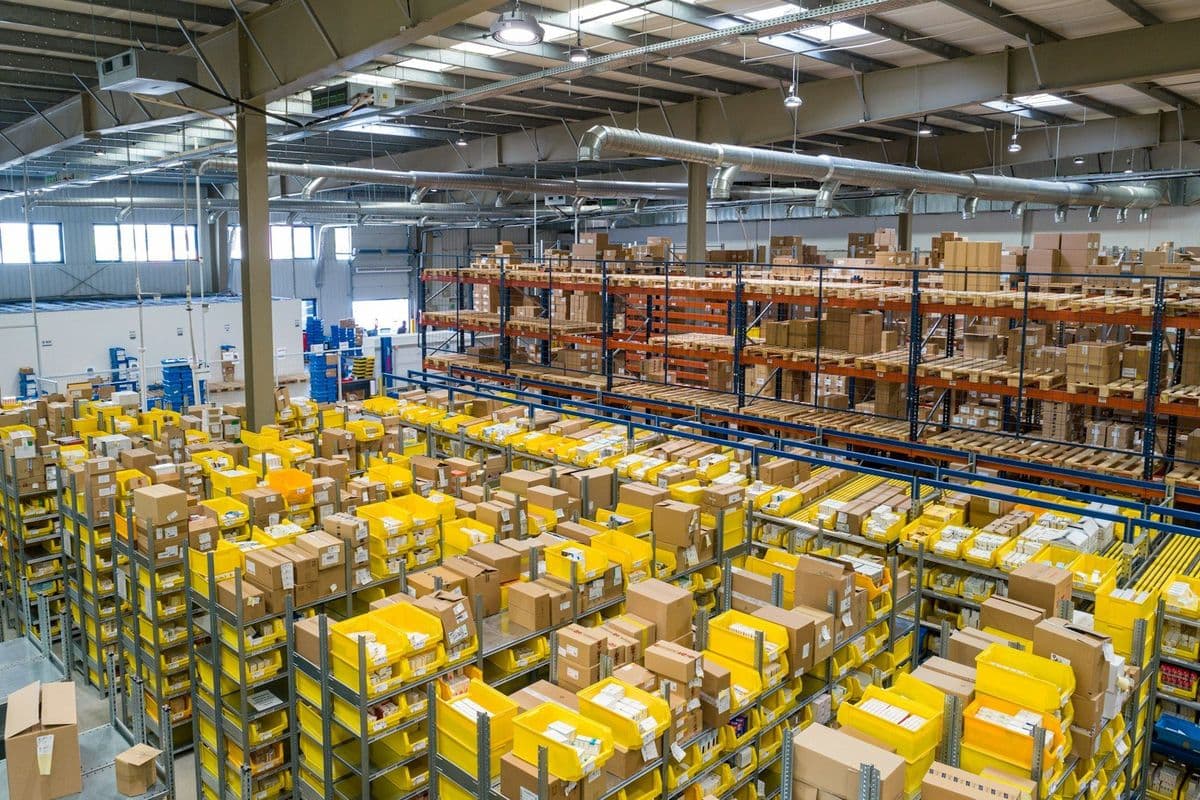
How to choose the right warehouse racking type and verify load capacity — comparing Selective Rack, Drive-In Rack, Push-Back, and Cantilever with per-shelf weight tables, EN 15512 / AS 4084 / RMI standards reference, and the 5 most common buying mistakes.
See the whole-system guide: the Warehouse/DC fit-out guide — this article is one step — see the end-to-end fit-out guide.
"How much weight can this rack hold?" — a question that sounds simple but has a more complex answer than the number printed in the catalogue. This guide explains how to correctly assess load capacity, choose the right rack type for your operation, and avoid the structural failures that come from buying wrong.
Four Main Rack Types
1. Selective Rack (Standard Pallet Racking)
Description: The most common racking type in Thailand. Each bay position stores one pallet, accessible directly without moving other pallets.
| Spec | Typical range |
|---|---|
| Load per shelf | 500–2,000 kg/shelf (per specification) |
| Maximum height | 12m+ (depending on column profile) |
| Bay width | 1.8–2.7m |
| Depth | 0.8–1.2m |
| Pallet access | 100% of all pallets (full FIFO) |
Best for:
- Warehouses with many SKUs and multiple lots — each pallet must be independently accessible
- FIFO operations: food, pharmaceuticals, date-sensitive materials
- Medium-to-large warehouses requiring layout flexibility
2. Drive-In Rack (High-Density Forklift Access)
Description: Deep rack system where forklifts drive inside to place and retrieve pallets — no cross aisles. Uses approximately 80% more floor area than Selective for same pallet count.
| Spec | Typical range |
|---|---|
| Load per lane/level | 500–1,500 kg |
| Maximum height | 8m |
| Pallet depth | 4–10 pallets deep |
| Bay width | 2.7–3.6m (per forklift size) |
| Pallet access | LIFO (or FIFO with drive-through 2-entry) |
Best for:
- Bulk storage with few SKUs — same product in large quantities
- Cold storage rooms — minimizes wall area, reduces refrigeration cost
- Seasonal products stored and retrieved in full lot batches
Note: Drive-In systems have higher forklift impact damage rates — column guards are essential on every upright.
3. Push-Back Rack (Automated LIFO)
Description: Pallets ride on carts on inclined rails. Loading a new pallet automatically pushes the previous one back; the front position is always the pick face.
| Spec | Typical range |
|---|---|
| Load per lane | 500–1,500 kg |
| Depth | 2–5 pallets |
| Max height | 8m |
| Access mode | LIFO (always pick from front) |
Best for:
- Products where FIFO is not required — lubricants, construction materials, spare parts
- Higher density than Selective with easier access than Drive-In
4. Cantilever Rack (Long-Goods Storage)
Description: Arms extend from a central column on one or both sides — no horizontal beams blocking loading. Designed for goods that cannot fit in standard pallet bays.
| Spec | Typical range |
|---|---|
| Load per arm | 500–3,000 kg/arm |
| Height | 3–8m+ |
| Arm length | 0.5–1.5m |
| Arm pitch (vertical) | Adjustable per product |
Best for:
- Steel pipes, angle iron, structural profiles — 3–12m lengths
- Timber, plywood sheets, aluminum extrusions
- Windows, doors, glass panels
- Automotive long parts storage
Four-Way Comparison Table
| Criterion | Selective | Drive-In | Push-Back | Cantilever |
|---|---|---|---|---|
| Pallet access | 100% FIFO | Low — LIFO/FIFO | Medium — LIFO | 100% FIFO |
| Storage density | Medium | Very high | High | Depends on product |
| SKU variety | High | Low | Low–medium | Long/large goods |
| Pick speed | Fast | Slow | Medium | Fast |
| Cold storage fit | Good | Excellent | Good | Not suitable |
| Cost per pallet | Low | Low (vs density) | Medium | Depends on spec |
| Forklift damage risk | Low | High | Low–medium | Low |
Calculating Load Capacity Correctly
The number in a catalogue is a Uniform Distributed Load (UDL) — not a universal maximum for all conditions.
Information you must provide before purchasing:
- Maximum pallet weight (kg) including pallet board
- Pallet dimensions (W × L × H)
- Maximum tiers per bay
- Total height required (m)
- Warehouse floor plan and door openings (determines minimum aisle width)
- Floor slab load rating — old factory floors may only carry 3–5 ton/m² but a 10m-high rack may require 8–12 ton/m² at column base
- Forklift type — turning radius determines aisle width
flowchart TD
  A["What is the pallet weight?"]
  A --> B{"> 1,500 kg/pallet?"}
  B -->|"Yes"| C["Heavy Duty
Requires custom design + foundation calculation"]
  B -->|"No"| D{"How many SKUs?"}
  D -->|"Many (>20 SKUs)"| E{"FIFO required?"}
  D -->|"Few (<5 SKUs)"| F["Drive-In or Push-Back"]
  E -->|"Yes (food/pharma)"| G["Selective Rack — full FIFO"]
  E -->|"Not required"| H["Selective or Push-Back"]
  D -->|"Long goods (>2m)"| I["Cantilever Rack"]
5 Most Common Buying Mistakes
1. Underspecifying weight — forgetting to include the pallet board weight (~15–25 kg), which causes beam deflection over time
2. Not measuring forklift clearance — a 3-way turret forklift requires 3.2m minimum aisle but if you buy standard counterbalance type you need 2.8–3.5m; rack layout must be designed for the actual forklift
3. Not checking the floor — old factory slabs may only carry 3–5 ton/m² but a 10m-high rack concentrates 8–12 ton/m² at column bases; structural survey is not optional
4. Buying unrated rack — no load certification document → insurance won't cover → no recourse if it collapses
5. No column guards — a single forklift impact on an upright can require replacing an entire bay row; column guards cost very little versus repair costs
Standards Reference
| Standard | Origin | Used for |
|---|---|---|
| EN 15512:2020 | Europe | Structural design of adjustable pallet racking |
| AS 4084:2023 | Australia/NZ | Asia-Pacific reference for rack design |
| RMI ANSI MH16.1:2021 | USA | Design, testing, utilization of industrial steel racks |
| SEMA Code | UK | Design of static racking (complementary reference) |
Racking supplied by Sahawatthanakit comes with structural calculation documents per EN 15512 and AS 4084, plus load tags on every bay specifying the certified maximum load.
Services Included with Every Racking Order
- Free on-site survey (Bangkok metro area) — actual floor measurement, slab condition check, layout recommendation
- Layout design — 2D/3D plan with aisle paths and forklift flow
- Load calculation — per EN 15512 for your actual product weights
- Installation — company engineering team
- Column guards — recommended and installed simultaneously
Request a Free Layout Design
Send us your floor dimensions and pallet weight — our engineers will produce a preliminary layout before you commit.
- Phone: +66-2-096-2118
- LINE: @sahawatt1988
- Email: info@sahawatthanakit1988.com
- Request a quote: Click here
Get this guide as a reference brief (PDF)
Summary + full section list + standards cited, Saha-branded for your memo/RFQ — emailed to you too.
Questions after reading? Talk to our engineers
Tell us what you need — our engineers help you spec it right, with a real quote. No charge.
Need help with this in your facility?
Our team handles full procurement and installation for the topics covered in this article. Free quote within 2 hours.
Another line of ours — spreadsheet tools for SMEs
Job Costing & Pricing Calculator (Thai + English editions)
For work sold as jobs — enter materials, on-site hours and freight, and get the cash floor, the break-even, and the price you should quote.
Comparison tables related to this article
Related content
AS 4084 vs EN 15512 — Choosing a Rack Standard for Thai TOR
Comparing 3 pallet rack standards — AS 4084 (Australia), EN 15512 (Europe), FEM 10.2.06 — and how to pick based on ministry TOR + Department of Public Works and Town & Country Planning + DPT 1311-50 seismic requirements
Warehouse & Distribution Center (DC) Fit-Out and Maintenance Field Guide — Select Racking to AS 4084/EN 15512 · Epoxy/PU Floors · Steel Corrosion Protection · Rooftop Solar · Forklift Oils · Cold Storage · Safe Hot Work + How to Lock In Project Material Pricing
Field guide for warehouse and distribution-center (DC) owners and maintenance teams: plan the whole building by function — choose a racking system (Selective/Drive-In/Push-Back/Cantilever) to AS 4084/EN 15512, design for seismic loads (DPT 1311/ASCE 7), guard rack uprights and inspect annually per EN 15635, coat floors (epoxy/PU/PU-cement) to the load, protect steel from corrosion, put solar on the roof only after a structural load assessment, select forklift/MHE hydraulic-gear-grease oils, run cold storage, and control hot work during rack install/expansion per NFPA 51B — plus how to standardize materials to lock project pricing and delivery.
Warehouse Storage Racking — Prices and Suppliers in Thailand 2026 — Selective / Drive-In / Heavy Duty
Warehouse storage racking prices in Thailand 2026, with standard size tables for Micro Rack, Heavy Duty, and Selective, plus free site survey and layout design services
Warehouse Racking Standards in Thailand — TIS 1227 / 1479 plus AS 4084 / EN 15512 / ANSI MH16.1
Thai contractors buy pallet racking without asking which code it was engineered to. TISI has not issued a dedicated TIS for racking systems, but the steel itself should comply with TIS 1227 / TIS 1479, and the rack as a system should follow AS 4084, EN 15512, or ANSI MH16.1. Here's how the two layers fit together.