
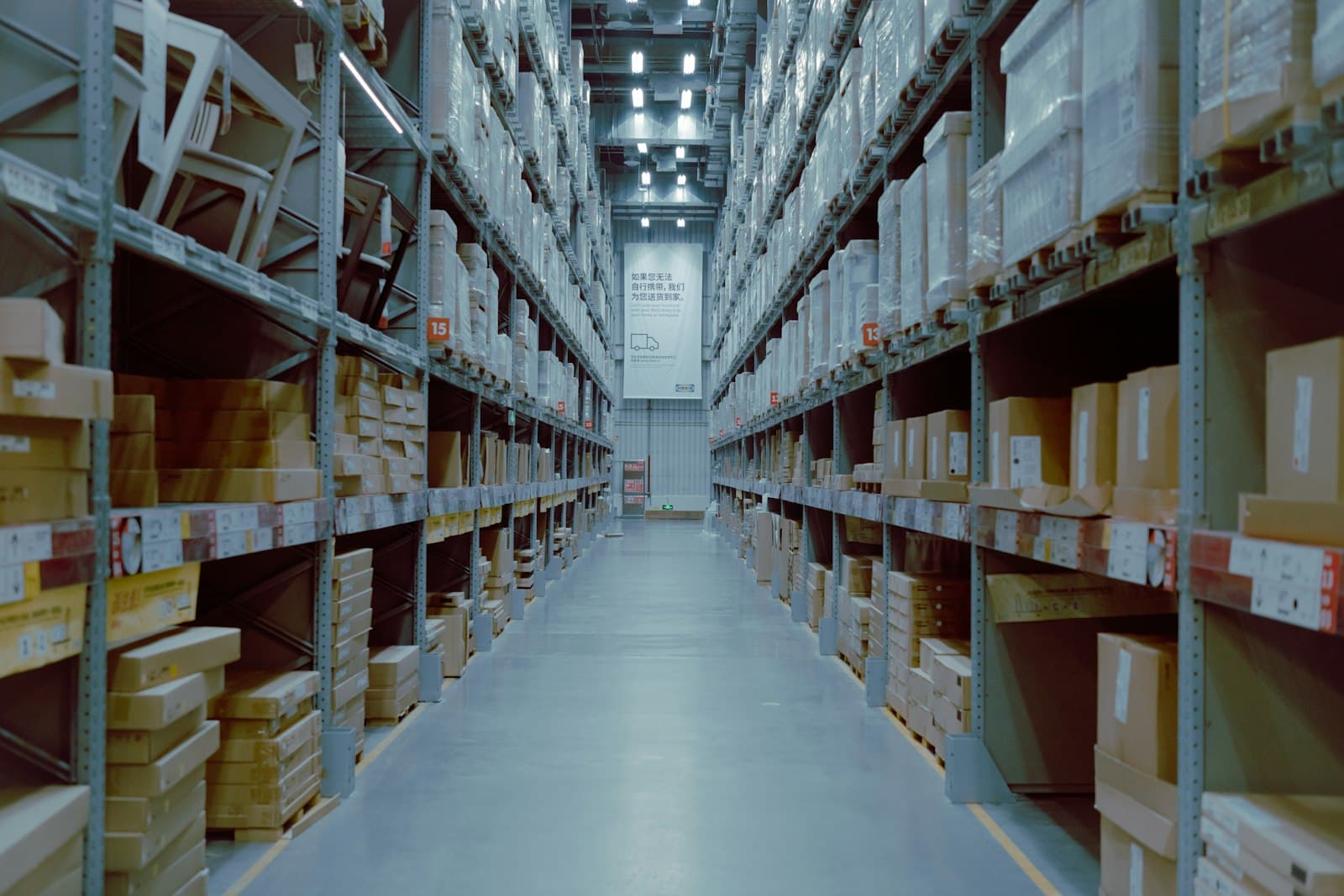
The three main pallet racking systems trade off very differently: Selective offers 100% pallet selectivity but the lowest density, Drive-In adds 40-60% density at the cost of LIFO and pick speed, Push-Back gains 50-100% density with single-aisle access. This article compares all three under ANSI MH16.1-2023, FEM 10.2.07, and EN 15512.
See the whole-system guide: the Warehouse/DC fit-out guide — this article is one step — see the end-to-end fit-out guide.
A warehouse manager receives a requisition to add 2,000 pallet positions and gets three quotes: supplier A offers Selective at 4,200 THB per position, supplier B offers Drive-In at 2,800 THB per position, supplier C offers Push-Back at 5,500 THB per position. Cheapest per position is rarely the right answer — the Drive-In quote may slow operations by 40% if the SKU profile is wrong. This article compares the three systems on the criteria that procurement actually has to decide on: SKU velocity, FIFO/LIFO, footprint cost, damage risk, and design standard compliance under ANSI MH16.1, FEM 10.2.07, and EN 15512.
The decisive criteria — SKU velocity and pallets per SKU
Before choosing a system, answer three questions:
- How many SKUs in inventory? — 50 distinct SKUs vs 5,000 distinct SKUs lead to fundamentally different system choices
- How many pallets per SKU? — 1-2 pallets per SKU vs 50+ pallets per SKU
- Is FIFO required? — perishables, batch tracking, expiry dates
The three systems sit at different points on the trade-off curve between selectivity (ability to access any pallet on demand) and density (pallets stored per square metre).
Selective Pallet Rack — the workhorse
Selective is the most common pallet rack worldwide — an aisle between every row, every pallet directly accessible from the aisle, standard counterbalanced forklifts can operate.
100% selectivity — every pallet in the system can be picked without moving any other pallet.
Design standards
- ANSI MH16.1-2023 (RMI, US) — covers selective, push-back, drive-in, pallet-flow, and pick modules
- EN 15512:2020+A1:2022 (Europe) — adjustable pallet racking specifically
- AS 4084:2023 (Australia) — common reference in the Asia-Pacific region
Best fit
- Warehouses with high SKU diversity (500+ SKUs)
- Few pallets per SKU (1-10)
- FIFO required by default — new pallets go in new positions, no contact with older stock
- High pick velocity — forklift must reach pallets quickly
Limitations
- Highest footprint cost — aisle-to-storage ratio is roughly 50:50
- 1,000 m² typically yields 700-900 pallet positions
Drive-In / Drive-Through Rack — maximum density
Drive-In eliminates aisles between rows — the forklift drives "into the rack" on rails attached to the uprights to place or retrieve pallets in lanes that are 4-10 pallets deep.
Drive-In (1 access aisle, LIFO)
- Single load/retrieve aisle
- Last pallet in is first pallet out (Last-In-First-Out)
- Density gain of 40-60% vs selective in the same footprint
Drive-Through (2 access aisles, FIFO)
- Aisles on both sides — load from one, retrieve from the other
- First pallet in is first pallet out (First-In-First-Out)
- Upright bracing must be stronger because there is no back wall to brace against
- Density gain drops to 30-40% (two aisles instead of one)
Design standards
- FEM 10.2.07 (Europe) — written specifically for drive-in/drive-through, supplements EN 15512 with calculations the general standard does not cover (e.g. load eccentricity from cantilever rails)
- ANSI MH16.1-2023 — has a section dedicated to drive-in
- Second-order analysis with global imperfections is mandatory under FEM 10.2.07 because drive-in lacks the cross-bracing of selective
Best fit
- Few SKUs (10-50) but many pallets per SKU (50+)
- Bulk raw materials with no rotation requirement — zinc ingots, silica sand, packaging stock
- Cold storage where energy cost per square metre is high — denser storage = lower utility cost
- Production-line buffer stock that arrives in batches
Hidden risks often overlooked
- 30-50% slower pick velocity vs selective — forklift must stop, square up, then creep into the lane
- High damage risk — forklift drives inside the lane, frequently impacts rails and uprights. SEMA/FEM 10.2.16 requires column protectors at least 400 mm high and end-of-aisle barriers for every lane
- Not FIFO unless configured drive-through, which surrenders half the density gain
- Specialised forklift training — new operators will damage rails within the first month
Push-Back Rack — the middle ground
Push-Back uses rolling carts that slide on slightly inclined rails. It works like a beverage cooler in a convenience store — when the front pallet is removed, the pallets behind it roll forward by gravity.
Loading and retrieval both happen from the same aisle — but the forklift never enters the lane (unlike drive-in).
Typical configuration
- Lane depth: 2-7 pallets (3-5 typical)
- Height: up to 4 levels
- Storage density gain: 50-100% vs selective
Design standards
- ANSI MH16.1-2023 covers push-back explicitly — rolling cart, rail pitch, end stop requirements
- Some Asian manufacturers cite EN 15512 alone, which is insufficient because EN 15512 does not cover push-back specifically. MH16.1 must be the primary reference
Best fit
- Medium SKU diversity (50-300 SKUs) — each with 3-7 pallets
- LIFO is acceptable — date rotation not required
- Medium pick velocity — no need to pick the oldest pallet first
- Limited floor space but unwilling to commit to drive-in (because of damage risk and FIFO constraint)
Limitations
- Highest cost per position — every lane has cart and rail mechanism
- Lanes deeper than 5 pallets are not recommended — gravity may not feed the rear pallets forward, carts get stuck, requiring people to enter the lane (unsafe)
- Mechanical maintenance required — wheel bearings wear, rails sag → carts hang up
Decision matrix
| Factor | Selective | Drive-In | Drive-Through | Push-Back |
|---|---|---|---|---|
| Selectivity | 100% | ~10-20% (lane only) | ~10-20% | ~25% (front pallet) |
| Density gain vs Selective | 0% (baseline) | +40-60% | +30-40% | +50-100% |
| Order method | FIFO | LIFO | FIFO | LIFO |
| Aisles | between every row | 1 side | 2 sides | 1 side |
| Forklift | standard | specialised (narrow, slow) | specialised | standard |
| Damage risk | low | very high (in-lane impact) | high | medium |
| Pick velocity | highest | low (-30% to -50%) | low | medium |
| Cost per position | medium | lowest | low | highest |
| Primary standard | EN 15512 / MH16.1 / AS 4084 | FEM 10.2.07 + EN 15512 | FEM 10.2.07 | MH16.1 (push-back section) |
| SKU profile fit | high (500+) | few (10-50) bulk | few bulk + perishable | medium (50-300) |
60-second decision tree
Ask in this order:
- More than 200 SKUs? → Selective
- Fewer than 50 SKUs + no FIFO requirement + 30+ pallets per SKU? → Drive-In
- Few SKUs but FIFO required (perishables)? → Drive-Through
- 50-300 SKUs + 3-5 pallet depth acceptable + LIFO acceptable? → Push-Back
- Mixed profile — some high-velocity, some bulk? → hybrid — Selective at the front, Drive-In or Push-Back at the back
Common procurement mistakes
Contractors that compete on price alone tend to miss four things:
- Citing a code that doesn't cover the system — quoting drive-in against EN 15512 alone is incomplete; FEM 10.2.07 must accompany it
- Omitting column protectors and end-of-aisle barriers — SEMA/FEM 10.2.16 requires these, but contractors often delete them to shave 3-5% off the price; the cost when a forklift impact collapses an aisle is the entire rack plus everything stored on it
- Capacity calculations from outdated tables — RMI states that frame capacity tables from MH16.1-2012 are no longer valid under MH16.1-2021/2023, which now considers nine factors including beam-to-column connector stiffness, base plate detail, site seismicity, and frame aspect ratio
- Missing LARC drawing — Load Application and Rack Configuration drawings must be displayed at the rack location and retained by both manufacturer and warehouse owner; required by MH16.1 and used during safety audits
Summary
The three pallet racking systems make explicit trade-offs — Selective optimises flexibility, Drive-In optimises density (with operational constraints), Push-Back is the balanced compromise at higher unit cost but with standard forklift compatibility. Choose by actual SKU profile and velocity, not lowest unit price. In every RFQ, require the contractor to declare which design standard (ANSI MH16.1, FEM 10.2.07, or EN 15512) governs, and demand the LARC drawing as a deliverable — these two things prevent rack collapses far more reliably than steel grade alone.
Sahawatthanakit (1988) designs and supplies all three racking system types to international standards. For specifications and load calculations, please contact us at /quote.
Get this guide as a reference brief (PDF)
Summary + full section list + standards cited, Saha-branded for your memo/RFQ — emailed to you too.
Questions after reading? Talk to our engineers
Tell us what you need — our engineers help you spec it right, with a real quote. No charge.
Need help with this in your facility?
Our team handles full procurement and installation for the topics covered in this article. Free quote within 2 hours.
Another line of ours — spreadsheet tools for SMEs
Job Costing & Pricing Calculator (Thai + English editions)
For work sold as jobs — enter materials, on-site hours and freight, and get the cash floor, the break-even, and the price you should quote.
Comparison tables related to this article
Related content
Warehouse Racking Standards in Thailand — TIS 1227 / 1479 plus AS 4084 / EN 15512 / ANSI MH16.1
Thai contractors buy pallet racking without asking which code it was engineered to. TISI has not issued a dedicated TIS for racking systems, but the steel itself should comply with TIS 1227 / TIS 1479, and the rack as a system should follow AS 4084, EN 15512, or ANSI MH16.1. Here's how the two layers fit together.
AS 4084 vs EN 15512 — Choosing a Rack Standard for Thai TOR
Comparing 3 pallet rack standards — AS 4084 (Australia), EN 15512 (Europe), FEM 10.2.06 — and how to pick based on ministry TOR + Department of Public Works and Town & Country Planning + DPT 1311-50 seismic requirements
Warehouse & Distribution Center (DC) Fit-Out and Maintenance Field Guide — Select Racking to AS 4084/EN 15512 · Epoxy/PU Floors · Steel Corrosion Protection · Rooftop Solar · Forklift Oils · Cold Storage · Safe Hot Work + How to Lock In Project Material Pricing
Field guide for warehouse and distribution-center (DC) owners and maintenance teams: plan the whole building by function — choose a racking system (Selective/Drive-In/Push-Back/Cantilever) to AS 4084/EN 15512, design for seismic loads (DPT 1311/ASCE 7), guard rack uprights and inspect annually per EN 15635, coat floors (epoxy/PU/PU-cement) to the load, protect steel from corrosion, put solar on the roof only after a structural load assessment, select forklift/MHE hydraulic-gear-grease oils, run cold storage, and control hot work during rack install/expansion per NFPA 51B — plus how to standardize materials to lock project pricing and delivery.
Warehouse Racking Load Capacity Guide — Selective, Drive-In, Cantilever Rack Buyer's Guide
How to choose the right warehouse racking type and verify load capacity — comparing Selective Rack, Drive-In Rack, Push-Back, and Cantilever with per-shelf weight tables, EN 15512 / AS 4084 / RMI standards reference, and the 5 most common buying mistakes.