
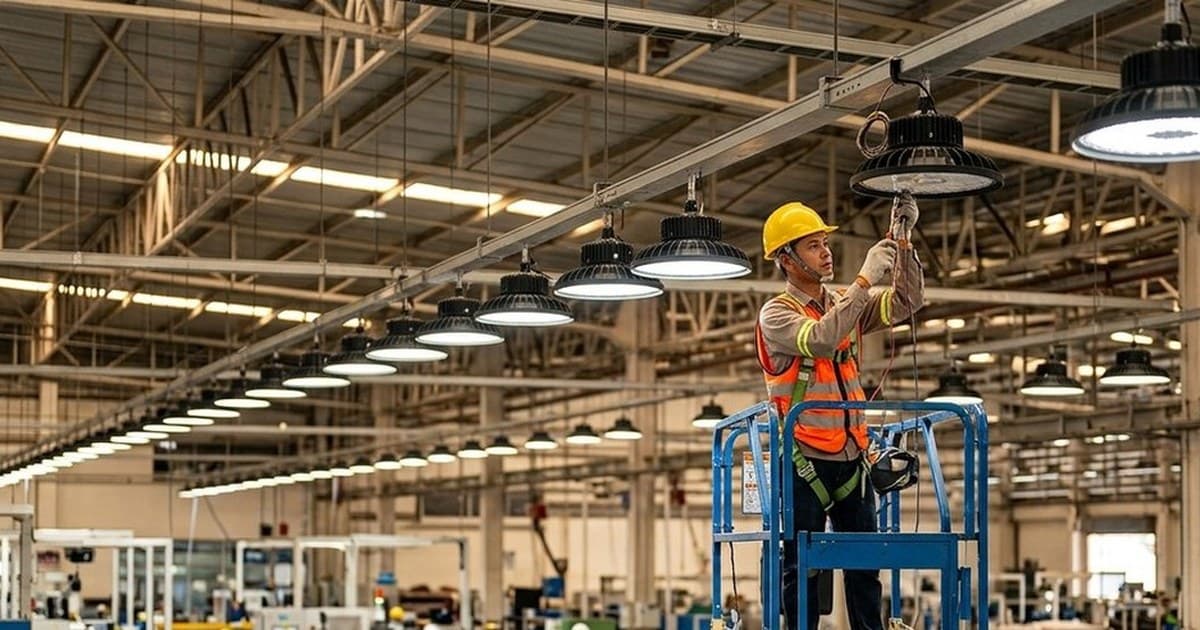
Comparing LED High Bay vs Metal Halide (HID) in Thai factories — Lumens/Watt, service life, payback period, 10-year total cost of ownership, the IEC 60598 standard, and DALI control
Factory lighting over 5,000-50,000 m² accounts for 15-30% of the total electricity bill — it is the fastest place to save if you switch from old Metal Halide (HID) to LED High Bay. ROI of 12-24 months is normal in Thailand — especially in warehouses + secondary production halls that run lights continuously. This article compares the numbers per IEC 60598 + IES TM-21 + DALI standard.
Main Table — LED High Bay vs Metal Halide
| Property | Metal Halide (HID) | LED High Bay 2026 |
|---|---|---|
| Initial Lumens/Watt | 65-95 lm/W | 150-200 lm/W |
| Lumens/W after 5,000 hr | 40-60 lm/W (degraded) | 145-195 lm/W (L80 retained) |
| Rated Life (hours) | 6,000-12,000 (lamp), 20,000 (ballast) | 50,000-100,000+ |
| Startup time to full | 5-10 minutes | Instant |
| Re-strike after blackout | 10-15 min (hot restrike fail) | Instant |
| CRI (Color Rendering Index) | 65-75 | 80-90+ |
| Mercury content | 30-50 mg / lamp | None |
| Dimming capability | Difficult (lose color) | 10-100% smooth |
| Maintenance interval | 1-3 years (lamp + ballast) | 7-10 years (driver only) |
| Operating temp range | -20 to 40°C | -40 to 60°C |
| Vibration tolerance | Low (filament risk) | High (solid state) |
| Power factor | 0.85-0.95 (with capacitor) | 0.95+ built-in |
TCO Comparison — 100-luminaire factory, 12 hr/day, 6 days/week
Thai TOU electricity: Peak average 4.50 baht/kWh, off-peak 2.85 baht/kWh — blend 3.75 baht/kWh
flowchart LR
  A[100 high bay luminaires
factory] --> B{Existing
Metal Halide 400W?}
  B -->|Yes| C[Annual: 400W × 100 ×
3,744 hr/yr =
149,760 kWh × ฿3.75 =
฿561,600/yr]
  B -->|Retrofit LED 150W| D[Annual: 150W × 100 ×
3,744 hr/yr =
56,160 kWh × ฿3.75 =
฿210,600/yr]
  C --> E[Maintenance:
lamp+ballast
~฿80,000/yr]
  D --> F[Maintenance:
~฿8,000/yr]
  E --> G[Total HID:
~฿641,600/yr]
  F --> H[Total LED:
~฿218,600/yr]
  G --> I[Savings ฿423,000/yr
+ 90% maintenance reduction]
  H --> I
Capital cost for 100 luminaire conversion:
- Full luminaire replacement: 5,000-12,000 ฿/luminaire × 100 = 500,000-1,200,000 baht
- Installation labor + scaffold: ~150,000-300,000 baht
- Total CAPEX: 650,000-1,500,000 baht
Payback period:
- Lowest case: ฿650,000 / ฿423,000 = 1.5 years
- Highest case: ฿1,500,000 / ฿423,000 = 3.5 years
- Median: 2-2.5 years
After payback: ฿423,000/year × 7-8 more years = ฿3-3.4 million NPV savings over 10 years
Flowchart — Selecting Wattage by Mounting Height
flowchart TD
  A[Define requirement] --> B{Lux requirement?}
  B -->|General warehouse
200-300 lux| C[Standard wattage]
  B -->|Assembly line
500-750 lux| D[Higher wattage]
  B -->|QC / Inspection
750-1000 lux| E[Highest wattage + supplemental]
  C --> F{Mounting height?}
  D --> F
  E --> F
  F -->|4-6 m| G[100-150W LED
15,000-22,500 lm]
  F -->|6-9 m| H[150-200W LED
22,500-30,000 lm]
  F -->|9-12 m| I[200-240W LED
30,000-36,000 lm]
  F -->|> 12 m| J[300W+ LED
or spot beam optic]
  G --> K[Spacing 8-10 m
general square grid]
  H --> K
  I --> K
  J --> K
  K --> L[Verify with Dialux
or AGi32]
IEC 60598 + IES TM-21 — Standard Compliance
A LED High Bay that meets the standards must have:
- IEC 60598-1 — General safety (insulation, mechanical, thermal)
- IEC 60598-2-22 — Emergency luminaire (if used as emergency)
- IEC 62717 — Performance requirements for LED modules
- IEC 62722-2-1 — Performance of LED luminaires
- IES LM-79 — Total flux + electrical + color measurement
- IES LM-80 — Lumen maintenance of LED package (long-term test)
- IES TM-21 — Projects LED long-term lumen output (uses LM-80 data extrapolated)
Common Rated Life metrics:
- L70 — time at which lumens remain at 70% of initial (= 50,000 hours typical)
- L80 — time at which lumens remain at 80% (= 30,000-40,000 hours)
- L90 — time at which lumens remain at 90% (= 15,000-25,000 hours)
Factories use L80 or L70 as mainstream. Rooms requiring color consistency (printing, QC) use L90
Light Distribution Pattern — Choosing the Right Optic
| Beam Pattern | Application |
|---|---|
| Symmetric Round (Type V) | General warehouse aisle, mounting around 6-9 m |
| Type II / III (wide rectangular) | Long warehouse aisle |
| Narrow / Spot Beam (10-25°) | Mounting high > 10 m, spot for specific tasks |
| Linear bar (low bay) | Office / production line under a 3-4 m ceiling |
Commonly used beam angles:
- 60-90° — square grid spacing 8-10 m
- 100-120° — square grid spacing 10-12 m
- 30-60° — high ceiling > 10 m + accent spotlight
IP Rating + Environment
Thai factories come in many conditions — choose the IP rating to match reality:
- IP20 — sealed ceiling, dust-free (electronic clean room)
- IP44 — splash water from any direction (kitchen, food processing — wash-down)
- IP54 — dust protected + splash (general factory)
- IP65 — dust tight + low pressure jet (warehouse with forklift dust)
- IP66 — dust tight + high pressure jet (outdoor, daily wash-down)
Typical Thai factory → IP65 is the safe standard. Outdoor / wash-down → IP66
Lighting Control — DALI vs 0-10V vs Bluetooth Mesh
| Control Type | Price per luminaire | Best-suited system |
|---|---|---|
| Switching (basic) | 0 (built-in) | < 20 luminaires, simple zones |
| 0-10V analog dimming | +500-1,000 ฿ | 20-50 luminaires, basic grouping |
| DALI (IEC 62386) | +1,500-3,000 ฿ | > 50 luminaires, addressable, scheduling |
| Bluetooth Mesh | +2,000-3,500 ฿ | Wireless, retrofit, app control |
| KNX | +5,000+ ฿ | Large building automation |
DALI is the international standard for professional lighting:
- Address individual luminaires (one at a time)
- Group + scene programming
- Sensor input (occupancy, daylight)
- Energy reporting for each luminaire
- Automatic fault detection
Energy savings from control:
- Manual switching: 0%
- 0-10V scheduling: 10-15%
- DALI + occupancy + daylight: 30-40%
- DALI tuned + adaptive: 40-50%
Replacement Cost Risk + Warranty
| Brand tier | Price/W | Warranty | Risk |
|---|---|---|---|
| Premium (Philips, Osram, Eaton) | 60-100 ฿/W | 5-7 years global | lowest, good service network |
| Mid-tier (Acuity, Sylvania, Cree) | 40-65 ฿/W | 5 years | moderate |
| Asian quality (LG, Panasonic) | 35-55 ฿/W | 3-5 years | moderate |
| Budget China brand | 15-35 ฿/W | 1-2 years (limited) | high — driver fails before LED |
The driver (electronic ballast) usually fails 2-3× before the LED chip. The driver costs ~30-40% of the luminaire. A budget brand with a 1-year warranty = risk of replacement from year 2 onward — TCO may be worse than premium
6-Point Procurement Guidelines
- TOR specifies IEC 60598-1 + IEC 62717 + IES LM-79 + LM-80 + L70 ≥ 50,000 hours
- CRI ≥ 80 + Color Temperature 4000K for general factory work
- IP65 minimum for industrial environments
- DALI or 0-10V dimming compatible for future upgrade
- Warranty ≥ 5 years including driver + LED module — written contract clause
- Photometric file (IES file) from the supplier to verify with Dialux/AGi32 before ordering
Conclusion
LED High Bay replacing Metal Halide in Thai factories delivers a payback of 1.5-3.5 years + savings of 60-70% on electricity + 90% reduction in maintenance. L70 ≥ 50,000 hours + CRI ≥ 80 + 4000K Natural White are the standard. IP65 for industrial. DALI control pays off for systems > 50 luminaires. Premium brands (Philips, Osram, Eaton) with 5-7 year warranties — better TCO than budget brands even though the initial price is 50-100% higher.
Sahawatthanakit provides lighting audit + retrofit design + Dialux simulation + installation for factories of 50-500 luminaires — consult us for an ROI calculation based on your actual size and operating conditions.
Frequently Asked Questions
What is the payback period? In a Thai factory running lights 12-16 hr × 6 days — a LED 150W replacing a MH 400W → payback 12-24 months. DALI dimming reduces it another 20-30%
How much do Lumens/W differ? MH initial 65-95 lm/W, dropping to 40-60 after 5,000 hr. LED 2026 initial 150-200, retaining 80%+ after 50,000 hr. A 2-3× difference throughout the lifetime
Which Color Temp to choose? General + warehouse 4000K. QC/inspection 5000-5700K CRI≥80. Food 4000K CRI≥80. Don't use 6500K+ — eye strain. Don't buy CRI < 70
How does Mounting Height matter? 6 m → 150W (22,500 lm) covers 75-100 m². 8-10 m → 200-240W. Calculate with Dialux/AGi32
DALI vs 0-10V? 0-10V analog is cheap, group dimming. DALI digital, addressable per luminaire + scheduling + sensor integration. Pays off for > 50 luminaires
Retrofit lamp vs Full replacement? Retrofit lamp is cheap but the old ballast draws 10-15W + poor thermal → short life. Full replacement is better with 5-year warranty + IP65 + driver efficiency — recommended for > 50 luminaires
Get this guide as a reference brief (PDF)
Summary + full section list + standards cited, Saha-branded for your memo/RFQ — emailed to you too.
Questions after reading? Talk to our engineers
Tell us what you need — our engineers help you spec it right, with a real quote. No charge.
Need help with this in your facility?
Our team handles full procurement and installation for the topics covered in this article. Free quote within 2 hours.
Another line of ours — spreadsheet tools for SMEs
Job Costing & Pricing Calculator (Thai + English editions)
For work sold as jobs — enter materials, on-site hours and freight, and get the cash floor, the break-even, and the price you should quote.
Frequently Asked Questions
1What is the LED High Bay payback period?
+
2How much do Lumens/Watt differ between LED and Metal Halide?
+
3Which Color Temperature should I choose for a factory?
+
4How does Mounting Height affect wattage selection?
+
5DALI vs 0-10V dimming control — which to choose?
+
6Can Metal Halide be retrofitted to LED?
+
Comparison tables related to this article
Related content
HVAC Commissioning — When to Demand It From Your Contractor, and How to Specify It
Start-up, TAB and commissioning are three different things. How ANSI/ASHRAE/IES 202-2018, Guideline 0-2019 and Guideline 1.4-2019 divide the work, and when a Thai industrial owner should make it contractual.
BMS Protocol Selection: BACnet vs Modbus vs KNX — and How to Spec It Without Vendor Lock-In
A standards-based comparison of BACnet (ANSI/ASHRAE 135 / ISO 16484-5), Modbus and KNX, with selection criteria by system layer, cybersecurity requirements, and specification language that keeps a building maintainable.
Thailand's Building Energy Code (BEC): OTTV, RTTV and LPD Limits — and Whether Factories Are Covered
The 2020 Ministerial Regulation made energy compliance a building-permit condition in Thailand from 13 March 2023 for all nine building types over 2,000 m². Full OTTV/RTTV/LPD table, HVAC criteria, and the whole-building compliance path.
Selecting an Industrial Process Pump + Preventing Cavitation (NPSH): Centrifugal vs Positive Displacement, BEP, and VFD Energy Savings per ANSI/HI–ISO for Thai Plants
Buyer's guide to industrial process pumps: differentiate Centrifugal vs Positive Displacement → calculate NPSHa to prevent cavitation → operate within BEP (70–120%) → cut electricity with VFD (Affinity Laws) → supplier checklist + ANSI/HI–ISO 13709/API 610/API 682 standards for plants in Thailand.