

Landed Cost Per Unit — Import Costing (Thai + English editions)
Fixed price · instant download after payment · no quote needed

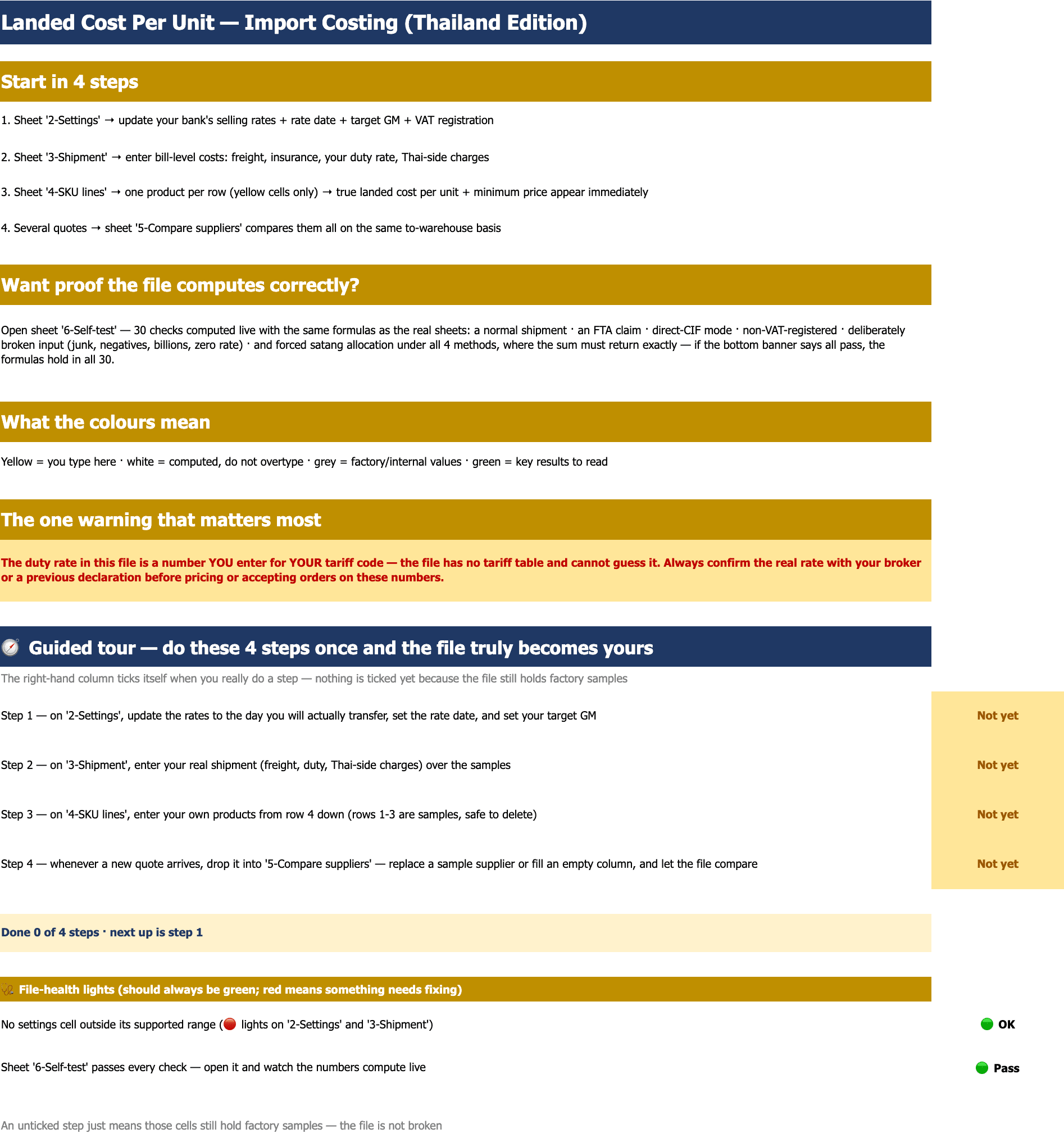
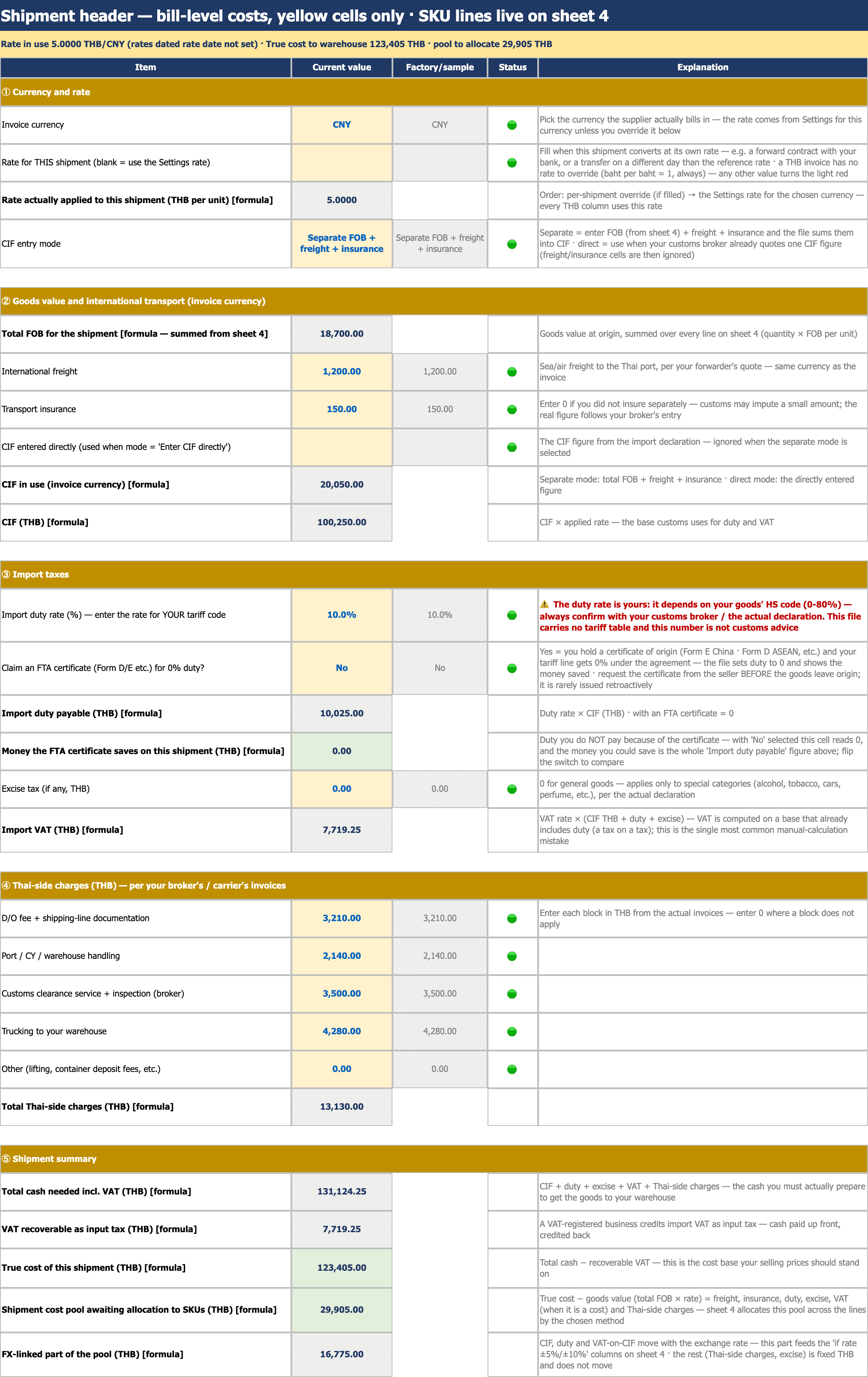
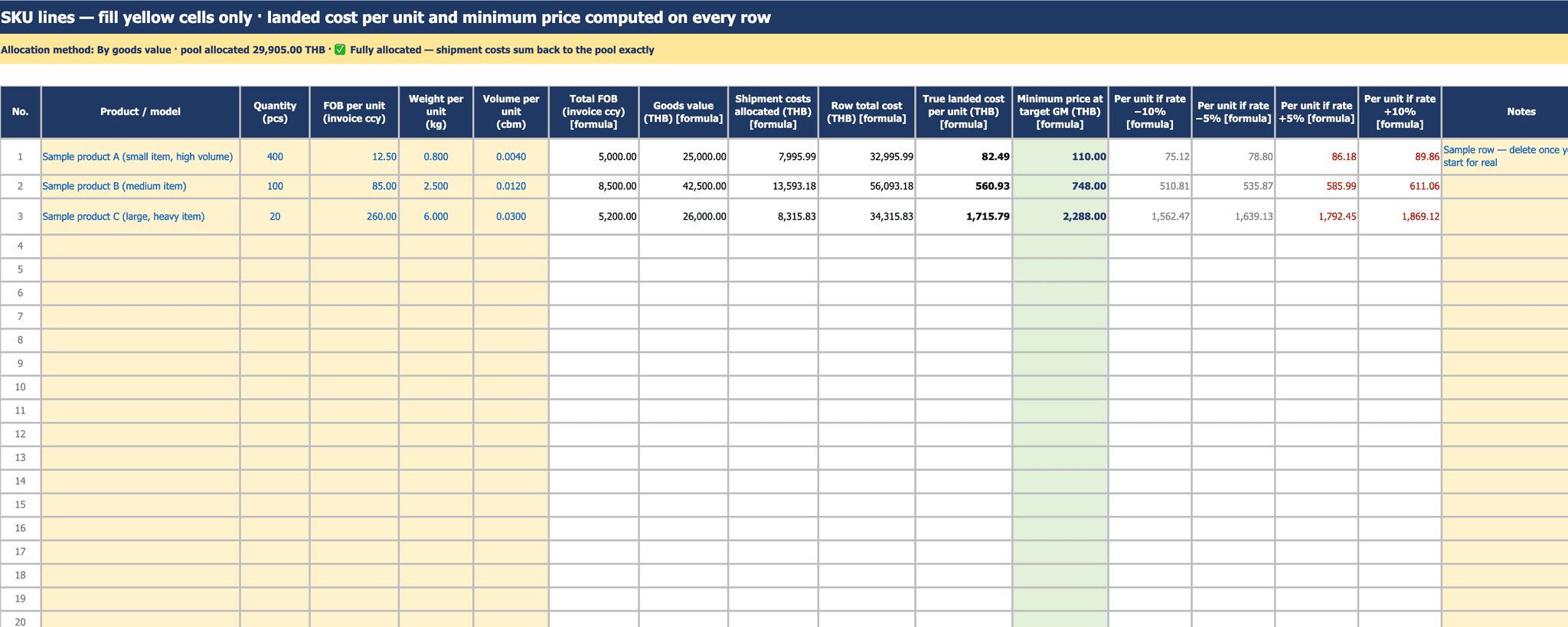
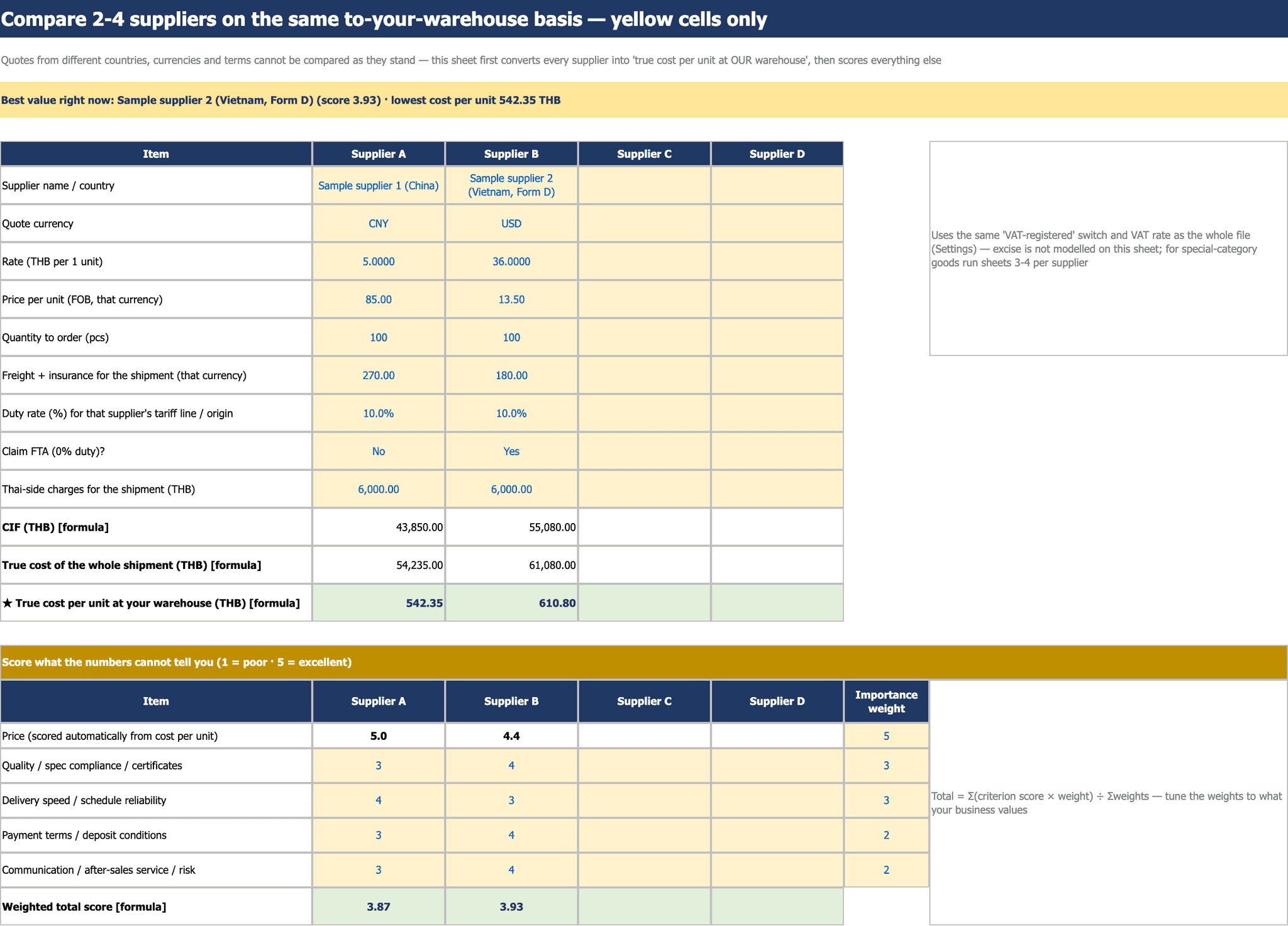
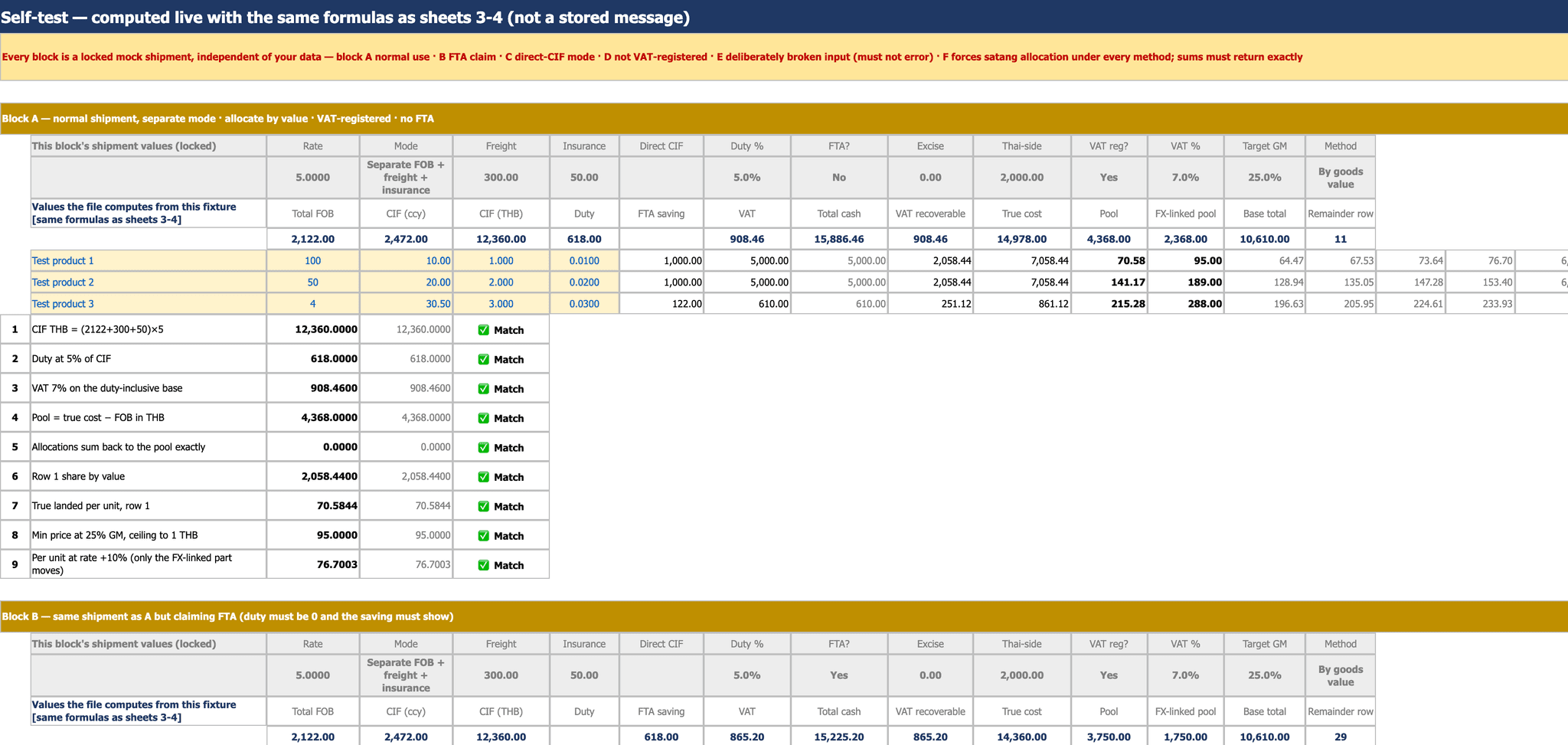
Screenshots of the file you actually receive — the figures shown are sample defaults, and every cell is yours to change.
One purchase, two files. You receive both the English (Thailand) edition shown in the screenshots above and the Thai edition — generated from the same formulas, so the two can never disagree about a number.
An Excel landed-cost calculator for businesses importing from China and beyond — enter one shipment header plus its SKU lines, and the file answers the only question that matters: once the goods reach your warehouse, what does one unit really cost, and what is the lowest price that still meets your target margin. Every layer of the customs arithmetic is included: CIF (separate FOB + freight + insurance, or a directly entered CIF figure from the declaration) → import duty at the rate you enter for your own tariff line → VAT computed on the duty-and-excise-inclusive base — the single most common manual mistake → and every Thai-side charge (D/O, port handling, clearance, trucking). A “VAT-registered?” switch separates cash needed at clearance from true cost (a registered business credits import VAT back). An FTA switch (Form D/E) zeroes the duty and shows, in plain baht, what the certificate saves on this shipment. Shipment costs allocate across up to 60 SKU lines by any of four methods (value / weight / volume / pieces), and the rounded satang always sum back to the pool exactly — the self-test forces it. Every line gets its true landed cost per unit, the minimum price at your target GM (rounded up in your chosen step, never down), and per-unit columns at rate −10% to +10% with the FX-linked part separated from fixed-baht Thai charges. A supplier-comparison sheet puts 2-4 quotes from different countries, currencies and terms on the same to-your-warehouse basis, with a weighted scorecard and a declared best-value supplier. The rates are yours: you enter your bank’s selling rate, date-stamp it, and can override per shipment — the file never auto-fetches, so a number can never silently change overnight. Every setting keeps a factory value to copy back, with 🟢🟡🔴 status lights and a settings sanity check. A 30-check live self-test computes with the same formulas as the real sheets (a normal shipment · an FTA claim · direct-CIF mode · non-VAT-registered · deliberately broken input — junk, negatives, billions, zero rates · forced satang allocation under all four methods). Sheet one is a four-step guided tour that ticks itself only when you have really done each step. One purchase, two files: the Thai edition and this English (Thailand) edition, generated from the same formulas. No macros — opens in Excel, LibreOffice and Google Sheets
Launch price · until 31 Dec 2026
This price includes 7% Thai VAT (goods ฿1,205.61 + VAT ฿84.39) — nothing else is added. You are charged ฿1,290 THB; the US$ figure is an approximate guide at today's rate and your bank converts at its own. Cards from any country are accepted.
- ✓Two editions in one purchase — Thai and English files, identical formulas.
- ✓Download immediately after payment — no waiting.
- ✓The manual lives inside the file (first sheet) — usable without anyone training you.
- ✓Every default is yours to change, and a “factory value” column restores the original when you break something.
- ✓A plain .xlsx with no macros — opens in Excel, LibreOffice and Google Sheets.
- ✓A full Thai tax invoice can be issued — deductible as a company expense (registered company).
- ✓Buy in your company’s name — enter the company name and 13-digit tax ID at checkout and we issue the tax invoice to match.
Pay by PromptPay or credit/debit card through Stripe (secure, industry-standard encryption).
Refundable within 7 days, no reason required · purchase terms
What support covers
This is a finished file sold outright, once. It does not include installation, training or per-customer customisation — the common questions are answered in the manual inside the file.