
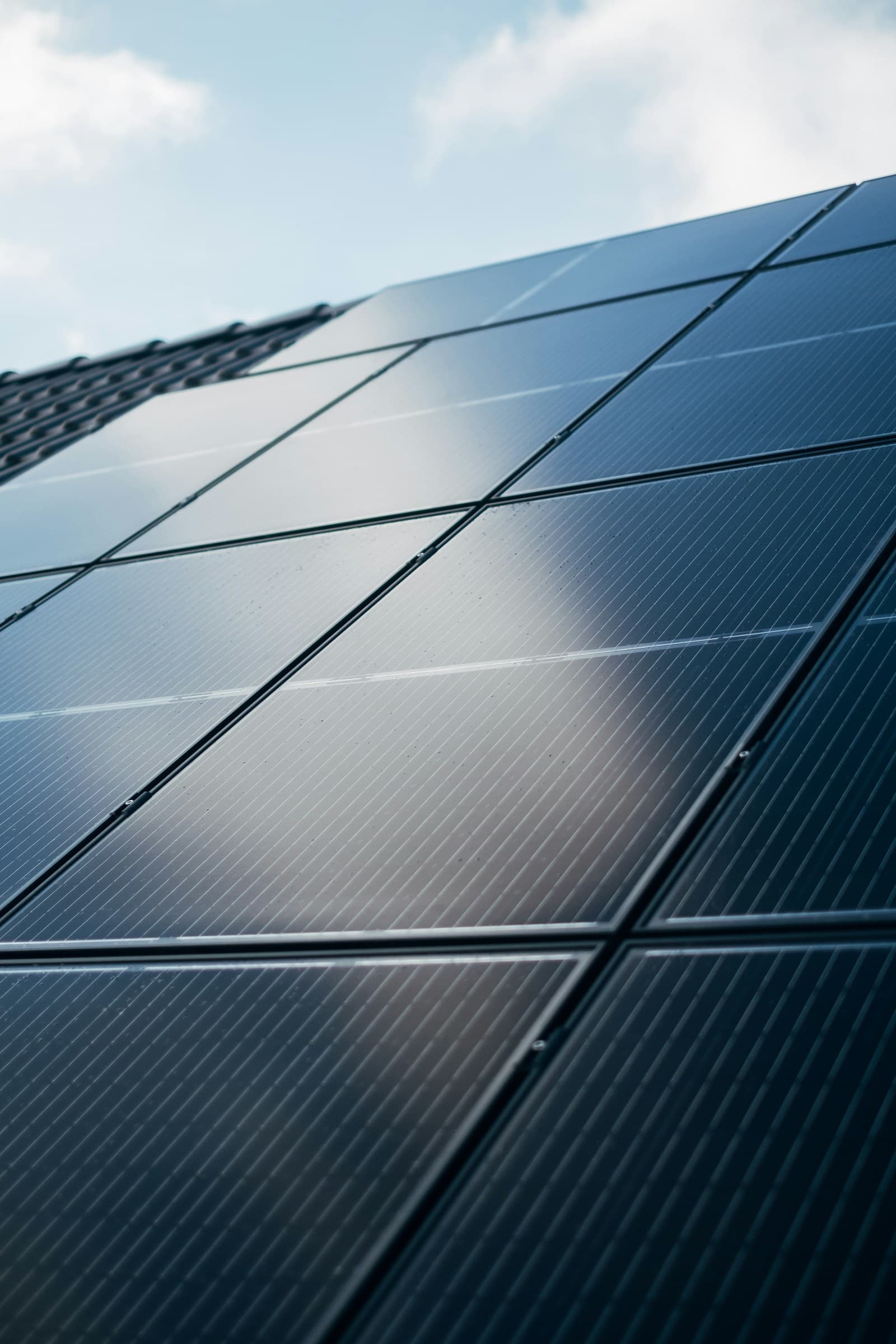
Comparing on-grid, hybrid, and off-grid solar systems for Thai factories and warehouses — cost comparison, ROI at different scales, PEA/MEA Net Metering (NEM) rules, and when each system type makes economic sense.
The most common question from Thai factory managers considering solar investment: "Is it actually worth it, and should I install on-grid or hybrid?"
The answer depends on three factors: your electricity demand profile, when during the day you use the most power, and how Thailand's Net Metering policy affects your economics. This guide separates the options clearly.
Three System Types
1. On-Grid (Grid-Tie) — Always Connected to the Utility
[Solar panels] → [On-Grid Inverter] → [Factory distribution board] → Consumption
                                              ↓ surplus
                                    [PEA/MEA grid] ← (NEM export)
Principle: Solar generates power — if production is less than demand, utility power supplements. If production exceeds demand, surplus is exported to the grid under Net Metering.
Advantages:
- Lowest capital cost — No battery required; cost per kWp is 30–50% lower than hybrid
- Fastest payback — 4–7 years for daytime-operating factories
- Zero battery maintenance — System lifespan 25+ years
- Best match for day-shift factories — Peak solar production aligns with production peak
Disadvantages:
- Grid outage = solar shutdown — On-grid inverters require a live utility grid reference before outputting power (anti-islanding protection per IEC 62116)
- No backup power during grid outages
- Export economics depend on NEM rate set by PEA/MEA
2. Hybrid (Grid + Battery Storage)
[Solar panels] → [Hybrid Inverter] → [Factory distribution board] → Consumption
                      ↑↓                         ↑
                  [Battery] ←→ [PEA/MEA grid] ← NEM when battery full
Principle: Surplus solar charges batteries first; only exports to the grid when batteries are full. During grid outages, the battery provides backup power.
Advantages:
- Backup power — Critical systems continue operating during grid outages
- Higher self-consumption — Using your own electricity is worth ~2× more than NEM export rate
- Time-of-use arbitrage — If TOU pricing is available, charge batteries during off-peak (cheap) hours and discharge during peak (expensive) hours
- Partial UPS function — Battery response time can protect sensitive process equipment
Disadvantages:
- Significantly higher capital cost — LFP (Lithium Iron Phosphate) battery packs cost ฿8,000–15,000/kWh
- Battery replacement required — LFP lifespan 8–15 years (far better than lead-acid, but still a future cost)
- Slower payback — 7–12 years depending on application
- BMS complexity — Requires a reliable Battery Management System for safe operation
3. Off-Grid — No Utility Connection
Applicable only for: remote locations without grid access, or facility expansions beyond PEA/MEA service coverage.
Not recommended for typical Thai factories because:
- Requires very large battery banks (2–3 days of storage)
- Requires backup generator as a secondary backup
- Very high capital cost per kWh delivered
- Most Thai factories already have PEA/MEA connections
Net Metering (NEM) Policy in Thailand — 2026
Net Metering allows factory owners to export surplus solar electricity to the grid, with the exported units credited against their import bill.
Current Rules (2026)
| Parameter | PEA (Provincial) | MEA (Bangkok Metro) |
|---|---|---|
| Program | VSPP (Very Small Power Producer) | MEA Net Metering |
| Maximum capacity | ≤ 10 MW per applicant | ≤ 1 MW per applicant |
| Eligible tariff types | Business/industrial (all tariffs) | Business/industrial |
| Export rate (NEM) | ~฿2.20/kWh | ~฿2.20/kWh |
| Self-consumed savings | ~฿4.00–6.00/kWh | ~฿4.00–6.00/kWh |
| Settlement | Monthly (net metered) | Monthly |
Critical Insight: Self-Consumption Always Wins
The NEM export rate (฿2.20/kWh) is approximately half the industrial electricity tariff (฿4.00–6.00/kWh). This means the system should be sized to maximize self-consumption, not to maximize export.
A factory with a daytime load profile will self-consume a much higher fraction of solar output than a factory running night shifts. Load profiling before system design is essential.
Connection Application Process
- Submit application to local PEA/MEA office with one-line diagram and inverter specifications
- Wait for approval — 30–90 days (varies by system size and local grid capacity)
- Bidirectional meter installation by PEA/MEA (at owner's cost)
- Testing and certification before commissioning
- Sign VSPP agreement and commence billing
ROI Analysis: Representative Cases
Case 1: Assembly Factory, Medium Scale (100 kW demand, daytime operation)
On-Grid 100 kWp:
- Installation cost: ~฿2,500,000 (฿25,000/kWp including labor, mounting, cabling)
- Annual generation: ~140,000 kWh/year (Thailand average capacity factor ~16%)
- Self-consumed: 120,000 kWh/year × ฿4.50/kWh = ฿540,000/year
- NEM export: 20,000 kWh × ฿2.20 = ฿44,000/year
- Total savings: ~฿584,000/year
- Simple payback: ~4.3 years
- 25-year NPV: ~฿12 million (net of installation cost)
Hybrid 100 kWp + 100 kWh LFP battery:
- Additional cost: ~฿1,200,000 (battery + hybrid inverter)
- Total installation: ~฿3,700,000
- Additional value from backup depends entirely on outage frequency
- Simple payback: ~6.3 years
Conclusion Case 1: On-grid wins for factories that don't need backup power
Case 2: Continuous Process Factory, 24-Hour Operation (200 kW demand)
- Load profile: 200 kW continuous around the clock
- Solar only generates 6–8 hours per day
- Low self-consume ratio — Solar covers only 25–35% of total consumption
- NEM export rate is low — surplus export value is limited
Recommendation: Smaller on-grid system (reduce daytime electricity cost) + evaluate hybrid only if peak shaving economics justify battery investment.
Case 3: Factory with High Demand Charges
Large industrial facilities with significant demand charges (kVA peak billing):
- Hybrid + battery for peak shaving — reduce peak demand during 09:00–22:00
- Reducing peak kVA demand can substantially cut monthly demand charges
- Battery ROI in this scenario is driven by demand charge reduction, not just energy savings
Cost and Sizing Reference — 2026
| System Size | On-Grid (฿) | Hybrid (฿) | Est. Annual Savings | On-Grid Payback |
|---|---|---|---|---|
| 20 kWp | 500,000 | 800,000 | ~฿120,000 | ~4 years |
| 50 kWp | 1,250,000 | 1,800,000 | ~฿280,000 | ~4.5 years |
| 100 kWp | 2,500,000 | 3,700,000 | ~฿584,000 | ~4.3 years |
| 200 kWp | 4,800,000 | 7,000,000 | ~฿1,100,000 | ~4.4 years |
| 500 kWp | 11,000,000 | 17,000,000 | ~฿2,600,000 | ~4.2 years |
Estimates include panels, inverter, mounting, cabling, labor, and permitting. Actual costs vary by roof type, cable run length, and access.
Common Selection Mistakes
Load profile mismatch — Solar generates peak output 10:00–15:00. A factory running night shifts will self-consume very little. ROI extends significantly.
Roof structure not assessed — Solar panels + mounting weigh 15–25 kg/m². Structural assessment is required before installation, especially for older factory roofs.
Orientation and tilt ignored — Flat roofs and south-facing pitched roofs produce the most power. North-facing roofs lose 15–25% of rated output in Thailand.
Inverter brand and serviceability — Inverters require maintenance and occasionally fail. Choose brands with in-Thailand service centers: Huawei, SMA, Fronius, Delta all have established presence.
Shading not modeled — Trees, adjacent buildings, water towers, cooling towers — even partial shading can reduce output by 15–30% without micro-inverters or optimizers.
Summary: When to Choose Each System
Choose On-Grid when:
- Factory operates primarily during daytime (06:00–18:00)
- Backup power is not required (utility supply is reliable)
- Fastest possible payback is the priority
- Budget is constrained
Choose Hybrid when:
- Critical processes cannot tolerate even brief power interruptions
- TOU pricing makes peak shaving economically attractive
- Local grid reliability is poor (frequent outages)
- Additional investment can be justified for longer-term returns
Defer investment when:
- Primary load is nighttime (self-consumption below 30%)
- Roof cannot support load or shading is significant
- Facility relocation or expansion is planned within 5 years
Sahawatthanakit (1988) provides solar system design and installation services for factories and warehouses, including on-site surveys and ROI analysis based on your actual load data. Contact our engineering team to arrange a site assessment.
Get this guide as a reference brief (PDF)
Summary + full section list + standards cited, Saha-branded for your memo/RFQ — emailed to you too.
Questions after reading? Talk to our engineers
Tell us what you need — our engineers help you spec it right, with a real quote. No charge.
Need help with this in your facility?
Our team handles full procurement and installation for the topics covered in this article. Free quote within 2 hours.
Another line of ours — spreadsheet tools for SMEs
Job Costing & Pricing Calculator (Thai + English editions)
For work sold as jobs — enter materials, on-site hours and freight, and get the cash floor, the break-even, and the price you should quote.
Comparison tables related to this article
Related content
Profitable but Unable to Make Payroll — The Warning Signs You Can Read Weeks Before That Week Arrives
A business whose sales are growing while cash runs short is not unlucky — it is overtrading, which has a well-defined cycle and gives warning weeks in advance. How to read the working-capital cycle of DSO plus DIO minus DPO, the six signals that precede the week payroll cannot be met, and why payroll is a hard deadline in a way no other outgoing is.
The 13-Week Cash Flow Forecast — The Turnaround Profession's Standard Tool, and Why Thai SMEs Should Have One Before They Need It
A 13-week rolling cash flow is the standard instrument of corporate turnaround practitioners, not an accounting report — weekly enough to see which week runs short, long enough to still fix it. Why it must be direct method, why thirteen weeks, why a negative balance does not mean death in the Thai SME context, and why a forecast never compared against actuals loses everyone's trust within a month.
HVAC Commissioning — When to Demand It From Your Contractor, and How to Specify It
Start-up, TAB and commissioning are three different things. How ANSI/ASHRAE/IES 202-2018, Guideline 0-2019 and Guideline 1.4-2019 divide the work, and when a Thai industrial owner should make it contractual.
Pick the Right Refrigerant for the Job — A Contractor's Field Guide: Charge Tables by System (Split / VRF / Chiller / Cold Room / Ice Plant / Auto) + R-22/R-404A Replacements + How to Source Cylinders Fast
Field guide for HVAC/R contractors in Thailand: choose the correct refrigerant by actual system type (residential/commercial Split & VRF, chillers, MT/LT cold rooms, ice plants, automotive, ULT) + R-22/R-404A drop-in & retrofit table + compressor oil you must change with it (MO/POE) + how to source refrigerant fast at contractor/fleet pricing.