
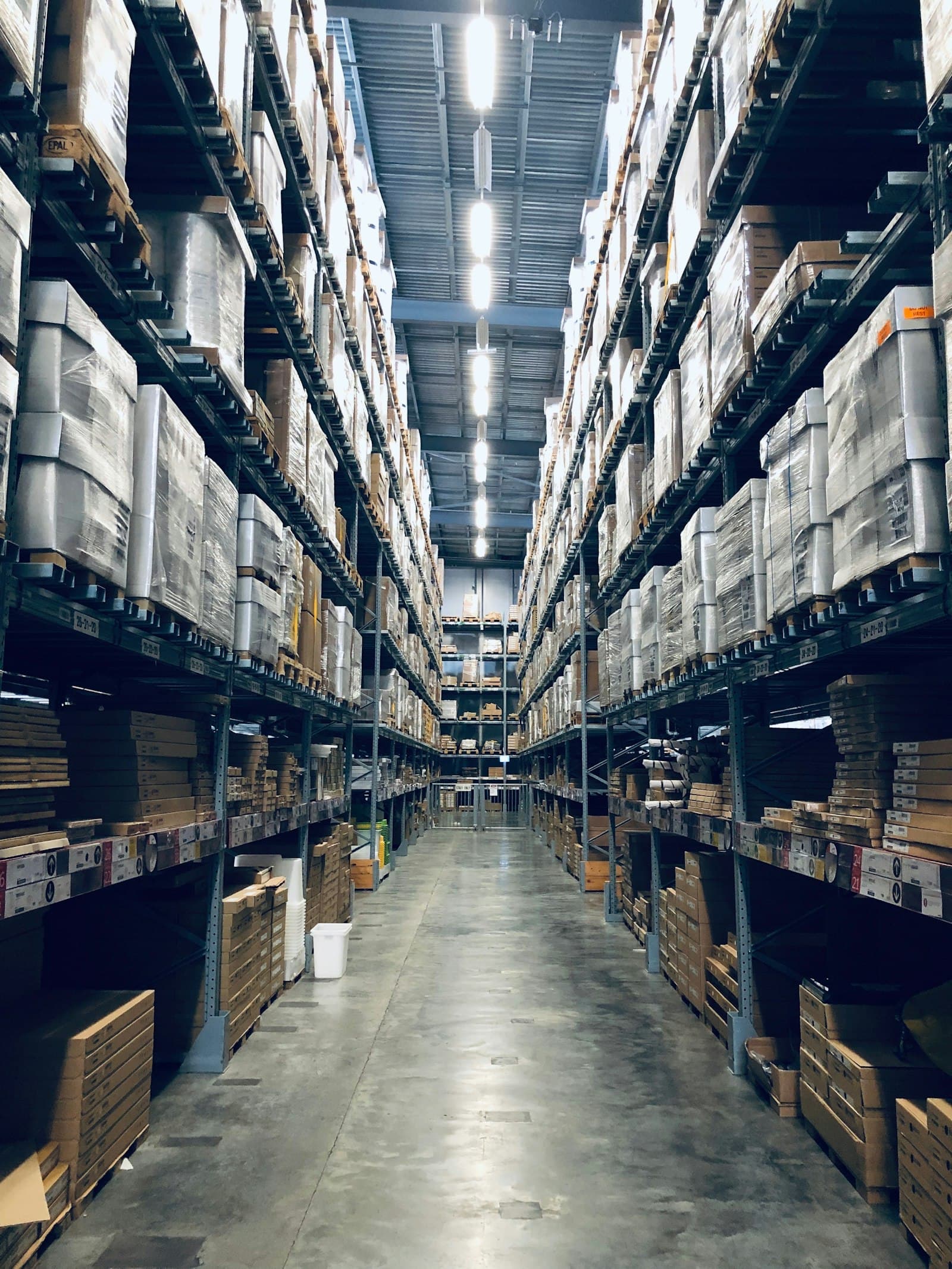
Comparing Pallet Trucks (manual + electric) with Forklifts (counterbalance + reach + order picker) — load capacity, total cost, OSHA operator training requirements, and selection criteria based on warehouse size
In Thai factory warehouses, the perennial question whenever production capacity expands is: buy a pallet truck or a forklift? The answer is not simply about price — it depends on load capacity, stacking height, aisle width, and the safety standards mandated by international customers (Toyota Tsusho, Honda, SCG) in their supplier site requirements. This article interprets OSHA 1910.178, ANSI B56.1, and ISO 3691-1 for procurement decisions in Thailand.
Four Categories of Equipment — An Overview
| Type | Lift height | Capacity | Price (THB) | Application |
|---|---|---|---|---|
| Manual Pallet Truck | 0.2 m | 2.0–3.0 tonnes | 8,000–25,000 | Short distances, level floors |
| Electric Pallet Truck | 0.2 m | 1.5–2.5 tonnes | 80,000–200,000 | Medium distances, inside warehouse |
| Counterbalance Forklift | 3–6 m | 1.5–7 tonnes | 350,000–1,500,000 | General use, loading/unloading trucks |
| Reach Truck | 6–12 m | 1.0–2.5 tonnes | 600,000–1,800,000 | High racking, narrow aisles |
| Order Picker | 6–12 m | 0.5–1.0 tonnes | 700,000–1,500,000 | High-level picking operations |
OSHA 1910.178 — Operator Training Is a Legal Requirement (US) and Best Practice (Thailand)
OSHA classifies any motor-driven machine as a powered industrial truck — which includes Electric Pallet Trucks and everything above them. Operators must complete:
- Formal instruction — Classroom and video training covering operating instructions and workplace conditions
- Practical training — Hands-on practice on the actual equipment in a safe area
- Evaluation — Supervisor assessment and documented record
- Refresher training — Every 3 years, or when the operator changes equipment, changes work area, or is involved in an incident
In Thailand, no national Forklift Licence exists, but the Occupational Safety Act B.E. 2554 (2011) and related ministerial regulations require employers to provide appropriate training. EPC contracts from Toyota Tsusho and ExxonMobil apply OSHA standards through contract clauses.
Decision Flowchart — Choosing by Warehouse Conditions
flowchart TD
  A[Moving pallets in warehouse] --> B{Travel distance?}
  B -->|< 30 m
level floor| C[Manual Pallet Truck
8,000–25,000 THB]
  B -->|30–100 m
inside warehouse| D[Electric Pallet Truck
80–200k THB]
  B -->|> 100 m
or stacking needed| E{Stacking height required?}
  E -->|< 3 m| F[Counterbalance
350–700k THB]
  E -->|3–6 m
wide aisle| F
  E -->|6–12 m
narrow aisle| G{Primary task?}
  G -->|Moving pallets| H[Reach Truck
600k–1.8M THB]
  G -->|Individual picking| I[Order Picker
700k–1.5M THB]
  C --> J[Daily inspection
10-item checklist]
  D --> J
  F --> J
  H --> J
  I --> J
Load Center and Tip-Over Physics
ANSI B56.1 sets the Load Center at 24 inches (60 cm) from the face of the forks to the centre of gravity of the load. Every capacity figure on a nameplate is calculated at this 24-inch load center.
If the load extends deeper than 24 inches:
- 36-inch deep load → reduce capacity ~20%
- 48-inch deep load → reduce capacity ~30%
Derate formula: Actual Capacity = Rated Capacity × (24 / Actual Load Center)
Example: A forklift rated at 2,500 kg @ 24". If carrying a load 48 inches deep → actual capacity = 2,500 × 24/48 = 1,250 kg only.
Tip-over physics:
- Lateral (left/right turns): turning with a high, loaded mast at speed above 5 km/h — centripetal force drives the combined load and truck centre of gravity outside the stability triangle
- Longitudinal (forward tip): load exceeds rated capacity + mast lifted high — centre of gravity shifts forward → tip forward
24% of fatal forklift accidents in the US are caused by tip-over (OSHA 2022 data). Prevention:
- Always wear the seatbelt — 80% of rollover deaths involve operators who attempted to jump clear
- Reduce speed to below 5 km/h before any turn
- Never load beyond rated × derate factor
- Work on level floors with slope less than 10%
5-Year TCO — Scenario: Factory Floor Area 2,000 m² in Bangkok
| Item | Manual PT × 4 | Electric PT × 2 | Counterbalance × 1 + PT × 2 |
|---|---|---|---|
| Initial CAPEX | 60,000 | 320,000 | 600,000 |
| OPEX/year (battery/maintenance) | 5,000 | 25,000 | 80,000 |
| Additional labour cost (1–2 staff) | 600,000 | 0 | 0 |
| 5-Year TCO | 3,025,000 | 445,000 | 1,000,000 |
| Average throughput speed | Slow | Moderate | Fast |
| Stacking capability | Floor level only | Floor level only | Stack 3–6 m |
Electric Pallet Truck wins on TCO for medium-sized warehouses (1,000–3,000 m²) that do not require stacking. If stacking is required — a Counterbalance Forklift is more cost-effective than hiring additional workers.
6 Procurement Guidelines
- Specify ISO 3691-1 + OSHA 1910.178 in the TOR — supplier must provide certification.
- Load capacity placard must be readable — required under OSHA and ANSI B56.1. Must show rated capacity and load center distance.
- Request Operator's Manual + Maintenance Manual in Thai — to be supplied with the equipment; English-only is not acceptable.
- Battery / Charger warranty of at least 2 years — Battery accounts for 30–40% of Electric PT/Forklift TCO.
- Training must be included — Supplier must provide on-site training for at least 1 day before acceptance.
- Service network in Thailand — Toyota Material Handling, Linde, Hyster-Yale, Cat, and Jungheinrich all have dealer coverage. Do not purchase any brand without a service centre within 100 km.
Summary
Warehouse under 500 m² with low stacking needs — Manual Pallet Truck is sufficient. Warehouses from 500–3,000 m² without high stacking — Electric Pallet Truck wins on TCO. Large warehouses or stacking above 3 m — Counterbalance or Reach Truck is essential. All types require operator training and daily inspection per OSHA 1910.178.
Sahawatthanakit provides consultation on equipment type selection and specification based on actual site conditions, and conducts load testing before acceptance — contact our engineering team for an on-site survey.
Frequently Asked Questions
Does a pallet truck require a licence? Manual: no. Electric/Powered: classified as a powered industrial truck under OSHA 1910.178(l) — operator must complete training + evaluation + recertification every 3 years. No national licence exists in Thailand, but employers are required to provide training per the Occupational Safety Act.
Counterbalance vs Reach Truck — how to choose? Counterbalance: outdoor work, uneven floors, short haul, aisle 3.5–4.5 m. Reach Truck: extendable forks for narrow aisles 2.5–2.8 m, high rack 6–12 m — 30–50% higher cost.
What is a 24-inch Load Center? The distance from fork face to the centre of gravity of the load. Nameplate capacity is calculated at 24-inch default. For loads deeper than 48 inches → apply derate formula Rated Capacity × 24/Actual.
LPG / Electric / Diesel — what are the differences? Electric: indoors, zero emissions, 8-hour charge for 6–8 hours use. LPG: well-ventilated indoor space, 5-minute tank swap. Diesel: outdoor use only, highest capacity.
How is tip-over prevented? OSHA statistics: 24% of fatal accidents = tip-over. Prevention: wear seatbelt + speed below 5 km/h before turning + do not exceed derated capacity + slope below 10%.
Daily checklist — 10 items? Oil level · Battery · Tyres · Fork + chain · Brakes · Horn/lights/back-up alarm · Seatbelt · Safety guards · Gauges · Capacity placard. Fail any item → tag out immediately (OSHA 1910.178(q)(7)).
Order & Inquiries
Sahawatthanakit (1988) Co., Ltd. — Warehouse equipment and racking systems supplier across Thailand, VAT invoices available.
- Tel: +66-2-096-2118
- Email: info@sahawatthanakit1988.com
- LINE: @sahawatt1988
- Web: sahawatthanakit1988.com
- Mon–Fri 08:00–17:00 ICT
- Nationwide delivery | Express in Bangkok / Nonthaburi
Get this guide as a reference brief (PDF)
Summary + full section list + standards cited, Saha-branded for your memo/RFQ — emailed to you too.
Questions after reading? Talk to our engineers
Tell us what you need — our engineers help you spec it right, with a real quote. No charge.
Need help with this in your facility?
Our team handles full procurement and installation for the topics covered in this article. Free quote within 2 hours.
Another line of ours — spreadsheet tools for SMEs
Job Costing & Pricing Calculator (Thai + English editions)
For work sold as jobs — enter materials, on-site hours and freight, and get the cash floor, the break-even, and the price you should quote.
Frequently Asked Questions
1Does a pallet truck require a licence or operator training?
+
2How do I choose between a Counterbalance and a Reach Truck?
+
3What is a 24-inch Load Center?
+
4What is the difference between LPG, Electric, and Diesel forklifts?
+
5Tip-over risk — statistics and prevention?
+
6What does the OSHA daily inspection checklist for a forklift include?
+
Comparison tables related to this article
Related content
Warehouse & Distribution Center (DC) Fit-Out and Maintenance Field Guide — Select Racking to AS 4084/EN 15512 · Epoxy/PU Floors · Steel Corrosion Protection · Rooftop Solar · Forklift Oils · Cold Storage · Safe Hot Work + How to Lock In Project Material Pricing
Field guide for warehouse and distribution-center (DC) owners and maintenance teams: plan the whole building by function — choose a racking system (Selective/Drive-In/Push-Back/Cantilever) to AS 4084/EN 15512, design for seismic loads (DPT 1311/ASCE 7), guard rack uprights and inspect annually per EN 15635, coat floors (epoxy/PU/PU-cement) to the load, protect steel from corrosion, put solar on the roof only after a structural load assessment, select forklift/MHE hydraulic-gear-grease oils, run cold storage, and control hot work during rack install/expansion per NFPA 51B — plus how to standardize materials to lock project pricing and delivery.
Rack Protection — Column Guards / End Barriers / Row Guards per EN 15512, EN 15620 & EN 15635 to Cut Forklift Damage
A guide to selecting pallet-rack protection against forklift impact: column/upright guards, end-of-aisle barriers, guard rails, guide rails — EN 15512 (0.5 kN accidental horizontal force at up to 0.4 m), column guards ≥ 400 mm high absorbing ≥ 400 Nm, EN 15620 clearances, EN 15635 GREEN/AMBER/RED damage assessment + PRRS, and what a TOR must specify to prevent rack collapse in Thai warehouses.
Seismic Design of Storage Racks — DPT 1311, ASCE 7-22, FEM 10.2.08 for Warehouses in Thailand
A guide to seismic design of pallet racking in Thailand: DPT standard 1311-50, ASCE/SEI 7-22, FEM 10.2.08 / EN 16681, ANSI MH16.1-2023, Bangkok soft-soil amplification, base plate + anchor + bracing, and what government TORs require.
Cantilever Racking for Long Goods — Storing Pipe, Timber, Steel Bar, and Panels per FEM 10.2.09
A guide to cantilever racking for long/bulky goods: pipe, timber, steel sections, panels — upright/arm/brace structure, straight vs inclined arms, capacity per arm, single/double-sided, standards FEM 10.2.09 / AS 4084 / RMI, and selection in Thailand.