
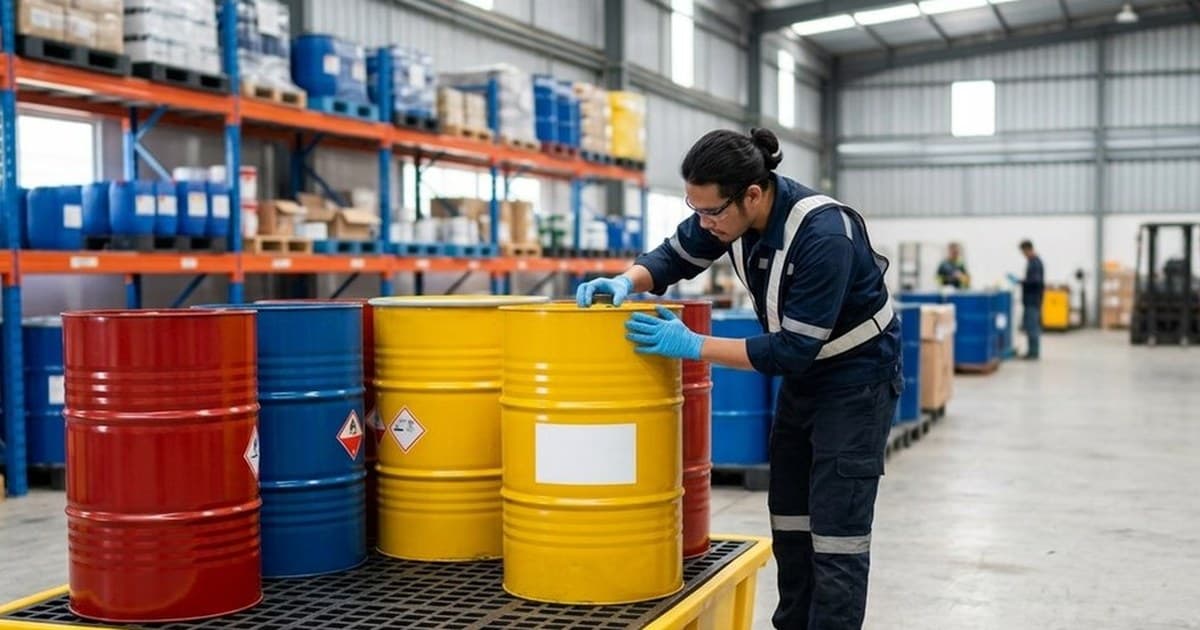
Guide to choosing a Spill Containment Pallet per US EPA 40 CFR 264.175, SPCC Plan, NFPA 30 — capacity, HDPE/Polyethylene material, load rating, use in chemical and oil storage in Thailand
Chemical, petrochemical, food, and oil storage facilities in Thailand all store liquid hazardous material — lubricants, cleaning agents, chemicals, solvents. If a spill occurs and there is no secondary containment, 4-5 parties get into trouble: the Department of Industrial Works (Factory Act B.E. 2535), the Pollution Control Department (environment), the Department of Welfare (occupational health), EPC customers (ISO 14001 audit), and the company's own machinery. A Spill Containment Pallet is a basic tool that prevents all of this, with an investment of just a few thousand baht.
EPA 40 CFR 264.175 — The World's Model Regulation
US EPA Regulation 40 CFR Part 264 Subpart I (Container Storage) defines the secondary containment requirement for hazardous waste:
Subpart 264.175(b) — physical conditions:
- (1) The base must be free of cracks/gaps + sloped to drainage
- (2) It must contain leaked liquid for a sustained period
- (3) Capacity ≥ 10% of the total combined volume or ≥ the volume of the largest container (whichever is greater)
- (4) Rainwater + spill must be drainable
In Thailand, the Factory Act B.E. 2535 + ministerial regulations on the storage of hazardous substances mandate secondary containment along the same lines. NFPA 30 (Flammable & Combustible Liquids Code) is the international standard used by EPC and insurance.
Sizing Calculation — How to Choose the Size
Example 1: storing four 200L drums of lubricant
- 10% rule: 4 × 200 × 10% = 80L
- Largest container: 200L
- Choose the greater → 200L sump capacity required
- Recommended: HDPE 4-drum pallet (250-300L sump capacity) — has a safety margin
Example 2: one 1,000L IBC tote
- 10% rule: 1,000 × 10% = 100L
- Largest: 1,000L
- Choose the greater → 1,000L sump capacity
- Recommended: IBC Spill Pallet with 1,100L capacity
Principle: secondary containment must survive a catastrophic failure of the largest container, not just a minor leak.
Flowchart for Choosing a Spill Pallet
flowchart TD
  A[Number of drums + size] --> B{Largest?}
  B -->|200L drum| C[4-drum pallet
HDPE sump 250L]
  B -->|IBC 1000L| D[IBC pallet
sump 1100L]
  B -->|Small drum < 60L| E[2-drum mini pallet
sump 70-100L]
  C --> F{Indoor or Outdoor?}
  D --> F
  E --> F
  F -->|Indoor| G[No lid required
open top, easy drum access]
  F -->|Outdoor| H[Lid + drain plug
rain protection]
  G --> I{Liquid type?}
  H --> I
  I -->|acid/alkali/solvent| J[HDPE — chemical resistant]
  I -->|Flammable liquid
NFPA Class I-II| K[Steel + fire-resistant coating]
  I -->|general oil/lubricant| L[HDPE or Steel]
  J --> M[Inspection every 30 days
EPA 264.171]
  K --> M
  L --> M
Material — HDPE vs Steel vs Concrete
| Material | Pros | Cons | Use Case |
|---|---|---|---|
| HDPE (Polyethylene) | Good chemical resistance, light, rustproof, economical | Limited load (1-2 tons), not fire-resistant, UV degradation outdoors | acid/alkali/solvent chemicals (90% of cases) |
| Galvanized Steel + coating | High load 3-5 tons, fire-resistant (NFPA 30) | Expensive, rusts if coating fails | Flammable liquid, heavy load |
| Concrete Berm/Dike | Highest load, good fire resistance, longevity | Construction must be done on site, hard to move | Bulk storage > 2,000L, permanent installation |
| Stainless Steel 316L | The most resistant to aggressive chemicals | Most expensive, 5-10x HDPE | Concentrated acids, pharmaceutical, food grade |
For 90% of factories in Thailand — an HDPE 4-drum pallet or IBC pallet is enough. An investment of 6,000-25,000 baht/unit vs the risk of fine + cleanup cost > 500,000-5,000,000 baht.
NFPA 30 — Additional Considerations for Flammable Liquid
If storing flammable liquid (FlashPoint < 100°F = 38°C, e.g., Gasoline, Acetone, Methanol):
- Class I A (FP < 73°F, BP < 100°F) — fast-evaporating liquids such as Pentane, Diethyl Ether
- Class I B (FP < 73°F, BP ≥ 100°F) — Gasoline, Acetone, MEK
- Class I C (73°F ≤ FP < 100°F) — Mineral Spirits, Xylene
- Class II (100°F ≤ FP < 140°F) — Diesel #1, Kerosene
- Class III (FP ≥ 140°F) — Diesel #2, Lubricant
Container storage of Class I — II must:
- Use a Steel pallet with fire-resistant coating (HDPE has a risk of melting + adding fuel)
- Distance from ignition source ≥ 6 m (20 ft)
- Ventilation 1 air change/hour minimum
- Bonding + grounding strap on metal drums
- Fire extinguisher Class B + 20-B rating within 3 m
NFPA 30 is used as the standard by insurance + EPC contractors in Thailand — even though the law doesn't mandate it directly.
Inspection + Maintenance
EPA 40 CFR 264.171 + 264.174 mandate an inspection schedule:
- Weekly walkthrough — look for signs of leak, crack, deterioration
- Monthly formal — pen-and-paper checklist with a record
- Annual — pressure test + structural integrity
Maintenance:
- Clean a spill in the sump within 24 hours
- Remove rainwater from an outdoor pallet before it reaches 80% full
- Replace the pallet when you see cracks, UV embrittlement, stress whitening (HDPE)
5-Year TCO — Mid-Sized Factory 100 drums/year
| Item | Investing in Spill Pallets | No Spill Pallet (1 incident occurs) |
|---|---|---|
| 4-drum HDPE pallet × 25 | 250,000 ฿ | 0 |
| Inspection labor (annual) | 30,000 × 5 = 150,000 | 0 |
| Replace 20% after 5 years | 50,000 | 0 |
| 5-Year TCO | 450,000 ฿ | 0 before incident |
| Spill cleanup (200L diesel) | 0 | 200,000-800,000 |
| Regulatory fine (worst case) | 0 | 500,000-5,000,000 |
| Insurance hike | 0 | +20-50%/yr every year |
| Reputation/ESG | 0 | 0-priceless |
A single spill incident is already 5-10 times more expensive than the 5-year TCO of the pallets.
Procurement Guidelines — 6 Points
- TOR specifies EPA 40 CFR 264.175 + NFPA 30 — the supplier provides a material certificate
- Capacity specifies sump volume + load rating — don't just write "4-drum size"
- Lid + drain plug for outdoor — add 1,500-3,000 ฿/pallet
- Forklift accessible — has fork pockets built into the pallet for moving
- Anti-static option for Class I flammable — bonding strap pre-installed
- Inspection schedule + training — the supplier provides on-site training for the safety officer team
Summary
A Spill Containment Pallet is a basic compliance tool that prevents million-baht-level costs and risks. EPA 40 CFR 264.175 sets sump capacity = max(10% of total, 1 × largest container). HDPE suits 90% of cases (chemicals + general oil). Steel + coating is necessary for Class I-II flammable liquids per NFPA 30. Outdoor pallets must have a lid + drain plug to keep rainwater from increasing the contaminated volume.
Sahawatthanakit sells Spill Containment Pallets in HDPE 4-drum, IBC pallet 1,000L, and Steel pallet for flammables — with inspection training for the safety officer team per EPA SPCC.
Frequently Asked Questions
What capacity does EPA 40 CFR 264.175 require? Max of (10% of total) or (1 × largest container). 4 × 200L → 10%=80L, max drum=200L → sump must be ≥ 200L
HDPE vs Steel, which to choose? HDPE is more chemical resistant, light, rustproof, load 1-2T. Steel load 3-5T, more fire-resistant (NFPA 30) but rusts if coating fails. General chemicals → HDPE. Flammable + heavy → coated Steel
For which oils is it used? EPA SPCC: a facility storing oil > 5,000L total above-ground must have an SPCC Plan + containment. Covers diesel, gasoline, lubricant, hydraulic, cooking oil. In Thailand, the Department of Industrial Works mandates it for HazMat at any quantity
What is the typical load capacity? HDPE: 1,500-2,500 kg static, 1,000-1,800 kg dynamic. Steel: 3,000-5,000 kg. Never exceed — crack or tip-over
Why grating? Lifts the drum above the collection sump — leaked contents fall into the sump without touching the drum (preventing corrosion). Removable to clean the sump. EPA 264.175(b)(4) mandates free of cracks + sloped + drained
Indoor vs Outdoor, how different? Outdoor must have a lid + drain plug for rain protection — EPA SPCC + NFPA 30 mandate the ability to remove rainwater without releasing chemical. Indoor doesn't need a lid
Get this guide as a reference brief (PDF)
Summary + full section list + standards cited, Saha-branded for your memo/RFQ — emailed to you too.
Questions after reading? Talk to our engineers
Tell us what you need — our engineers help you spec it right, with a real quote. No charge.
Need help with this in your facility?
Our team handles full procurement and installation for the topics covered in this article. Free quote within 2 hours.
Another line of ours — spreadsheet tools for SMEs
Job Costing & Pricing Calculator (Thai + English editions)
For work sold as jobs — enter materials, on-site hours and freight, and get the cash floor, the break-even, and the price you should quote.
Frequently Asked Questions
1What capacity does EPA 40 CFR 264.175 require?
+
2HDPE/Polyethylene vs Steel — which to choose?
+
3For which oils must a Spill Pallet be used?
+
4What is the typical load capacity (load rating) of a pallet?
+
5Why does a pallet have grating?
+
6How is an Indoor vs Outdoor Spill Pallet different?
+
Comparison tables related to this article
Related content
Warehouse & Distribution Center (DC) Fit-Out and Maintenance Field Guide — Select Racking to AS 4084/EN 15512 · Epoxy/PU Floors · Steel Corrosion Protection · Rooftop Solar · Forklift Oils · Cold Storage · Safe Hot Work + How to Lock In Project Material Pricing
Field guide for warehouse and distribution-center (DC) owners and maintenance teams: plan the whole building by function — choose a racking system (Selective/Drive-In/Push-Back/Cantilever) to AS 4084/EN 15512, design for seismic loads (DPT 1311/ASCE 7), guard rack uprights and inspect annually per EN 15635, coat floors (epoxy/PU/PU-cement) to the load, protect steel from corrosion, put solar on the roof only after a structural load assessment, select forklift/MHE hydraulic-gear-grease oils, run cold storage, and control hot work during rack install/expansion per NFPA 51B — plus how to standardize materials to lock project pricing and delivery.
Warehouse Automation ASRS / AGV / AMR: How to Choose, Calculate ROI, Storage Density, and ISO 3691-4 Safety for Thai Plants & DCs
Buyer's guide to warehouse automation: compare ASRS unit-load/mini-load/shuttle/VLM → choose AGV vs AMR by layout → calculate real ROI (labour + density vs capex) → contractor checklist → ISO 3691-4 / EN 528 / NFPA sprinkler standards for Thai factories and distribution centres.
Rack Protection — Column Guards / End Barriers / Row Guards per EN 15512, EN 15620 & EN 15635 to Cut Forklift Damage
A guide to selecting pallet-rack protection against forklift impact: column/upright guards, end-of-aisle barriers, guard rails, guide rails — EN 15512 (0.5 kN accidental horizontal force at up to 0.4 m), column guards ≥ 400 mm high absorbing ≥ 400 Nm, EN 15620 clearances, EN 15635 GREEN/AMBER/RED damage assessment + PRRS, and what a TOR must specify to prevent rack collapse in Thai warehouses.
Seismic Design of Storage Racks — DPT 1311, ASCE 7-22, FEM 10.2.08 for Warehouses in Thailand
A guide to seismic design of pallet racking in Thailand: DPT standard 1311-50, ASCE/SEI 7-22, FEM 10.2.08 / EN 16681, ANSI MH16.1-2023, Bangkok soft-soil amplification, base plate + anchor + bracing, and what government TORs require.