
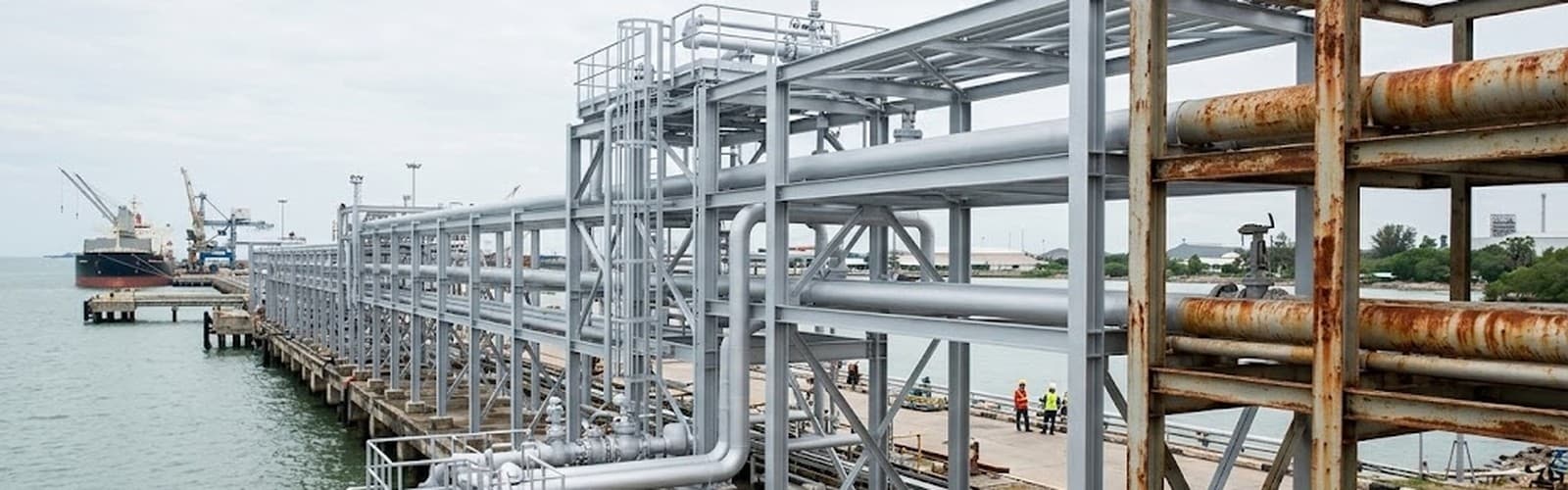

Guide to steel surface preparation before anti-corrosion painting: cleanliness grades Sa 1/2/2.5/3 per ISO 8501-1, SSPC-SP / NACE equivalents, abrasive blast profile (Rz/anchor pattern) per ISO 8503, soluble salt testing, dew point vs RH 85%, and a blast-cleaning inspection checklist for Thailand.
The most expensive truth in industrial painting: peeling, flaking, and premature rust usually come not from low-quality paint, but from poor surface preparation. Coating-industry literature commonly cites that roughly 70-80% of coating system failures trace back to the preparation stage, not the paint itself.
No matter how expensive the anti-corrosion paint, it won't help if applied over steel that still has rust, oil, salt, or a surface too smooth to grip. This article explains the surface-preparation standards that must be specified in your TOR/spec, and the inspection hold points you cannot skip.
1. Cleanliness Grades — Sa 1 / 2 / 2.5 / 3 (ISO 8501-1)
The most widely referenced standard is ISO 8501-1, which grades abrasive blast cleaning (symbol Sa) by comparison against standard photographs:
| Grade | Name | Stains allowed | SSPC/NACE equiv. | Application |
|---|---|---|---|---|
| Sa 1 | Brush-off | Loose rust/paint removed | SP 7 / NACE 4 | Temporary work |
| Sa 2 | Commercial | ≤ 33% of area | SP 6 / NACE 3 | General atmospheric |
| Sa 2.5 | Near-white | ≤ 5% (faint shadow/spots) | SP 10 / NACE 2 | Most anti-corrosion coating work |
| Sa 3 | White metal | 0% — clean to bare metal | SP 5 / NACE 1 | Immersion, petrochemical, critical |
Sa 2.5 is the default you should specify for structural steel/tanks/pipe in Thai conditions — the balance of adhesion quality and cost. Move up to Sa 3 only for immersion or aggressive chemical service.
2. Surface Roughness — Blast Profile (ISO 8503)
Cleanliness alone is not enough. The coating needs an anchor pattern (a rough peak-and-valley surface) for mechanical grip:
flowchart LR
  A[Rusty/contaminated steel] --> B[Abrasive blast]
  B --> C{Check two things}
  C --> D[Cleanliness
Sa 2.5 = SP 10
ISO 8501-1]
  C --> E[Roughness profile
Rz 50-75 micron
ISO 8503 + Testex tape]
  D --> F[Pass both]
  E --> F
  F --> G[Prime within 4 hrs
before flash rust]- Too low (smooth surface) → adhesion failure, peeling
- Too high (tall sharp peaks) → rogue peaks poke through the film, causing pinpoint rust
- The paint maker specifies the required profile (e.g. 50-75 micron Rz) — measured with profile tape (Testex) or a profile gauge per ISO 8503
- Abrasive size/type (garnet, steel grit, copper slag) determines the profile achieved
3. The Invisible Enemies — Salt, Dust, Oil, Moisture
A visually clean blast is not the finish line. Four invisible checks remain:
| Check | Problem | Test method | Typical limit |
|---|---|---|---|
| Soluble salt | Osmotic blister + under-film rust | Bresle (ISO 8502-6/9) | ≤ 20-50 mg/m² (immersion) |
| Dust | Reduces adhesion | Tape test (ISO 8502-3) | Rating 2 or better |
| Oil/grease | Patchy non-adhesion | Solvent wipe before blast | No residue |
| Moisture/dew point | Condensation under film | Dew point meter | Surface > dew point +3°C, RH ≤ 85% |
Iron rule in Thailand: in the morning and rainy season the steel is often cooler than the air, forming an invisible film of dew. Measure dew point on site; do not coat when the surface is less than 3°C above dew point or RH exceeds 85%.
4. The Time Window — Flash Rust
Steel just blasted to near-white begins to flash rust (a thin surface rust) quickly in Thai humidity:
- Apply primer within 4 hours, or before the surface starts changing color (whichever comes first)
- Flash rust appearing = re-blast required (wasting both time and abrasive)
- Plan blasting in batches matched to painting capacity — never leave blasted steel overnight
5. Surface-Preparation Inspection Checklist
- Specify the Sa grade (usually Sa 2.5 = SSPC-SP 10) clearly in the TOR/spec
- Specify the blast profile (e.g. 50-75 micron Rz) to match the coating maker's requirement
- Check cleanliness against ISO 8501-1 photographs + check profile with Testex tape
- Soluble salt test (Bresle) for marine/chemical/immersion work
- Dust tape test (ISO 8502-3) + solvent wipe to check for oil
- Measure dew point + RH before blasting and before coating, every time — record the values
- Prime within 4 hrs — with an inspection hold point before top-coating
- Record every value in the ITP/inspection report for hand-over
We supply and coordinate complete surface preparation + anti-corrosion coating systems — specifying the Sa grade and blast profile to match the chosen paint system, controlling soluble salt/dust/dew point on site, and producing an ITP with recorded inspection values for government/factory hand-over.
Talk to our engineering team to spec surface preparation that lets the coating reach its full life — call 02-096-2118 or LINE OA @sahawatt1988.
Summary
- 70-80% of coating system failures trace back to surface preparation, not the paint
- Sa 2.5 (near-white, SSPC-SP 10) = the default for most anti-corrosion work; Sa 3 for immersion/critical
- You must check two things: cleanliness (ISO 8501-1) + roughness profile (ISO 8503, Rz 50-75 micron)
- Invisible enemies: salt (Bresle) · dust (tape) · oil · dew point/RH 85%
- Flash rust forces priming within 4 hrs — plan blasting in batches
Surface preparation is 80% of a coating system's life — saving here means paying again for the whole system within months.
Get this guide as a reference brief (PDF)
Summary + full section list + standards cited, Saha-branded for your memo/RFQ — emailed to you too.
Questions after reading? Talk to our engineers
Tell us what you need — our engineers help you spec it right, with a real quote. No charge.
Need help with this in your facility?
Our team handles full procurement and installation for the topics covered in this article. Free quote promptly during business hours.
Another line of ours — spreadsheet tools for SMEs
Quote Register + Win Rate (Thai + English editions)
For quotes that go silent — one row per quote, telling you which to chase today and what your real win rate is.
Frequently Asked Questions
1What is Sa 2.5 and how does it differ from Sa 2 and Sa 3?
+
2Why do you need a blast profile (surface roughness), not just cleanliness?
+
3Why is soluble salt testing important?
+
4What are the dew point and RH 85% rules?
+
5How soon after blasting must you paint?
+
Related content
Holiday / Pinhole Detection in Coatings — Wet Sponge vs High-Voltage Spark per NACE/AMPP SP0188 & ASTM D5162
A guide to detecting holidays/pinholes (invisible discontinuities) in protective coating films: choosing low-voltage wet sponge (thin film < 500 µm) vs high-voltage spark/DC (thick film > 500 µm) per NACE/AMPP SP0188, SP0490 and ASTM D5162 — setting voltage by DFT (too low misses holidays, too high burns the film), which work requires it (tanks/pipes/immersion/marine), mark-repair-retest, and what a TOR must specify.
Coating Inspectors: NACE/AMPP CIP vs FROSIO — Who Needs Certification, Levels 1/2/3, and TOR Requirements
A comparison of the two main coating-inspector certification schemes: NACE/AMPP CIP (Coating Inspector Program — Levels 1/2/3, after NACE merged into AMPP in 2021) vs FROSIO (the Norwegian scheme — competence levels I/II/III) — what each level can do, which projects need which level, recognition in Thailand and abroad, and what a TOR must specify (level, independence, hold points, reporting) so coating work can actually be accepted.
Coating Application Conditions — The 'Surface ≥ Dew Point + 3°C' Rule, RH < 85% per ISO 8502-4 & ISO 12944-7
A guide to environmental conditions during protective-coating application: steel surface must be at least 3°C above the dew point, relative humidity RH < 85% (per the TDS), surface temperature within the product's range — how to measure the 4 readings (air temp, RH, dew point, surface temp) per ISO 8502-4 and ISO 12944-7, why painting in humid/near-dew-point conditions causes peeling/blistering/flash rust, and what a TOR must specify for Thailand's humid climate.
ISO 12944 Protective Paint Systems for Steel — Selecting Corrosivity C2–CX, Durability, and Primer/Intermediate/Topcoat for Thailand
How to select a protective coating system for steel structures per ISO 12944: corrosivity categories C1–C5/CX (2017/2018 revision), durability ranges L/M/H/VH, matching zinc-rich primer + epoxy MIO + PU topcoat systems to dry film thickness (DFT) per category, mapping to Thai environments (urban plants vs coastal Map Ta Phut/Laem Chabang), and the spec mistakes TOR writers make most.