
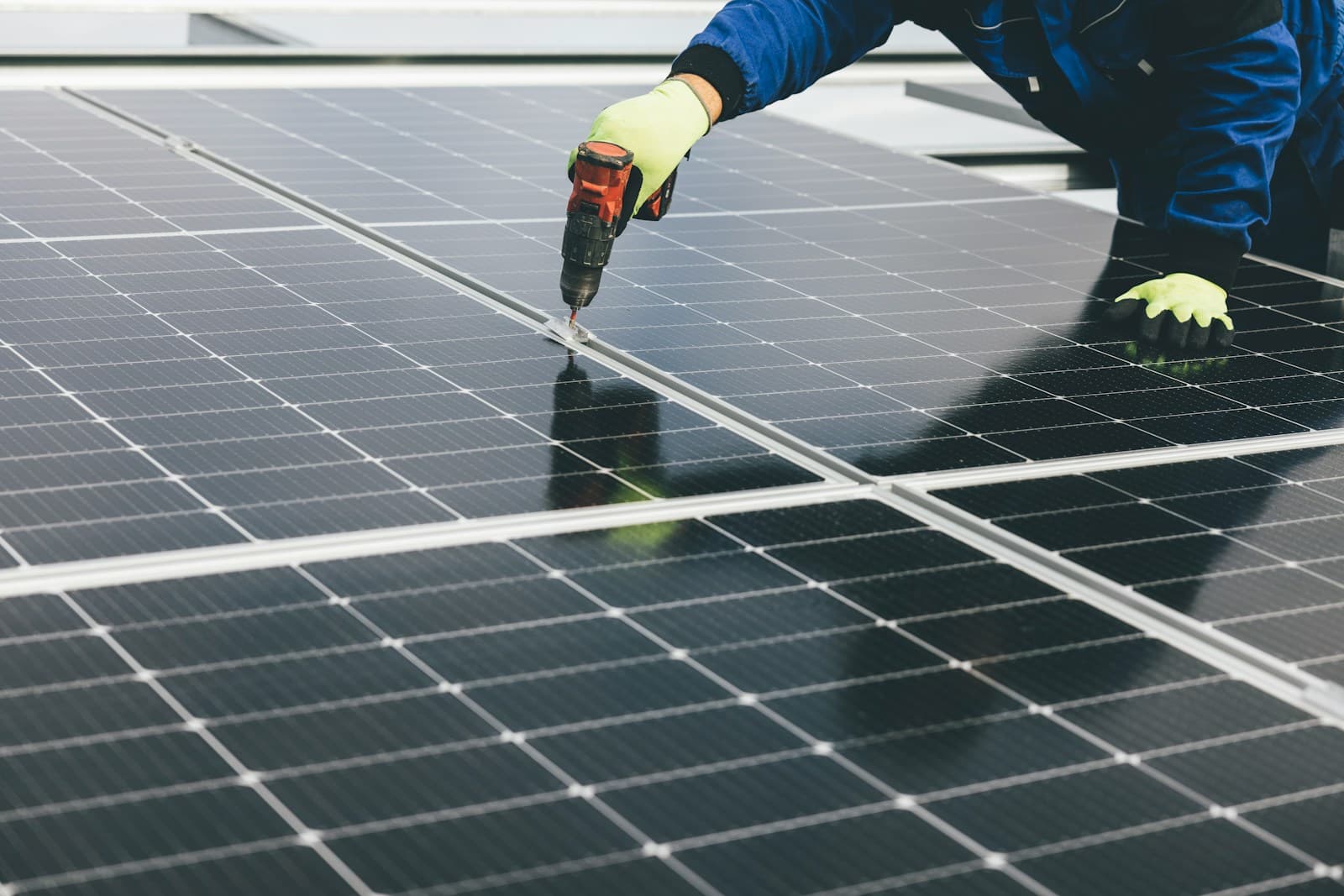
เปรียบเทียบ Tier 1 vs Tier 2 PV modules ตาม BNEF (BloombergNEF) classification — ความหมาย, Top brands 2024 list, bankability, IEC 61215 + IEC 61730 standards, degradation rate, การเลือกสำหรับ ROI 25 ปี
ทำไม Tier 1 vs Tier 2 สำคัญสำหรับเจ้าของโรงงาน
โครงการ Solar Rooftop ขนาด 500 kWp:
- Investment: ฿7-9M
- Project life: 25 ปี
- Risk: ถ้า panel manufacturer ปิดบริษัทใน 10 ปีแรก → warranty ไร้ค่า + replacement panel หายาก
Tier 1 = insurance policy ว่า manufacturer ยังอยู่ + warranty enforceable. ไม่ใช่ technical quality.
Real example (Thai market): Solar farm ขนาด 1 MWp ในนครราชสีมา ติดตั้ง panel Tier 2/3 จีนปี 2014 — manufacturer ปิดบริษัทปี 2019 — replacement cost ฿2.8M (ของเดิม ฿4.5M) + 18 เดือนหาคนกลางได้
BNEF Tier 1 Criteria — เกณฑ์การจัด
flowchart TD
    A[PV Manufacturer Applies] --> B{ผลิตเอง?}
    B -->|No - OEM/rebrand| Reject1[Disqualify]
    B -->|Yes own manufacturing| C{Sales to projects
with non-recourse bank loan?}
    C -->|No| Reject2[Disqualify - no bankability proof]
    C -->|Yes - ขายให้ ≥1 project แล้ว| D{From ≥6 different commercial banks?}
    D -->|No - 1-5 banks| Tier2[Tier 2 - acceptable but not bankable]
    D -->|Yes - 6+ banks| E{Within last 2 years?}
    E -->|No - older deals| Tier2
    E -->|Yes - recent| Tier1[BNEF Tier 1 Status]
    Tier1 --> Recheck[Re-verified each quarter]
Key insight: ไม่มี "Tier 3" official — มีแค่ Tier 1 (bankable) vs Non-Tier 1 (everything else). คำว่า "Tier 2" = informal trade term
Top BNEF Tier 1 Manufacturers 2024 (Q3 list)
Top 10 by Global Shipment (2023 data)
| Rank | Brand | Country | 2023 Shipment (GW) | Tech focus |
|---|---|---|---|---|
| 1 | LONGi Green Energy | China | 67.5 | Mono PERC + N-type HJT |
| 2 | JinkoSolar | China | 56.0 | Mono PERC + TOPCon |
| 3 | JA Solar | China | 47.3 | Mono PERC + TOPCon |
| 4 | Trina Solar | China | 42.0 | Mono PERC + N-type TOPCon |
| 5 | Canadian Solar | Canada/China | 30.8 | Mono PERC + Hi-MO |
| 6 | Risen Energy | China | 17.5 | Mono PERC |
| 7 | Tongwei Solar | China | 17.0 | Mono PERC + HJT |
| 8 | First Solar | USA | 13.2 | CdTe thin-film (unique) |
| 9 | Yingli Green Energy | China | 7.5 | Mono PERC |
| 10 | Q CELLS (Hanwha) | South Korea/Germany | 7.0 | Q.ANTUM PERC + DUO Z |
ในไทย — ราคาเทียบเดือนล่าสุด
| Brand | Power class | ราคา (฿/Wp installed) | Stock พร้อมส่ง |
|---|---|---|---|
| JinkoSolar Tiger Neo | 580W N-type TOPCon | 16-18 | 7-14 วัน |
| LONGi Hi-MO 6 | 580W Mono PERC | 15-17 | 5-10 วัน |
| JA Solar DeepBlue 4.0 | 570W Mono PERC | 15-17 | 7-14 วัน |
| Trina Vertex N | 590W N-type TOPCon | 17-19 | 10-14 วัน |
| Canadian Solar TOPHiKu | 580W TOPCon | 16-18 | 14-21 วัน |
| First Solar Series 6 Plus | 470W CdTe | 22-26 | 21-28 วัน (special order) |
Saha note: ราคา installed รวม inverter + structure + labor + commissioning. Module-only ราคา ฿8-12/Wp
Tier 1 vs Tier 2 — Side-by-Side
| Feature | Tier 1 | Tier 2 | No-Name |
|---|---|---|---|
| BNEF status | Listed | Not listed | Not listed |
| Bank financing | ✓ Yes (most banks) | Case-by-case | ✗ Usually rejected |
| IEC 61215 cert | ✓ Standard | ✓ Most have | Often fake/missing |
| IEC 61730 safety | ✓ Standard | ✓ Most have | Often missing |
| PVEL Top Performer | ✓ Many on list | Some | ✗ Rarely tested |
| Linear 25-yr warranty | ✓ Standard | Step warranty common | ✗ Often 5-10 yr only |
| Degradation rate | 0.5-0.7%/yr | 0.7-1.2%/yr | 2-5%/yr |
| Power output tolerance | +0/+5% positive | ±3% bilateral | Up to -10% |
| Insurance coverage | Easy (any insurer) | Possible (premium higher) | Very hard |
| Resale value (3-yr later) | 40-60% of new | 20-30% | 5-15% |
| Manufacturer survival risk | Low | Medium | High |
| Price premium vs No-Name | +20-40% | +10-20% | baseline |
Critical Test Standards — อ่านบน Datasheet
IEC 61215 — Design Qualification (Performance + Reliability)
ทดสอบอะไร:
- Thermal cycling 200 cycles (-40°C to +85°C)
- Damp heat 1,000 hours @ 85°C/85% RH
- UV preconditioning 15 kWh/m²
- Hail impact test (25mm ice ball at 23 m/s)
- Mechanical load 2,400 Pa (snow) + 5,400 Pa (wind)
Pass criterion: Power output > 95% of nameplate after all tests
Tip: ดูในที่ test ทำที่ไหน — TUV Rheinland / VDE / SGS / Intertek ถือเป็น top-tier labs
IEC 61730 — Safety (Construction + Testing)
ทดสอบอะไร:
- Fire safety (UL 1703 cross-ref)
- Electrical safety (insulation resistance, dielectric strength)
- Mechanical safety (frame strength, junction box)
Pass criterion: No safety failure under maximum operating conditions
IEC 61853 — Performance Energy Rating
ทดสอบอะไร:
- 5 power output measurements at different temperature/irradiance combinations
- Provides realistic energy yield prediction (kWh/year per Wp)
Tip: ดู Climate-specific Energy Rating (CSER) per IEC 61853-4 — Tropical climate index ดี = ใช้ในไทยได้ดี
PVEL Module Reliability Scorecard (annual)
Independent test by PV Evolution Labs — beyond IEC requirements:
- Thermal cycling 600 cycles (vs IEC 200)
- Damp heat 2,000 hr (vs IEC 1,000)
- Dynamic mechanical load (DML)
- Potential Induced Degradation (PID) extended
"Top Performer" badge = pass all 6 extended tests with minimal degradation. Look for this on Tier 1 brands.
Real-World Degradation Data
Fraunhofer ISE long-term study (2024)
| Technology | Year-1 LID | Annual degradation | 25-yr remaining |
|---|---|---|---|
| Mono PERC (older) | -2 to -3% | -0.6 to -0.8%/yr | 76-80% |
| Mono PERC (new, 2020+) | -1 to -1.5% | -0.45 to -0.55%/yr | 82-86% |
| N-type TOPCon | -0.5 to -1% | -0.35 to -0.45%/yr | 87-91% |
| N-type HJT | -0.3 to -0.8% | -0.25 to -0.35%/yr | 89-93% |
| Thin-film (CdTe) | -1.5 to -2% | -0.45 to -0.6%/yr | 82-85% |
Implication: Newer N-type modules แม้แพงกว่า PERC 5-10% — yield สูงกว่า 5-8% over 25 yr → better ROI
Local Thai case data (Saha customers)
3 projects monitored 2018-2024:
- Project A (LONGi Mono PERC, Bangkok): 0.62%/yr · cumulative 4.0% after 6 yr
- Project B (JinkoSolar Tiger, Rayong): 0.58%/yr · 3.7% after 6 yr
- Project C (Trina Vertex N TOPCon, Chonburi): 0.42%/yr · 2.5% after 6 yr
ทั้งหมดอยู่ใน range ของ Fraunhofer prediction
Mistake Patterns ที่เจอใน Thai market
1. "All panels are the same" — wrong
- ✗ ราคา ฿7/Wp vs ฿15/Wp — ห่าง 2 เท่า, quality ห่าง 3-5 เท่า
- ✓ Compare on levelized cost of energy (LCOE) over 25 yr, not unit price
2. "Buy cheap, replace early"
- ✗ Plan to replace panel ครึ่งทาง — แต่ panel มีอายุ 25+ ปี, replacement labor expensive + downtime
- ✓ Buy ones with longest predictable warranty (linear, IEC + PVEL + BNEF)
3. "Generic spec — let installer choose"
- ✗ Installer choice = highest margin to installer, lowest to project
- ✓ Spec at TIS 1843 + IEC 61215 + IEC 61730 minimum + BNEF Tier 1 in TOR
4. "Tier 1 is too expensive for SME"
- ✗ ห่าง ฿2-4/Wp = ฿200,000-400,000 on 100 kWp project
- ✓ Over 25 yr, Tier 1 produces ~15-20% more energy = ฿1.5-2M extra revenue
5. "Buy used Tier 1 to save"
- ✗ Used panel = unknown degradation history + reduced warranty + no insurance
- ✓ Only buy new Tier 1 with original factory cert + warranty
Selection Framework — Saha Method
flowchart TD
    Start[Project Size?] --> Q1
    Q1{< 50 kWp residential?}
    Q1 -->|Yes| Resi[Tier 1 mono PERC
e.g., LONGi Hi-MO 6
simple + reliable]
    Q1 -->|No| Q2

    Q2{50-500 kWp SME?}
    Q2 -->|Yes| SME[Tier 1 N-type TOPCon
JinkoSolar Tiger Neo
better ROI over 25 yr]
    Q2 -->|No| Q3

    Q3{> 500 kWp commercial?}
    Q3 -->|Yes| Comm{Bank loan needed?}
    Q3 -->|No| Q4

    Comm -->|Yes| Tier1Strict[Tier 1 MANDATORY
+ 25-yr linear warranty
+ BOI promotion if applicable]
    Comm -->|No - self-funded| Tier1Flex[Tier 1 preferred
Tier 2 acceptable if IEC+PVEL]

    Q4{> 5 MWp utility-scale?}
    Q4 -->|Yes| Utility[Tier 1 N-type HJT
or First Solar CdTe
+ ERC license + EIA]
    Q4 -->|No| Specific[Consult Saha engineering team]
Saha Solar Panel Procurement
ทีมเราจัด direct authorized distribution กับ:
- LONGi Solar (Hi-MO series Tier 1 mono PERC + Hi-MO 7 TOPCon)
- JinkoSolar (Tiger series Tier 1 mono PERC + Tiger Neo N-type)
- Trina Solar (Vertex S + Vertex N TOPCon)
- Canadian Solar (HiKu + TOPHiKu N-type)
ส่ง original cert IEC 61215 + 61730 + linear warranty 25 ปี + BNEF Tier 1 documentation
Authorized distributor advantages:
- Original warranty enforceable (not gray market)
- Replacement support 24-48 hr ในไทย
- Insurance partnership (Tokio Marine + Erika เน้น solar)
- BOI promotion package — apply ผ่าน Saha consultant included
ROI Impact — Tier 1 vs Tier 2 vs No-Name
Project: 100 kWp commercial rooftop, 25-yr analysis
| Tier 1 (LONGi) | Tier 2 (mid-China) | No-Name | |
|---|---|---|---|
| Installed cost | ฿1,700,000 | ฿1,400,000 | ฿1,100,000 |
| Year 1 production | 150,000 kWh | 145,000 kWh | 140,000 kWh |
| Annual degradation | 0.55%/yr | 0.9%/yr | 2.5%/yr |
| Year 25 production | 132,000 kWh | 116,000 kWh | 75,000 kWh |
| 25-yr cumulative kWh | 3,510,000 | 3,265,000 | 2,712,000 |
| Revenue @ ฿4/kWh self-consume | ฿14,040,000 | ฿13,060,000 | ฿10,848,000 |
| Net (revenue - capex) | ฿12,340,000 | ฿11,660,000 | ฿9,748,000 |
| NPV (8% discount) | ฿5.8M | ฿5.1M | ฿3.9M |
| IRR | 22.4% | 21.7% | 18.5% |
Verdict: Tier 1 ROI +15-50% vs lower tier despite higher upfront cost
Summary
- BNEF Tier 1 = bankability, not quality per se
- Real quality measure: IEC 61215 + 61730 + 61853 + PVEL Top Performer
- Tier 1 brands ในไทย: LONGi · JinkoSolar · JA Solar · Trina Solar · Canadian Solar (Top 5)
- Linear 25-yr warranty ตรงกว่า step (90/80) — เลือก linear
- Degradation rate realistic: 0.5-0.7%/yr Tier 1 · 2-5%/yr No-Name
- ROI difference: Tier 1 vs No-Name = 15-50% better over 25 yr
- For bank-financed project: Tier 1 mandatory · for self-funded: Tier 1 still better LCOE
Saha service: ออกแบบ + ขออนุญาต + ติดตั้ง Tier 1 modules + 25-yr warranty support — ติดต่อ 02-096-2118 หรือดู /solar landing page
รับเอกสารสรุปหัวข้อนี้เป็น PDF
บทสรุป + หัวข้อครบ + มาตรฐานอ้างอิง มีโลโก้ Saha แนบ memo/TOR ได้ทันที — ส่งเข้าอีเมลให้ด้วย
อ่านแล้วมีคำถาม? ให้วิศวกรช่วย
บอกสิ่งที่อยากรู้สั้นๆ — วิศวกรสหวัฒนกิจช่วยเลือกสเปกที่เหมาะ พร้อมใบเสนอราคาจริง ไม่มีค่าบริการ
ต้องการให้ทีมช่วยเหลือเรื่องนี้?
ทีมงานรับเสนอราคา + จัดส่ง + ติดตั้งครบวงจรในหัวข้อที่บทความนี้พูดถึง — ใบเสนอราคาฟรี ภายใน 2 ชั่วโมง
อีกสายงานหนึ่งของเรา — เครื่องมือหลังบ้านสำหรับ SME
ระบบคิดต้นทุนงานและตั้งราคาขาย — สำหรับธุรกิจที่ขายเป็น “งาน” (ไทย + English ในชุดเดียว)
รับงานเป็นโครงการ แล้วไม่รู้ว่างานไหนกำไรจริง — กรอกค่าของ ค่าแรงหน้างาน ค่าขนส่ง แล้วบอกราคาต่ำสุดที่รับได้ กับราคาที่ควรเสนอ
คำถามที่พบบ่อย
1BNEF Tier 1 คืออะไร?
+
2Tier 1 = quality ดีกว่า Tier 2 จริงไหม?
+
3ในไทยใช้ Tier 1 อย่างไรให้คุ้ม?
+
4Tier 1 brands ปี 2024 ในไทยมีใครบ้าง?
+
5Linear vs Step warranty ต่างยังไง?
+
6Degradation rate ที่ realistic?
+
ตารางเปรียบเทียบที่เกี่ยวข้องกับบทความนี้
เนื้อหาที่เกี่ยวข้อง
ติดโซลาร์โรงงาน ลงทุนเอง (CAPEX) vs PPA vs เช่า (Leasing) — โมเดลไหนคุ้มกว่ากัน
เทียบ 3 โมเดลลงทุนโซลาร์รูฟท็อปโรงงานในไทยให้ตัดสินใจได้จริง: CAPEX (ลงทุนเอง จ่ายก้อนเดียว เป็นเจ้าของ คืนทุน 4–6 ปี ใช้สิทธิ BOI + หักค่าเสื่อม), PPA (ผู้พัฒนาลงทุนให้ฟรี เราซื้อไฟราคาลด 20–40% สัญญา 10–25 ปี zero capex), Leasing (จ่ายค่าเช่าคงที่รายเดือน ใช้ไฟเต็ม). พร้อมตารางเทียบ side-by-side, ตัวอย่างกระแสเงินสดระบบ 100 kWp 10 ปี, 5 ปัจจัยชี้ขาด (งบ/ภาษี/การถือครองหลังคา/ความเสี่ยง/ระยะเวลา) และ 6 จุดที่ต้องอ่านในสัญญา PPA ก่อนเซ็น (escalation, buyout, REC/คาร์บอนเครดิต, performance, การโอนเมื่อขายอาคาร) ตาม กกพ./BOI/MEA และ TFRS 16
หลังคาโรงงานรับน้ำหนักโซลาร์ได้ไหม — ประเมินโครงสร้าง, กฎ 20 kg/m² และแรงลม มยผ. 1311 ก่อนติด PV
คู่มือประเมินความพร้อมโครงสร้างหลังคาโรงงานก่อนติดตั้งโซลาร์: น้ำหนักที่ระบบ PV เพิ่มลงหลังคา (panel + raceway + ballast), เส้นแบ่งกฎหมาย 20 kg/m² (กฎกระทรวง 2566 ยกเว้นใบอนุญาตดัดแปลง), จุดอ่อนจริงของหลังคาเมทัลชีท (แป + จุดยึด) vs ดาดฟ้าคอนกรีต, แรงลม uplift ตาม มยผ. 1311-50 / AS-NZS 1170 และ checklist ที่ต้องให้วิศวกรโยธาเซ็นก่อนเริ่ม
String vs Central vs Micro Inverter + Power Optimizer — เลือกสถาปัตยกรรม Inverter โซลาร์โรงงาน
เปรียบเทียบสถาปัตยกรรม inverter โซลาร์ 4 แบบสำหรับหลังคาโรงงานและอาคารพาณิชย์ไทย: string inverter, central inverter, microinverter และ power optimizer (DC optimizer) — ครอบคลุมความละเอียด MPPT, การทนเงา/mismatch, การมอนิเตอร์ระดับแผง, ความปลอดภัย rapid shutdown, ต้นทุนต่อวัตต์, การบำรุงรักษา, มาตรฐาน IEC 62109 / IEC 62116 anti-islanding และแนวทางเลือกให้ตรงงาน
Solar Carport Structure Design — ออกแบบโครงสร้างลานจอดโซลาร์ตามแรงลม มยผ. / AS/NZS 1170
คู่มือออกแบบโครงสร้าง solar carport (ลานจอดรถติดโซลาร์) สำหรับโรงงานและอาคารพาณิชย์ไทย — เน้นแรงลมยก (wind uplift) ที่เป็นโหลดวิกฤต, มาตรฐาน มยผ. 1311 / AS/NZS 1170.2 / ASCE 7, การเลือกมุมเอียงให้สมดุลพลังงานกับแรงลม, ระยะ clearance รถ + EV charger, เหล็กชุบกัลวาไนซ์กันสนิม, ฐานราก ต้านการพลิกคว่ำ, และข้อกำหนดใบอนุญาต อ.1 + วิศวกรเซ็นรับรอง