
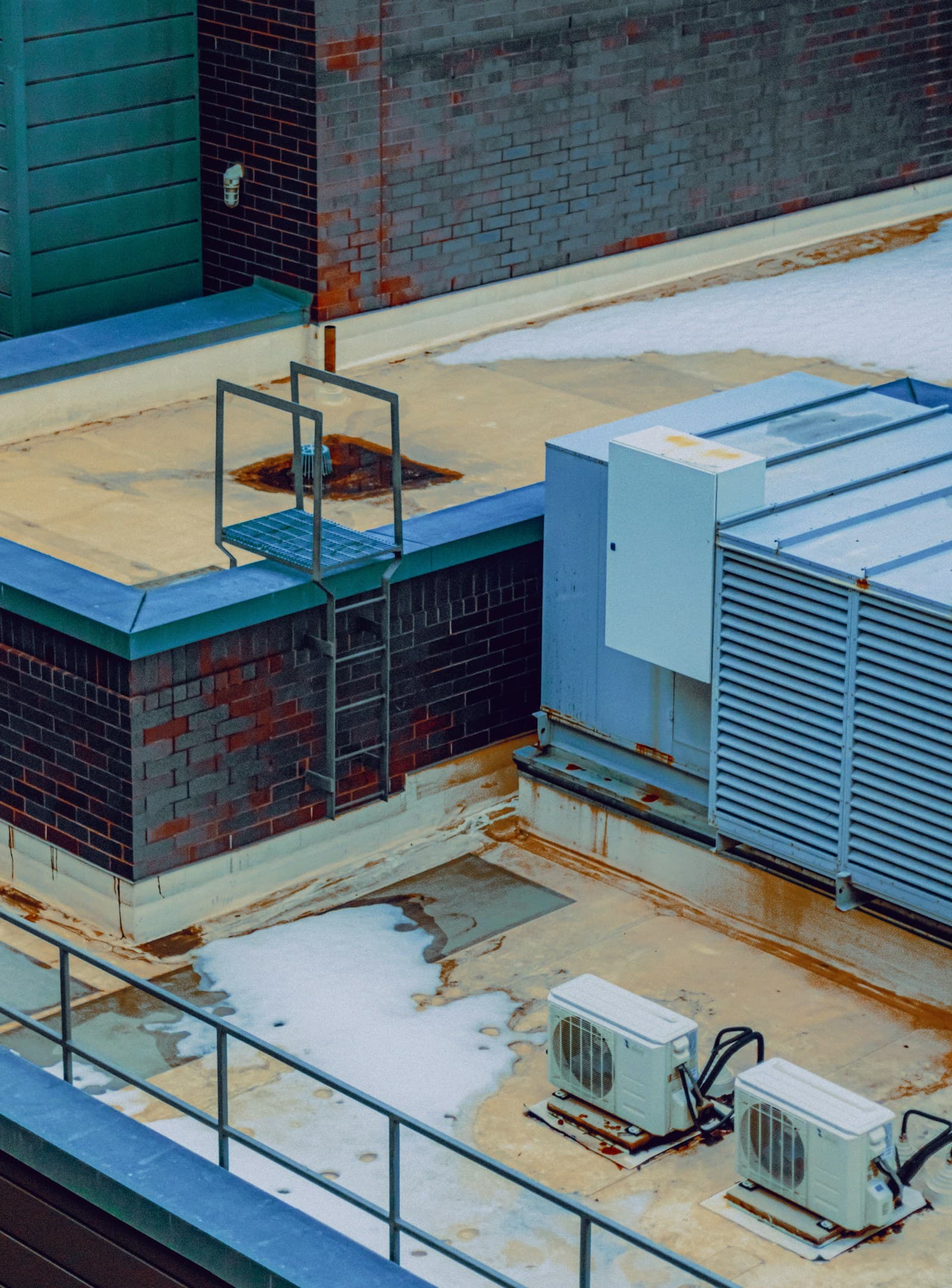
Preventive maintenance guide for industrial HVAC systems in Thai factories. Covers ASHRAE 180 PM schedules, refrigerant leak indicators, critical failure points, repair vs replacement decision matrix, and EER/MTBF KPI targets.
Why Factory HVAC Systems Fail Prematurely in Thailand
Most industrial HVAC equipment is designed for 20–25°C ambient conditions, but Thai factories operate at 35–42°C year-round. The practical consequences:
- Compressors run 30–50% harder than their design point
- Compressor lubricant degrades faster under elevated thermal load
- Condenser coils foul faster in dusty, high-humidity environments
- Systems without regular PM typically fail in 3–5 years instead of the 10–15 year design life
PM Schedule per ASHRAE 180
Daily Checks (every working day)
| Check Point | Normal Range | Action Required |
|---|---|---|
| Discharge pressure | Per manufacturer design | >15% above clean baseline → investigate |
| Suction pressure | Per manufacturer design | >15% below baseline → check for refrigerant loss |
| Discharge temperature | Below 130°C | Above 130°C = compressor overload or overheating |
| Controlled space temperature | Setpoint ±1°C | Deviation >±3°C for >30 min → investigate |
| Unusual sounds | None | Banging/grinding → shut down immediately |
Monthly Tasks
- Clean condenser coil (air-cooled units) — dust and lint reduce efficiency 10–25%
- Inspect and flush drain pan and drain line — prevents Legionella risk and mould
- Measure compressor amp draw and compare to nameplate current
- Check belt tension and pulley alignment (belt-drive configurations)
- Measure supply air vs return air temperature — normal ΔT = 8–14°C
Annual Tasks (or every 2,000 operating hours)
- Replace all air filters — record ΔP before and after
- Clean evaporator coil with approved coil cleaner (avoid strong acids on aluminium fins)
- Leak check entire refrigerant circuit with electronic leak detector (sensitivity ≤5 g/yr)
- Measure refrigerant charge — verify subcooling and superheat against manufacturer spec
- Inspect all electrical connections — thermal imaging to find hotspots
- Compressor oil analysis — acid number, moisture content, wear metals
Four Critical Failure Warning Signs
1. Condenser Coil Fouling
Indicator: Discharge pressure >15% above clean baseline Impact: EER drops 15–30%; compressor life shortened; electricity cost rises Remedy: Clean with coil cleaner — do not pressure-wash directly (this crushes aluminium fins)
2. Drain Blockage
Indicators: Water overflowing drain pan, unexplained humidity rise, musty odour Impact: Ceiling/floor water damage, Legionella risk, mould contamination Remedy: Flush drain line with pressurised water; verify drain pan slope is adequate
3. Fan Motor Bearing Failure
Indicators: Squealing or grinding noise, motor housing temperature >80°C, elevated vibration Remedy: Replace bearing immediately — do not delay until complete failure (a stalled fan causes evaporator freeze-up and compressor damage)
4. Capacitor Degradation
Indicators: Slow motor start, abnormally high current draw, motor overheating Test: Measure capacitance with a capacitor meter — if below 80% of nameplate value, replace Risk: Motor burn-out follows (repair cost is 10–30× the cost of a replacement capacitor)
Repair vs Replace Decision Matrix
| Condition | Recommendation |
|---|---|
| Age <10 years, isolated single fault | Repair — positive ROI |
| Age >15 years, 3rd repair in 2 years | Replace before next peak cooling season |
| Repair cost >50% of new equipment | Replace |
| Refrigerant is R22 (phased out) | Plan replacement — parts scarce, prices rising |
| EER below 80% of rated value | Replace — likely to save 20–40% on electricity |
Work requiring a licensed engineer: refrigerant recovery/recharge, any electrical work >100V, compressor replacement.
KPIs to Track
| KPI | Target | How to Measure |
|---|---|---|
| EER (Energy Efficiency Ratio) | ≥80% of rated EER | Power meter + cooling capacity calculation |
| MTBF | >8,760 hours (1 full year) | CMMS work order tracking |
| PM Completion Rate | ≥95% of scheduled tasks | PM checklist sign-offs |
| Unplanned Downtime | <24 hours/year | Work order log |
Consult on HVAC PM programmes and R32/R410a refrigerant supply: +66 2-096-2118 | +66 83-494-6958 Sahawatthanakit (1988) Co., Ltd. — Nonthaburi, Thailand Request a Refrigerant Quote →
Get this guide as a reference brief (PDF)
Summary + full section list + standards cited, Saha-branded for your memo/RFQ — emailed to you too.
Questions after reading? Talk to our engineers
Tell us what you need — our engineers help you spec it right, with a real quote. No charge.
Need help with this in your facility?
Our team handles full procurement and installation for the topics covered in this article. Free quote within 2 hours.
Another line of ours — spreadsheet tools for SMEs
Landed Cost Per Unit — Import Costing (Thai + English editions)
Know what one unit really costs once it reaches your warehouse — duty, VAT, clearance and trucking included, with the lowest price that still meets your target margin.
Comparison tables related to this article
Related content
Choosing Food-Grade (NSF H1) Lubricant, Grease & Cleaner Brands in Thailand: Bechem vs Interflon vs CRC vs Klüber vs Cassida
A buyer's guide to food-grade NSF H1 brands for food & beverage plants — each brand's strengths across the Western set (Interflon MicPol/PFAS-free, CRC ready-to-use sprays, Bechem, Klüber, FUCHS Cassida) and the Japanese/Asian in-stock set (SUMICO, Molykote, NOK Klüber, Ichinen, Suzuki Kikoh), a model-by-model cross-reference table (ISO VG/NLGI), NSF H1 vs ISO 21469, and how to choose without locking to one brand.
The Full Shell Industrial Lubricant Range — How to Choose Rimula, Tellus, Omala, Corena, Gadus
A buyer's guide to Shell lubricants for Thai factories and fleets — Rimula diesel engine oil, Tellus hydraulics, Omala industrial gear oil, Corena compressor oil, Gadus grease, Diala transformer oil, Turbo turbine oil, Mysella gas-engine oil, plus how to cross-reference grades against SK ZIC.
Choosing the Right Metalworking Fluid / Cutting Coolant — A Machine-Shop Field Guide: Neat Oil vs Soluble vs Semi-Synthetic vs Synthetic + Concentration Control (Refractometer), Sump Care & How to Lock In Drum Pricing
A field guide for machine-shop production and procurement teams: selecting the right metalworking fluid (MWF) by operation and material — neat/straight cutting oil for heavy-duty tapping/reaming/broaching, soluble oil for general work, semi-synthetic for balanced lubrication and cooling, synthetic for grinding and high speed, plus material-specific selection (steel/stainless/aluminium/cast iron), refractometer concentration control, pH/tramp-oil/bacteria sump management, mist health limits (NIOSH), and how to buy concentrate by the drum to lock in annual pricing.
Fleet & Heavy-Equipment Lubrication Field Guide — Choose Every Oil on the Machine: Diesel Engine (API CK-4) · Gears/Final Drive (API GL-5) · Hydraulics · Grease + Change Intervals by km/Hours and How to Lock In Fleet Pricing
Field guide for fleet maintenance and procurement: a whole-machine lubrication map for trucks/prime movers, excavators, cranes, loaders, and mining equipment — diesel engine API CK-4/CJ-4 SAE 15W-40, hypoid final drive API GL-5, severe-duty hydraulics ISO VG 46/68, NLGI 2 EP grease + crane wire-rope grease — change intervals by kilometre/engine-hour + oil analysis to extend drains safely, and how to standardize grades to lock in annual fleet pricing.