
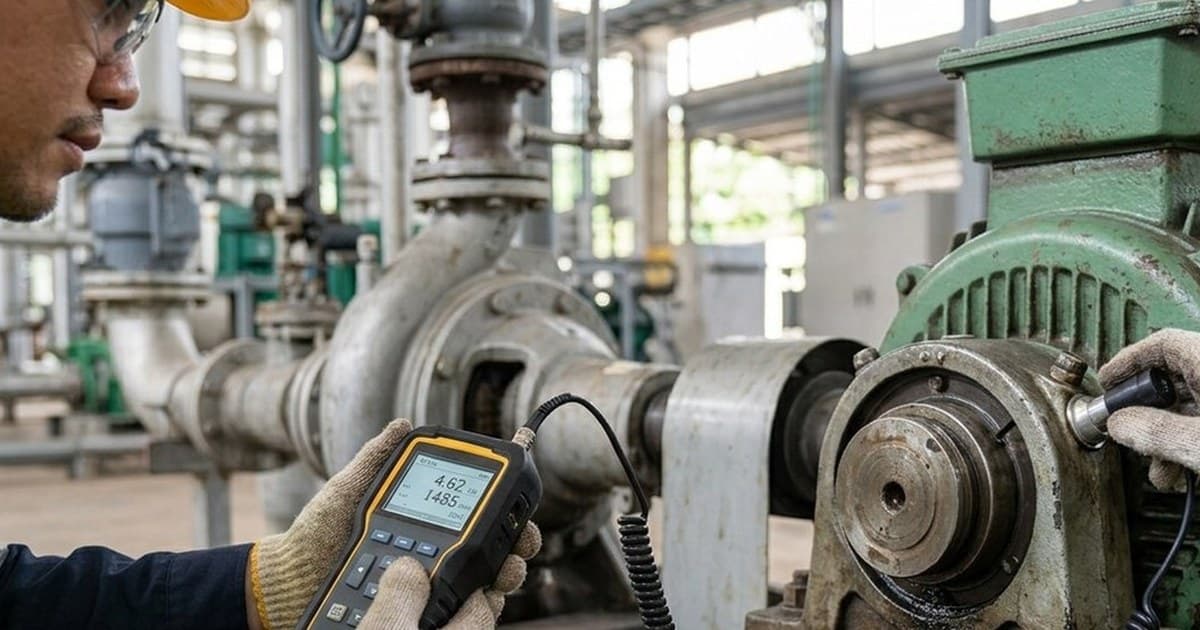
A guide to analyzing bearing failure with vibration analysis per ISO 10816 + ISO 13373 + FFT — 8 failure modes, FTF/BPFO/BPFI/BSF formulas, alarm thresholds, predictive replacement
Bearings are the most frequently failing component in rotating machinery — 50-70% of unscheduled downtime in pumps, motors, fans, and gearboxes comes from bearings. Remarkably, bearings do not fail randomly — they degrade along a predictable pattern + can be detected via vibration signature 1-6 months before catastrophe. The standards ISO 10816 + ISO 13373 are the framework that industries (oil & gas, power, manufacturing) use worldwide. This article interprets the characteristic frequency formulas + 8 failure modes + alarm thresholds
Why Bearings Need Vibration Analysis
Bearing degradation timeline is divided into 4 stages (ISO 13373-3):
- Stage 1 (incipient defect) — sub-surface stress, detected at 250-350 kHz ultrasonic
- Stage 2 (developing defect) — micro-spall, peak at resonance frequency (700-2,000 Hz)
- Stage 3 (advanced defect) — visible peak at characteristic freq (BPFO/BPFI/BSF/FTF)
- Stage 4 (catastrophic) — random broadband + heat + audible noise — fails within 1-7 days
Detection at Stage 2-3 gives 1-6 months to plan replacement. Stage 4 = emergency
Characteristic Frequencies — Formulas + Example
Geometry formulas:
- FTF (Fundamental Train Frequency) — rotation of the cage: $$\text{FTF} = \frac{1}{2} \left(1 - \frac{D_b \cos\alpha}{D_p}\right) \times \frac{n_{shaft}}{60}$$
- BPFO (Ball Pass Frequency Outer race) = n × FTF
- BPFI (Ball Pass Frequency Inner race) = n × (n_shaft/60) × ½(1 + D_b·cos α / D_p)
- BSF (Ball Spin Frequency): $$\text{BSF} = \frac{D_p}{2 D_b} \times \frac{n_{shaft}}{60} \left(1 - \left(\frac{D_b \cos\alpha}{D_p}\right)^2\right)$$
Variables:
- n = number of balls
- D_b = ball diameter
- D_p = pitch diameter (center-to-center of inner-outer raceway)
- α = contact angle (deg) — radial bearing ≈ 0°, angular contact = 15-40°
- n_shaft = shaft RPM
Example: SKF 6205-2RS deep groove ball bearing, motor 1,750 RPM
- n = 9 balls, D_b = 7.94 mm, D_p = 38.5 mm, α = 0°
- FTF = ½ × (1 - 7.94/38.5) × 1750/60 = 11.6 Hz
- BPFO = 9 × 11.6 = 104.5 Hz
- BPFI = 9 × (1750/60) × ½(1 + 7.94/38.5) = 157.6 Hz
- BSF = (38.5/15.88) × (1750/60) × (1 - (7.94/38.5)²) = 68.7 Hz
In the FFT spectrum, if a high peak appears at 104.5 Hz + harmonics → outer race defect
SKF / Timken / Schaeffler offer free online calculators + Bearing Failure Atlas — input bearing model + RPM for instant results
8 Bearing Failure Modes (ISO 13373 + SKF Atlas)
flowchart TD
  A[Vibration Signature] --> B{Where peak?}
  B -->|BPFO + harmonics| C[Outer race spalling/pitting]
  B -->|BPFI + sidebands| D[Inner race spalling]
  B -->|BSF + cage modulation| E[Ball/Roller defect]
  B -->|FTF + harmonics| F[Cage damage]
  B -->|1× + 2× + 3× shaft| G[Misalignment / overload]
  B -->|Broadband 1-10 kHz| H[Lubrication failure]
  B -->|Periodic at FTF × shaft| I[Electrical erosion fluting]
  B -->|Random broadband noise| J[Skidding / slip]
  C --> K[Pattern: peak grows
over weeks-months]
  D --> K
  E --> K
  F --> L[Critical — fail in days-week]
  G --> M[Realign + reduce load]
  H --> N[Check lubrication system
+ contamination]
  I --> O[Add shaft grounding
VFD-driven motor]
  J --> P[Reduce speed
+ check preload]
ISO 10816 / ISO 20816 — Overall Vibration Limits
ISO 10816 (renamed ISO 20816 from 2016) divides rotating machines into 4 classes by size and foundation:
| Class | Description | Power (kW) | Mount |
|---|---|---|---|
| I | Small machine | < 15 | Rigid |
| II | Medium machine | 15-75 | Rigid |
| III | Large machine | > 75 | Rigid foundation |
| IV | Large machine | > 75 | Flexible foundation |
Overall vibration zones (mm/s RMS):
| Zone | Class I | Class II | Class III | Class IV | Action |
|---|---|---|---|---|---|
| A (Good) | < 0.71 | < 1.12 | < 1.8 | < 2.8 | Continue operation |
| B (Acceptable) | 0.71-1.8 | 1.12-2.8 | 1.8-4.5 | 2.8-7.1 | Monitor closely |
| C (Alarm) | 1.8-4.5 | 2.8-7.1 | 4.5-7.1 | 7.1-11.2 | Plan repair |
| D (Damage) | > 4.5 | > 7.1 | > 7.1 | > 11.2 | Stop immediately |
These values are overall vibration. For bearing-specific defects, use envelope detection (ESP) at the specific frequency
Envelope Detection — Method for Bearing Defect
Standard FFT often misses early-stage bearing defects because:
- Bearing defects generate "impacts" — short pulse signals
- The pulse spreads energy across the spectrum
- The peak at the characteristic frequency is lower than the running-speed peak
Envelope Detection (ESP) / Demodulation:
- Band-pass filter at the resonance frequency (bearing level) — 500 Hz - 10 kHz
- Rectify the signal (full-wave)
- Low-pass filter
- FFT
- Result: an envelope spectrum where the characteristic frequency stands out clearly
Modern vibration analyzers (SKF Microlog, CSI 2140, GE Bently Nevada) have envelope built-in. Threshold:
- < 0.1 g RMS — healthy
- 0.1-0.5 g — early defect
- 0.5-1.5 g — developing
1.5 g — advanced, plan replacement
3.0 g — critical, stop ASAP
Trend Analysis + Alarm Strategy
flowchart LR
  A[Periodic Measurement
weekly/monthly] --> B[Plot overall + envelope
vs baseline]
  B --> C{Trend?}
  C -->|Stable| D[Continue routine
monitoring]
  C -->|Increasing
< 6 dB above baseline| E[Increase frequency
weekly → daily]
  C -->|+6 dB Warning| F[Plan replacement
spare ready]
  C -->|+12 dB Alarm| G[Immediate plan
replace 30 days]
  C -->|+18 dB Critical| H[Stop machine
replace immediately]
Baseline reset rule:
- When a new bearing is installed → measure 24-48 hr after break-in → set as the new baseline
- Keep a separate baseline for each machine
Sensor + Equipment Selection
| Equipment | Price (baht) | Use Case |
|---|---|---|
| Handheld Vibration Meter (single channel) | 30,000-120,000 | Spot check on routine rounds |
| Portable Vibration Analyzer (FFT + envelope) | 250,000-1,500,000 | Walk-around predictive program |
| Online Continuous Monitoring | 1,000,000-10,000,000+ | Critical machine 24/7 |
| Wireless IoT sensor (per point) | 8,000-25,000 | Distributed monitoring, edge processing |
Accelerometer type:
- Piezoelectric IEPE (industrial standard) — 100 mV/g, frequency response 1 Hz-10 kHz
- MEMS — cheaper, smaller, integrates with IoT — frequency response 1 Hz-5 kHz
- Eddy current proximity probe — measures shaft displacement directly, for turbomachinery
Sensor installation:
- Mount: stud (best), magnetic (good), handheld (worst — used only for routine checks)
- Location: bearing housing, axial + radial + tangential 3 axes
- Cable: shielded twisted pair, ground at the sensor end only
Predictive Replacement Economics
Example: a plant with 50 pumps, 75 kW motors:
| Strategy | Annual Cost |
|---|---|
| Reactive (run-to-failure) | ~฿800,000 unplanned + production loss |
| Time-based (replace every 3 years) | ~฿450,000 (planned) + 20% of bearings discarded while still usable |
| Predictive (vibration analysis) | ~฿120,000 monitoring + ~฿200,000 replacement = ฿320,000 |
Predictive saves 60-70% vs reactive + 25-30% vs time-based
6 Procurement Guidelines
- TOR should specify ISO 10816 / 20816 + ISO 13373 for the vibration program
- Vibration analyzer with FFT + envelope built-in — not just an overall meter
- Training: ISO Cat I/II/III — certified vibration analyst (certified by Mobius, BINDT, IRD)
- Database software — store trend data + auto-alarm + reporting. Mainstream: SKF Aptitude, CSI AMS, GE System 1
- Permanent sensors for critical machines — IEPE accelerometer + protective housing
- Annual recalibration of sensor + analyzer per an ISO 17025 lab
Summary
Bearing failure can be detected via vibration signature 1-6 months before catastrophe. ISO 10816 / 20816 sets the overall vibration limit per machine class. Characteristic frequencies (FTF, BPFO, BPFI, BSF) are calculated from geometry — peaks at these frequencies in the FFT envelope = bearing defect. The 8 failure modes have different signatures — outer race spalling (BPFO), inner race (BPFI), cage (FTF), ball (BSF), misalignment (1×/2×/3× shaft), lube failure (broadband 1-10 kHz). A predictive strategy saves 60-70% vs reactive
Sahawatthanakit provides a vibration analysis program — initial baseline + periodic measurement + report with recommended actions for pumps, motors, fans, and gearboxes in Thai plants — consult our team to request a machine audit
Frequently Asked Questions
What does vibration analysis tell us about a bearing? A bearing has a unique vibration signature at FTF/BPFO/BPFI/BSF — peaks at these frequencies in the FFT envelope = defect. Detected 1-6 months before catastrophe, cutting unplanned downtime by 70-90%
Where does ISO 10816 measure? Non-rotating parts — bearing housing, foundation. mm/s RMS. Divided into Class I-IV by size + foundation. Class III rigid > 75 kW: Good < 1.8, Acceptable < 4.5, Alarm < 7.1, Damage > 7.1
FFT spectrum analysis? Accelerometer time signal → FFT → frequency spectrum. Bearing fault peaks at the characteristic freq (not the shaft frequency). Tool: handheld 30-120k, analyzer 250k-1.5M, permanent 1M+
FTF/BPFO/BPFI/BSF formulas? From bearing geometry: n balls, Db diameter, Dp pitch, α contact angle, n_shaft RPM. SKF/Timken/Schaeffler offer free calculators
8 failure modes? Outer race spalling (BPFO), Inner race (BPFI), Ball (BSF), Cage (FTF), Misalignment (1×/2×/3×), Lube failure (broadband 1-10 kHz), Electrical erosion (periodic FTF × shaft), Skidding (random broadband)
Where to set the alarm? ISO 10816 overall limit per class. Envelope-specific: +6 dB warning, +12 dB alarm. Reset baseline after bearing replacement
Get this guide as a reference brief (PDF)
Summary + full section list + standards cited, Saha-branded for your memo/RFQ — emailed to you too.
Questions after reading? Talk to our engineers
Tell us what you need — our engineers help you spec it right, with a real quote. No charge.
Need help with this in your facility?
Our team handles full procurement and installation for the topics covered in this article. Free quote within 2 hours.
Another line of ours — spreadsheet tools for SMEs
Job Costing & Pricing Calculator (Thai + English editions)
For work sold as jobs — enter materials, on-site hours and freight, and get the cash floor, the break-even, and the price you should quote.
Frequently Asked Questions
1What does vibration analysis tell us about a bearing?
+
2Where on the machine does ISO 10816 measure vibration?
+
3How is FFT spectrum analysis done?
+
4How are FTF, BPFO, BPFI, BSF calculated?
+
5What are the 8 bearing failure modes identified by ISO 13373?
+
6Where do you set the alarm threshold?
+
Comparison tables related to this article
Related content
HVAC Commissioning — When to Demand It From Your Contractor, and How to Specify It
Start-up, TAB and commissioning are three different things. How ANSI/ASHRAE/IES 202-2018, Guideline 0-2019 and Guideline 1.4-2019 divide the work, and when a Thai industrial owner should make it contractual.
BMS Protocol Selection: BACnet vs Modbus vs KNX — and How to Spec It Without Vendor Lock-In
A standards-based comparison of BACnet (ANSI/ASHRAE 135 / ISO 16484-5), Modbus and KNX, with selection criteria by system layer, cybersecurity requirements, and specification language that keeps a building maintainable.
Thailand's Building Energy Code (BEC): OTTV, RTTV and LPD Limits — and Whether Factories Are Covered
The 2020 Ministerial Regulation made energy compliance a building-permit condition in Thailand from 13 March 2023 for all nine building types over 2,000 m². Full OTTV/RTTV/LPD table, HVAC criteria, and the whole-building compliance path.
Selecting an Industrial Process Pump + Preventing Cavitation (NPSH): Centrifugal vs Positive Displacement, BEP, and VFD Energy Savings per ANSI/HI–ISO for Thai Plants
Buyer's guide to industrial process pumps: differentiate Centrifugal vs Positive Displacement → calculate NPSHa to prevent cavitation → operate within BEP (70–120%) → cut electricity with VFD (Affinity Laws) → supplier checklist + ANSI/HI–ISO 13709/API 610/API 682 standards for plants in Thailand.